


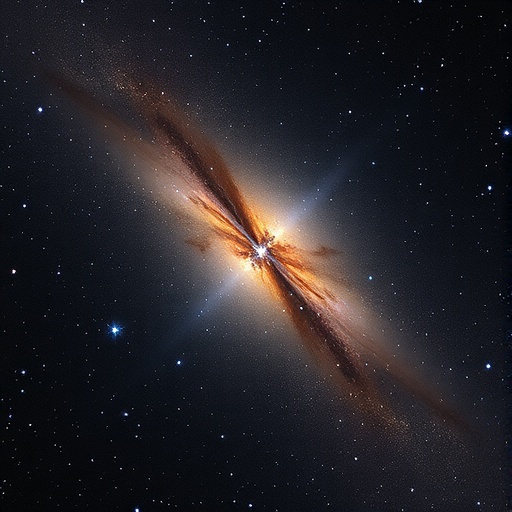
In an extraordinary leap forward in our understanding of the earliest epochs of cosmic history, astronomers have identified a star of remarkable chemical purity residing in the halo of the Large Magellanic Cloud (LMC). This discovery challenges prevailing models of stellar evolution and chemical enrichment in the universe by revealing a star whose elemental composition is almost untouched by the complex processes that have altered most other known stars. The star, designated SDSS J0715−7334, exhibits elemental abundances that push the boundaries of what is considered chemically primitive. Its iron and carbon content, measured as [Fe/H] = −4.3 and [C/Fe] < −0.2 respectively, alongside a total metallicity of less than 7.8 × 10⁻⁷ (or log Z/Z⊙ < −4.3), make it one of the most chemically pristine stars ever identified.
The significance of identifying such a star rests on its potential to serve as a living relic from the era shortly after the Big Bang, when the universe was largely devoid of elements heavier than helium. In astrophysics, these heavier elements are collectively termed “metals,” and their abundance—or paucity—in a star’s atmosphere provides a critical diagnostic of that star’s age and evolutionary history. The first generation of stars, known as Population III stars, were formed directly from primordial hydrogen and helium left over from the Big Bang. Because these primordial gases lacked metals, the first stars were expected to be extraordinarily massive and short-lived, with none surviving to the present day. What researchers have now identified is what is likely a descendant of these primordial giants—one whose origins are intimately tied to a foundational supernova explosion from a star with an initial mass approximately 30 times that of the Sun.
The observational techniques employed to characterize SDSS J0715−7334 involved high-resolution spectroscopy that allowed the detailed measurement of its chemical abundances. Such observations enable researchers to parse the fingerprints of individual elements and reconstruct the nucleosynthetic pathways that forged these metals. What is striking about this star is its ultralow iron and carbon abundances, which place it tenfold more metal-poor than the most extreme galaxies observed at high redshift by the James Webb Space Telescope. This undermines previous assumptions about the chemical evolution occurring within dwarf galaxies like the LMC and speaks to a complex interplay of star formation processes that managed to preserve this star’s pristine nature over billions of years.
Diving deeper into the star’s chemical signature reveals that although it is pungently metal-poor, the pattern of elemental abundances aligns well with the theoretical yields of a primordial supernova. This event, produced by a massive Population III star exploding in the nascent universe, seeded the surrounding environment with just enough heavy elements to enable the formation of low-mass stars, including SDSS J0715−7334 itself. The mass of the progenitor supernova—about 30 solar masses—is critical here as it delineates the subtle balance between dispersing heavy elements and allowing subsequent star formation to proceed in relative chemical isolation. This star thus acts as a tangible cosmic fossil, granting insights into the supernova nucleosynthesis and the initial mass function of the very first stars.
The star’s orbit provides additional contextual information by confirming its extragalactic origin. Its trajectory through space situates it firmly within the halo of the Large Magellanic Cloud, a satellite galaxy of the Milky Way. The LMC, with its lower mass and distinct chemical evolution compared to our own galaxy, offers a unique laboratory to explore how early chemical enrichment and star formation unfolded under different astrophysical conditions. The survival of SDSS J0715−7334 over billions of years within this environment is notable, suggesting that dwarf galaxies can harbor stars preserving near-primordial compositions unlike those commonly found within the Milky Way’s stellar halo.
What pushes this discovery beyond mere identification is the implication for theories of star formation under chemically primitive conditions. Existing models predict that the formation of low-mass stars in metal-poor environments is a challenging process, generally requiring mechanisms like dust cooling to facilitate the collapse of gas clouds. The existence of SDSS J0715−7334 testifies to the efficacy of dust as a cooling agent in ancient star-forming regions and lends robust observational evidence to theoretical frameworks that hinge on the presence of tiny solid particles in primordial gas clouds. This, in turn, sheds light on the conditions that prevailed in the early universe, influencing our understanding of the timeline and manner in which the cosmos transitioned from simplicity to chemical complexity.
Furthermore, comparison of this star’s chemical properties with those of known ultra-metal-poor stars in our own Milky Way highlights significant differences that refine our broader picture of galactic chemical evolution. While ancient stars with similar metallicities have been discovered within the Milky Way’s halo, none exhibit the combination of low iron and carbon abundances displayed by SDSS J0715−7334. Such nuanced distinctions underscore the heterogeneity of early star formation environments and hint at variances in the initial mass function, supernova yields, and gas mixing processes in different galactic settings. This realization informs models of galaxy assembly and demonstrates that various satellite galaxies can retain singular populations of chemically primitive stars.
One of the most fascinating aspects of this finding involves how it integrates with observations from the James Webb Space Telescope (JWST). The JWST is renowned for detecting high-redshift galaxies that boast extraordinarily low metallicities, offering glimpses into some of the earliest stages of galaxy formation. Yet, surprisingly, SDSS J0715−7334 is over ten times more chemically pristine than even these distant, young galaxies, serving as a benchmark for the lowest metallicities achievable in star-forming environments. This raises intriguing questions about the relationship between local dwarf galaxies, their star formation histories, and the nature of star-forming environments within the earliest galaxies observed at cosmic dawn.
The analytical approach harnessing chemical abundances thus provides a powerful window into the past, allowing astrophysicists to probe the specific conditions under which the first chemical elements heavier than helium were seeded into the universe. The pattern of elements observed directly informs models of nucleosynthesis and the mass distribution of primordial stars, which collectively shape how subsequent generations of stars and galaxies formed and evolved. The identification of SDSS J0715−7334 not only confirms the existence of stars with near-pristine chemical composition but also calibrates theoretical models regarding the initial star mass spectrum and the physics of primordial supernovae.
Moreover, the discovery has ripple effects across multiple branches of astrophysics, touching on cosmology, star formation theory, and galaxy evolution. For cosmologists, the star acts as an observational anchor for the chemical and dynamical conditions prevalent during the epoch of reionization. For those studying star formation, it provides empirical evidence supporting the necessity of certain cooling pathways in the earliest star-forming clouds. Meanwhile, those investigating galaxy assembly gain a new data point illustrating how small satellite systems like the LMC can preserve populations of stars with near-unchanged chemical signatures despite dynamic interactions with larger galaxies like the Milky Way.
This breakthrough also reinvigorates the search for other chemically pristine stars in nearby dwarf galaxies and the outer reaches of our galaxy. The techniques refined in this discovery, especially high-resolution spectroscopy combined with detailed modeling of stellar atmospheres, can be applied broadly to identify additional relic stars. Such stars hold the keys to unlocking a more comprehensive understanding of cosmic chemical evolution, revealing the full diversity of stellar populations that emerged in the universe’s infancy. Their study helps map the intricate pathways through which the universe transitioned from a simple composition dominated by hydrogen and helium to the chemically rich cosmos we observe today.
In summary, the independent identification and chemical examination of SDSS J0715−7334 unfolds a saga of cosmic origin and evolution, providing a rare glimpse into the early universe’s conditions. The star’s ultralow elemental abundances, combined with its orbital context within the Large Magellanic Cloud, confirm it as a genuine cosmic relic from the aftermath of a primordial supernova. Its chemical composition is so pristine—surpassing even the excitement generated by the most metal-poor galaxies observed by the JWST—that it challenges prevailing star formation theories and emphasizes the critical role of dust cooling in enabling the birth of low-mass stars shortly after the universe’s dawn. As astronomers continue to explore our galactic neighborhood, SDSS J0715−7334 stands as a beacon illuminating the universe’s formative years with unprecedented clarity.
Cite Scienmag News
Grant Pearson. (April 3, 2026). Nearly Pristine Star Discovered in Large Magellanic Cloud. Scienmag. https://scienmag.com/nearly-pristine-star-discovered-in-large-magellanic-cloud/
Grant Pearson. "Nearly Pristine Star Discovered in Large Magellanic Cloud." Scienmag, 3 April 2026, https://scienmag.com/nearly-pristine-star-discovered-in-large-magellanic-cloud/. Accessed 3 September 2026.
Grant Pearson. "Nearly Pristine Star Discovered in Large Magellanic Cloud." Scienmag. April 3, 2026. https://scienmag.com/nearly-pristine-star-discovered-in-large-magellanic-cloud/


