


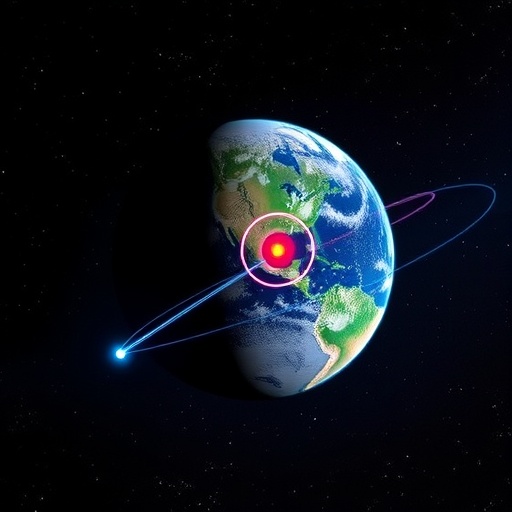
In a groundbreaking confluence of geophysics and space technology, researchers from Sun Yat-sen University’s School of Physics and Astronomy, together with collaborators from the TianQin Research Center for Gravitational Physics, have unveiled a novel approach to detecting Earth’s free oscillations using space-borne gravitational wave detectors. This pioneering work, recently published in Space: Science & Technology, introduces a theoretical and analytical framework that capitalizes on the TianQin satellite constellation’s unique capabilities to probe the subtle vibrations ringing through our planet after major seismic events.
Earth’s free oscillations—often described as the planet’s own resonant fingerprints—reveal intricate details about its internal structure, composition, and dynamic processes. Traditionally, these oscillations have been captured via ground-based seismometers and gravimeters arranged globally. However, these terrestrial methods encounter limitations such as local seismic noise, calibration discrepancies, and incomplete spatial coverage, which can hinder precise measurement and comprehensive analysis.
The TianQin mission, a constellation of three satellites arranged in an equilateral triangle orbiting approximately 100,000 kilometers above the Earth, offers a revolutionary vantage point. Utilizing ultra-stable laser interferometry, TianQin measures minute changes in the distances between its satellites with picometer accuracy. This high-altitude platform effectively evades interference from Earth’s complex high-degree gravity field, providing an unparalleled environment to monitor the planet’s large-scale gravitational fluctuations induced by free oscillations.
Building upon this, the research team developed an analytical response model based on Kaula’s linear perturbation theory to mathematically describe how planetary free oscillations impact inter-satellite distance measurements within the TianQin Time-Delay Interferometry (TDI)-X channel. Their model conceptualizes the Earth’s free oscillations as a superposition of multiple damped oscillatory modes, each associated with specific coefficients in a spherical harmonic expansion. Crucially, the model incorporates frequency splitting effects that arise from Earth’s rotation coupled with the satellites’ orbital motion, a complexity often overlooked in prior studies.
To validate their model, the team employed TQPOP, a numerical simulation program that generates precise satellite orbit data and responses to gravitational perturbations. A comparative analysis between simulated numerical waveforms and the analytical expressions revealed high consistency throughout the observed time series, except for minor deviations immediately following the earthquake onset. This close alignment not only substantiates the robustness of the theoretical framework but also provides a reliable foundation for future detection and analysis endeavors.
Further insights were gleaned by examining the frequency domain representation of the free oscillation signals, where characteristic strain spectra displayed multiple frequency splitting phenomena. These spectral features directly correspond to the theoretical predictions, reinforcing the model’s fidelity and its ability to capture subtle dynamical effects induced by the Earth’s rotation and satellite movement.
Recognizing the importance of quantitative signal extraction, the researchers applied Bayesian inference techniques, leveraging Markov Chain Monte Carlo (MCMC) algorithms to systematically estimate oscillation parameters from synthetic observational datasets combining signal and noise. Assuming Gaussian stationary noise characteristic of the TianQin detector, the team fixed mode frequencies and quality factors according to the Preliminary Reference Earth Model and treated spherical harmonic coefficients as parameters to be inferred.
In simulations mimicking a magnitude 7.9 seismic event analogous to the 2008 Wenchuan earthquake, the injected free oscillation signals, combined with TianQin’s noise model, were analyzed to assess detection precision. Notably, the TianQin constellation could achieve a signal-to-noise ratio reaching up to 73, enabling the clear identification and discrimination of at least nine distinct oscillation modes, as validated by posterior distributions and parameter uncertainty analyses. These findings establish TianQin’s efficacy for direct Earth oscillation detection from space, marking a significant breakthrough in geophysical observation methodologies.
The study also explored the behavior of free oscillation signals across various TDI measurement channels beyond the X channel, such as Y and Z channels, noting simple transformations derivable through satellite orbital phase adjustments. Intriguingly, when examining the A, E, and T orthogonal channels commonly employed in gravitational wave detection, the team discovered that free oscillations generate substantial responses even in the T channel, which is typically suppressed for plane-wave gravitational waves. This disparity originates from the near-field nature of Earth’s gravitational perturbations versus the distant source assumption underlying gravitational wave analysis.
This distinction offers a powerful avenue for signal separation and joint analysis: simultaneous detection of cosmic gravitational waves and terrestrial seismic signals within TianQin’s data streams becomes feasible by exploiting their contrasting response profiles across TDI channels. Such multi-physical field signal disentanglement promises a transformative framework for comprehensive space-based geophysical and astrophysical research.
This innovative research trajectory not only affirms the TianQin mission’s potential for independent geophysical observation but also elevates it as a versatile platform bridging Earth sciences and gravitational physics. By overcoming terrestrial noise limitations and enhancing global spatial coverage, TianQin paves the way for a new class of spaceborne Earth observation tools capable of probing the planet’s interior with unprecedented precision.
As humanity ventures deeper into understanding planetary interiors and their dynamic phenomena, these findings highlight how autonomous space technology investments can yield multifaceted scientific dividends. The methodology established here is positioned to inspire analogous detection strategies across forthcoming high-altitude or deep-space laser interferometry missions, augmenting the worldwide geophysical observational network.
The pioneering approach detailed in this work establishes a vibrant interdisciplinary nexus, where space-based gravitational wave detection synergizes with traditional geophysical inquiry. It accentuates a paradigm shift in Earth observation, wherein gravitational perturbations are decoded not only from seismic data on the ground but also dynamically monitored directly from orbital platforms with exquisite sensitivity.
In summary, this research reshapes our capability to listen to the Earth’s subtle resonant hum, illuminating the hidden structures and seismic intricacies that shape our planet. The integration of TianQin’s unique high-orbit interferometric measurements with sophisticated theoretical and statistical frameworks heralds a new era of geophysical exploration that will enrich our understanding of Earth’s complex inner workings.
Cite Scienmag News
Violet Maxwell. (April 3, 2026). Sun Yat-sen University TianQin Research Center: Detecting Earth’s Free Oscillations with Tianqin | Space Research Spotlight. Scienmag. https://scienmag.com/sun-yat-sen-university-tianqin-research-center-detecting-earths-free-oscillations-with-tianqin-space-research-spotlight/
Violet Maxwell. "Sun Yat-sen University TianQin Research Center: Detecting Earth’s Free Oscillations with Tianqin | Space Research Spotlight." Scienmag, 3 April 2026, https://scienmag.com/sun-yat-sen-university-tianqin-research-center-detecting-earths-free-oscillations-with-tianqin-space-research-spotlight/. Accessed 3 September 2026.
Violet Maxwell. "Sun Yat-sen University TianQin Research Center: Detecting Earth’s Free Oscillations with Tianqin | Space Research Spotlight." Scienmag. April 3, 2026. https://scienmag.com/sun-yat-sen-university-tianqin-research-center-detecting-earths-free-oscillations-with-tianqin-space-research-spotlight/


