


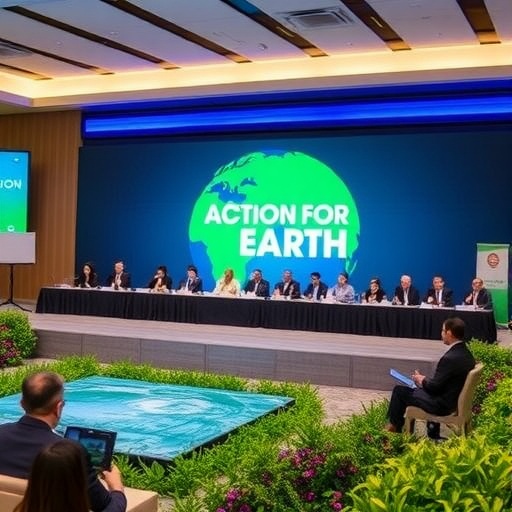
The “Action for Earth” Summit, a cornerstone event of Hong Kong Climate Week 2026, convened today at the Rayson Huang Theatre within The University of Hong Kong. This landmark gathering united a diverse array of thought leaders and stakeholders, including representatives from the United Nations, the Chinese Ministry of Ecology and Environment, the Hong Kong SAR Government, the private sector, and premier academic institutions worldwide. The Summit’s focal point was the crucial paradigm shift in global climate policy — transitioning from an emphasis on mitigation strategies to prioritizing climate adaptation. This shift underscores an evolving international consensus that recognizes the immediacy and complexity of adapting to the multifaceted impacts of climate change, which mitigation efforts alone cannot fully address.
The event commenced with keynote remarks delivered by influential figures, notably Professor Peng Gong, Vice-President and Pro-Vice Chancellor for Academic Development at HKU, alongside Ms Yang Liu, Deputy Director-General of the Department of Climate Change at China’s Ministry of Ecology and Environment. Mr Tse Chin-wan, Secretary for Environment and Ecology of the Hong Kong SAR Government, also set the tone by emphasizing the urgency and collaborative spirit necessary for advancing climate adaptation policies. These opening statements framed the discussions that followed, reinforcing the critical need for integrative, science-driven approaches that incorporate policy, ecological science, social equity, and technological innovation.
Central to the discourse were two keynote sessions that provided distinctive yet complementary perspectives on climate action. The first session, “Priority Policies for Global Climate Adaptation,” convened distinguished policymakers and experts, such as Dr. Youssef Nassef from the UNFCCC Adaptation Division, Mr Joseph Chan, Under Secretary for Financial Services and the Treasury of Hong Kong, Mr Tian Chen, Director-General of Beijing’s Ecology and Environment Bureau, and Mr Yi Wang, an influential member of China’s Environmental Protection Committee. Their presentations distilled regional climate policy frameworks, highlighting mechanisms for cross-jurisdictional cooperation and the integration of climate risks into economic and financial planning. This session underscored the imperative of embedding climate adaptation into the fabric of governance at all levels, with a strong emphasis on actionable, scalable policies.
The second keynote panel titled “Frontier Research for Global Climate Adaptation” showcased pioneering scientific research and emerging technological solutions critical for adaptive climate resilience. Esteemed academicians from the Chinese Academy of Sciences and the Chinese Academy of Engineering—Professors Huadong Guo, Jianya Gong, and Kebin He—presented cutting-edge methodologies ranging from advanced climate modeling to ecological engineering, remote sensing technologies, and innovations in carbon capture and storage. Their collective insights illuminated how technological breakthroughs can directly inform policy and practical adaptation strategies, particularly in densely populated and environmentally sensitive urban regions, which are especially vulnerable to climate-related disruptions.
Following the keynote presentations, an intensive roundtable discussion engaged leaders from governmental bodies, industry, and non-governmental organizations. Participants such as Mr Arthur Lee, Hong Kong’s Commissioner for Climate Change, Mr Patrick Ho of Swire Properties, Mr Thomas Lui from CLP Power, Mr Leo Horn-Phathanothai of Bangkok Climate Action Week, and Dr Ting Li representing RMI Beijing Office, deliberated on the complexities of transitioning infrastructure, governance, and capital flows toward a resilient, low-carbon future. Moderated by Mr Sze Ping Lo of the Sequoia Climate Foundation, the dialogue emphasized the necessity of cross-sector collaboration, the mobilization of public and private capital for adaptive projects, and principles of inclusivity and equity in climate action.
A highlight of the Summit was the formal inauguration of the CATL-HKU ICCN Joint Laboratory. This innovative laboratory symbolizes the confluence of CATL’s cutting-edge energy technology leadership and The University of Hong Kong’s academic prowess, fostering a multidisciplinary platform designed to accelerate breakthroughs in clean energy and net-zero technologies. The initiative embodies a strategic response to the urgent need for scalable, high-impact solutions to carbon emissions and climate adaptation challenges, particularly in urban mega-regions such as the Greater Bay Area.
For the third consecutive year, The University of Hong Kong’s Institute for Climate and Carbon Neutrality (ICCN) has been at the helm of Hong Kong Climate Week. This year, the event expanded into a comprehensive seven-day city-wide climate movement under the theme “From Mitigation to Adaptation – Bridging Global Consensus and Local Implementation.” By leveraging Hong Kong’s status as an international financial hub and a gateway to Asia, the week-long program aims to align global climate goals with tailored local solutions, accelerating inclusive and resilient pathways toward a net-zero carbon future.
Hong Kong Climate Week (HKCW) itself represents an innovative climate collaboration platform that integrates knowledge, capital, and innovation across multiple domains. Initiated by HKU’s ICCN, HKCW builds upon its predecessors—the Hong Kong Climate Forums of 2024 and 2025—scaling from isolated forums to an expansive city-wide movement. Through strategic engagements spanning policy, finance, scientific research, technological innovation, and cultural change, HKCW seeks to catalyze a systemic transformation of climate governance and action that is robust, equitable, and scalable throughout Asia and globally.
The strategic utility of Hong Kong’s unique geopolitical and economic position cannot be overstated. As an international financial epicenter with unparalleled global connectivity, Hong Kong is particularly well-positioned to convene and channel resources toward climate adaptation research, funding mechanisms, and technology transfer. Such platforms are critical for ensuring equitable access to climate resilience tools, particularly for vulnerable populations in rapidly urbanizing environments prone to climate-related stresses such as heat extremes, flooding, and air and water pollution.
The Institute for Climate and Carbon Neutrality (ICCN) continues to spearhead interdisciplinary research that bridges ecological science, engineering innovation, socio-economic impact analysis, and technology deployment. Its mandate extends beyond understanding climate phenomena—it actively nurtures collaboration networks that integrate Hong Kong with mainland China’s Greater Bay Area and its surrounding regions, enhancing capacity building and clean technology diffusion. This regional integration is crucial for addressing shared climate risks and fostering technology exchange in one of the world’s most dynamic economic zones.
Overall, the “Action for Earth” Summit highlighted the intricate linkages required across science, policy, industry, and civil society to operationalize climate adaptation at scale. It demonstrated that transitioning from mitigation-centric approaches to proactive, anticipatory adaptation mechanisms demands a paradigm of integrated governance, supported by the latest scientific research, cross-border cooperation, and ambitious public-private partnerships. This holistic framework is vital to navigating the rapidly changing climatic realities and safeguarding vulnerable ecosystems and communities worldwide.
The Summit echoed a growing recognition within the international community: while mitigation remains essential to limit future climate change, adaptation is indispensable to manage the unavoidable impacts already in motion. Advancing such adaptation measures will require transformative innovation, inclusive policies, and sustained global-local collaboration, with hubs like Hong Kong playing a pivotal role in this evolving landscape. As climate risks intensify, forums such as these become critical nodes for authentic knowledge exchange, partnership development, and the practical realization of a resilient, sustainable future.
News Publication Date:
2026
Web References:
http://www.hkclimateweek.org/
Cite Scienmag News
Sloane Callahan. (April 1, 2026). Global Leaders Convene at “Action for Earth” Summit During Hong Kong Climate Week to Advance Climate Adaptation Policy and Action. Scienmag. https://scienmag.com/global-leaders-convene-at-action-for-earth-summit-during-hong-kong-climate-week-to-advance-climate-adaptation-policy-and-action/
Sloane Callahan. "Global Leaders Convene at “Action for Earth” Summit During Hong Kong Climate Week to Advance Climate Adaptation Policy and Action." Scienmag, 1 April 2026, https://scienmag.com/global-leaders-convene-at-action-for-earth-summit-during-hong-kong-climate-week-to-advance-climate-adaptation-policy-and-action/. Accessed 3 September 2026.
Sloane Callahan. "Global Leaders Convene at “Action for Earth” Summit During Hong Kong Climate Week to Advance Climate Adaptation Policy and Action." Scienmag. April 1, 2026. https://scienmag.com/global-leaders-convene-at-action-for-earth-summit-during-hong-kong-climate-week-to-advance-climate-adaptation-policy-and-action/


