


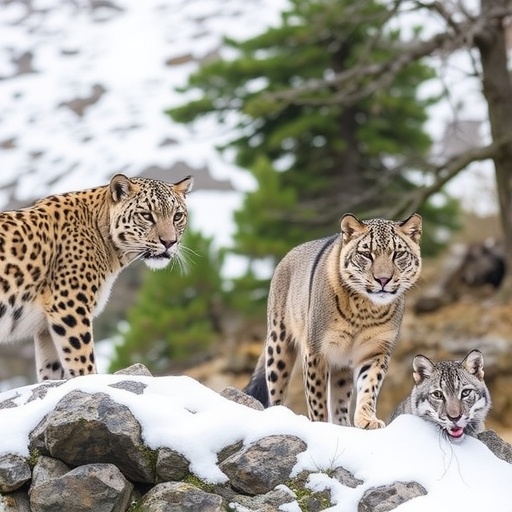
In the remote Lapchi Valley of the Central Himalayas, an extraordinary ecological balance unfolds among three apex predators: snow leopards, leopards, and wolves. A recent comprehensive study, conducted through an international collaboration of researchers from China, the United States, Nepal, and Hong Kong, reveals the intricate mechanisms that enable these formidable carnivores to coexist within overlapping territories. The key to their shared survival lies in niche partitioning, a strategy through which these predators meticulously select distinct prey species and adapt their hunting behaviors, minimizing direct competition and fostering harmonious coexistence in one of the world’s most challenging environments.
This research offers unprecedented insights into the spatial and dietary adaptability of high-altitude carnivores. By deploying advanced camera traps across varying elevations, including areas above the treeline at 4200 meters, the researchers captured compelling evidence of the presence and activity patterns of snow leopards and leopards. These findings are significant as they challenge previous assumptions about species distributions in the Himalayas and highlight the flexibility of apex predators in response to environmental constraints and interspecific interactions.
Snow leopards, often portrayed as elusive and solitary hunters, demonstrate remarkable prey specialization, primarily targeting smaller ungulates suited to their stealth and high-altitude adaptations. Leopards, contrastingly, exploit a broader spectrum of prey at lower elevations, illustrating a strategic niche divergence that reduces overlap with their snow leopard counterparts. Wolves, as social hunters, employ pack strategies to capture larger prey, carving out a distinct trophic niche that further alleviates resource competition. This sophisticated resource partitioning underscores the complexity of predator coexistence amid scarce food resources and rugged terrain.
The study incorporated rigorous field data collection techniques, including camera traps calibrated for temporal activity patterns and spatial distribution. Researchers also analyzed scat samples to determine dietary composition, employing molecular techniques to accurately identify prey species consumed by each predator. These multi-method approaches provided robust evidence supporting the premise that diverse dietary preferences and habitat utilization allow these apex predators to maintain population stability despite potential competition.
Understanding predator coexistence is crucial not only for ecological theory but also for conservation practice in the Himalayas, where habitat fragmentation and human encroachment threaten biodiversity. The Lapchi Valley, characterized by its steep gradients and isolated habitats, presents a natural laboratory where niche partitioning processes can be studied without the confounding effects of human disturbance common in other regions. This setting enables a clearer interpretation of interspecific dynamics among carnivores under near-pristine conditions.
The implications of this research extend to predator management and the maintenance of ecosystem balance in high-altitude environments. By elucidating how snow leopards, leopards, and wolves partition their niche spatially and trophically, conservationists can devise targeted strategies that accommodate the specific ecological needs of each species. This approach is essential for mitigating human-wildlife conflicts, particularly as livestock grazing and infrastructure development projects encroach into predator habitats, potentially disrupting established resource partitioning.
Moreover, the study highlights the importance of interdisciplinary collaborations across countries and institutions, combining expertise in wildlife biology, molecular ecology, and geographic information systems. Such synergy enhances the accuracy and comprehensiveness of ecological studies, allowing for better-informed conservation policies that reflect the complex realities of predator interactions and landscape use.
This research was supported by varied funding sources, including the University Grants Commission of Nepal, the Andrew Sabin Family Foundation, Zoo New England, and the China Exploration and Research Society, reflecting the global investment in protecting apex carnivores. Additional support came from the National Institutes of Health in the United States, emphasizing the cross-sectoral recognition of the study’s value for biodiversity conservation and scientific advancement.
Camera trap imagery poignantly captures moments of solitary elegance and raw predator power, such as the snow leopard perched majestically above the treeline, symbolizing the delicate interplay of life and survival strategies in harsh, alpine ecosystems. Such visual documentation complements analytical data, making the study’s findings accessible and impactful for both the scientific community and public audiences.
The comprehensive publication of these findings in a reputable open-access journal ensures that the knowledge transcends geographic and disciplinary boundaries, facilitating broader dissemination and application in Himalayan conservation efforts. By sharing detailed observations about predator diets, habitat use, and behavioral adaptations, this study sets a benchmark in large carnivore ecology and offers hope for sustaining biodiversity under changing climatic and anthropogenic pressures.
This research also challenges conservation narratives that often depict apex predators simply as competing forces, instead revealing a nuanced picture of coexistence shaped by evolutionary adaptations and ecological constraints. The mutual avoidance and dietary specialization evident among snow leopards, leopards, and wolves reflect a natural equilibrium that has developed over millennia, emphasizing the resilience of mountain ecosystems when left undisturbed.
In conclusion, the study of niche partitioning among three apex predators in Nepal’s Lapchi Valley provides groundbreaking insights into the mechanisms of coexistence in high-altitude ecosystems. It underscores the critical role of habitat complexity and dietary specialization in maintaining predator diversity and offers invaluable guidance for conservation strategies aimed at preserving the delicate balance of Himalayan wildlife communities amid ongoing environmental challenges.
Keywords
Niche partitioning, apex predators, snow leopard, leopard, wolf, Central Himalayas, Lapchi Valley, high-altitude ecology, camera trap, dietary specialization, coexistence mechanisms, conservation biology
Cite Scienmag News
Margaret Porter. (April 1, 2026). Himalayan Apex Predators—Snow Leopards, Leopards, and Wolves—Coexist by Targeting Different Prey, New Study Reveals. Scienmag. https://scienmag.com/himalayan-apex-predators-snow-leopards-leopards-and-wolves-coexist-by-targeting-different-prey-new-study-reveals/
Margaret Porter. "Himalayan Apex Predators—Snow Leopards, Leopards, and Wolves—Coexist by Targeting Different Prey, New Study Reveals." Scienmag, 1 April 2026, https://scienmag.com/himalayan-apex-predators-snow-leopards-leopards-and-wolves-coexist-by-targeting-different-prey-new-study-reveals/. Accessed 4 September 2026.
Margaret Porter. "Himalayan Apex Predators—Snow Leopards, Leopards, and Wolves—Coexist by Targeting Different Prey, New Study Reveals." Scienmag. April 1, 2026. https://scienmag.com/himalayan-apex-predators-snow-leopards-leopards-and-wolves-coexist-by-targeting-different-prey-new-study-reveals/


