


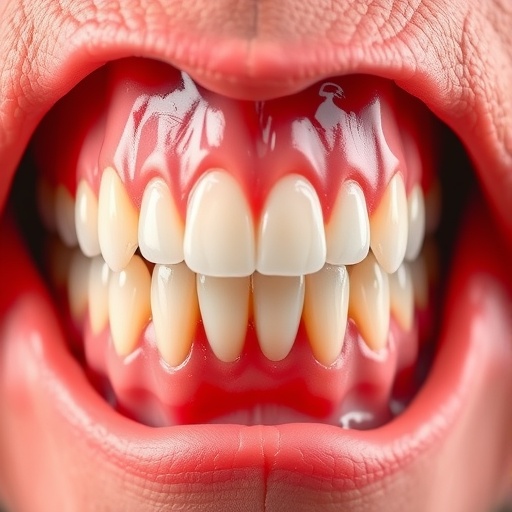
Periodontitis remains one of the most pervasive and debilitating chronic inflammatory diseases affecting the oral cavity, impacting millions worldwide with serious consequences. Characterized by the progressive destruction of the supporting bone and soft connective tissues around the teeth, periodontitis is a leading cause of tooth loss in adults. Beyond localized oral tissue damage, mounting evidence links this disease to systemic conditions such as diabetes, cardiovascular disease, and respiratory infections, illustrating its broader health implications. Despite advances in dental therapies aimed at managing bacterial infections and inflammation, current treatments often fall short in restoring the essential structural integrity of gingival tissues, thereby limiting the tissue’s capacity for regeneration and proper immune function.
Traditional nonsurgical interventions, such as scaling and root planing, focus primarily on eradicating pathogenic biofilms and mitigating inflammation but do not address the fundamental breakdown of the extracellular matrix (ECM) within gingival tissues. The ECM provides a critical biomechanical scaffold that supports cellular architecture and signaling necessary for maintaining tissue homeostasis and immune defenses. Chronic inflammation, triggered by persistent bacterial insult, disrupts this delicate ECM network, leading to tissue softening and loss of mechanical rigidity. Without the restoration of this biophysical environment, gingival tissues remain vulnerable to continued inflammation, creating a self-perpetuating cycle of damage and impaired healing.
A groundbreaking study from the University of Pennsylvania, led by Dr. Kyle H. Vining and Hardik Makkar, proposes a paradigm shift in understanding periodontal disease’s pathophysiology by highlighting the pivotal role played by the mechanical properties of the gingival ECM. Published in the highly respected journal Advanced Materials, their work elucidates how matrix stiffness governs the behavior of gingival fibroblasts—the primary cellular architects responsible for maintaining the ECM—and their subsequent influence on immune homeostasis within the gums. This pioneering research bridges material science and oral biology to reveal novel mechanobiological pathways underpinning tissue inflammation and regeneration in periodontitis.
The investigators employed an innovative hydrogel model that mimics the physical characteristics of human gingival tissue, controlling the material’s stiffness in a finely tunable manner. This system, analogous to a biologically compatible Jell-O, allowed the team to isolate and systematically manipulate the microenvironment’s rigidity, from the stiff matrix typical of healthy gingiva to the softer, degraded matrix characteristic of diseased tissue. By embedding human gingival fibroblasts within these tunable hydrogels, they assessed how changes in extracellular stiffness influenced cell phenotype, particularly the inflammatory signaling cascades that exacerbate periodontal disease.
Their findings revealed a striking mechanosensitive response: fibroblasts residing in softer matrices exhibited a heightened inflammatory state, secreting pro-inflammatory cytokines that further degrade tissue architecture. This pathological feedback loop mirrors clinical observations where enzymatic degradation of the ECM by bacterial proteases reduces tissue stiffness, which in turn amplifies cellular inflammatory activity, accelerating tissue destruction. Conversely, when hydrogel stiffness was experimentally increased to replicate healthy gingival tissue, these fibroblasts significantly downregulated their inflammatory responses, highlighting the critical role of matrix mechanics in immune regulation.
To translate these insights beyond the in vitro hydrogel models, the team corroborated their results using ex vivo human gingival tissue samples collected from patients at Penn Dental Medicine’s clinic. They enzymatically restored tissue stiffness in these samples and then challenged them with microbial stimuli to mimic infection. Remarkably, stiffened tissues demonstrated a markedly diminished inflammatory response compared to their softer counterparts. This direct human tissue validation underscored the translational potential of modulating tissue mechanics as a therapeutic strategy in periodontitis.
These discoveries underscore a fundamental reconsideration of periodontal therapy: rather than focusing exclusively on antimicrobial and anti-inflammatory interventions, augmenting the biomechanical environment of the gingiva may provide a complementary and powerful approach to halt disease progression and promote healing. Dr. Vining envisions the development of injectable biomaterial fillers capable of restoring or enhancing gum tissue stiffness in patients with advanced periodontal disease. Such biomaterials could reinforce weakened gingival tissues, making them more resilient against recurrent infections and improving the success of surgical interventions such as grafting.
The implications of mechanically tuning tissue environments extend beyond merely halting inflammation. By correcting the biophysical cues in the ECM, these biomaterials might reestablish homeostatic interactions between fibroblasts and immune cells, promoting tissue regeneration and long-term periodontal health. This strategy represents a convergence of bioengineering, material science, and clinical dentistry that could usher in a new era of precision biomaterial-based therapies, fundamentally altering the therapeutic landscape of chronic oral diseases.
Future research efforts by Vining’s team are strategically focused on dissecting the molecular pathways that translate mechanical signals into cellular inflammatory responses. By employing small-molecule inhibitors targeting these mechanotransduction pathways, they aim to further unravel the complex interplay between matrix stiffness and immune regulation. Additionally, ongoing proof-of-concept studies are exploring injectable biomaterials optimized for periodontal applications, assessing their safety, efficacy, and integration within the dynamic oral environment.
This interdisciplinary work is emblematic of how cutting-edge bioengineering can be harnessed to address complex biological problems with direct clinical ramifications. The collaborative infrastructure at the University of Pennsylvania, which integrates dental medicine with engineering and regenerative sciences, has been instrumental in moving this innovative research from bench to potential bedside applications. As conventional periodontal therapies encounter limitations, such biomaterial solutions offer hope for more effective, durable, and patient-friendly interventions.
Researchers and clinicians alike are particularly excited by the potential for these injectable fillers to reduce the need for invasive grafting procedures, which often come with significant patient morbidity. Strengthening gingival tissue via engineered stiffness may not only improve graft outcomes but could also have prophylactic value by enhancing tissue resistance to future bacterial challenges. This novel therapeutic avenue may transform the management of periodontal disease from reactive to preventative, focusing on maintaining tissue integrity before irreparable damage occurs.
As the team advances toward clinical translation, their work invites a broader reevaluation of how biomechanics influence immune-mediated diseases beyond the oral cavity. Similar mechanobiological principles may govern chronic inflammatory conditions such as rheumatoid arthritis and fibrosis, suggesting that therapies modulating tissue stiffness could have wide-ranging applicability. This study serves as a call for further integration of material science knowledge into medical and dental research paradigms, encouraging innovation that transcends traditional treatment boundaries.
In summary, the discovery that matrix stiffness critically regulates fibroblast-driven immune homeostasis within the gingiva offers a transformative insight into periodontal disease pathogenesis and therapy. By restoring the biomechanical foundation of gingival tissues, scientists are moving closer to novel biomaterial-based treatments that complement antimicrobial approaches and promote durable, functional tissue repair. This pioneering research sets the stage for next-generation periodontal therapies and underscores the importance of biomechanical cues as a therapeutic target in chronic inflammation.
News Publication Date: 8-Feb-2026
Web References:
Advanced Materials DOI 10.1002/adma.202520717
Keywords
Biomaterials, Dentistry, Dental care, Hydrogels, Gingiva, Extracellular matrix
Cite Scienmag News
Denise Maddox. (March 31, 2026). Fortifying Oral Health: A New Perspective on Gum Disease. Scienmag. https://scienmag.com/fortifying-oral-health-a-new-perspective-on-gum-disease/
Denise Maddox. "Fortifying Oral Health: A New Perspective on Gum Disease." Scienmag, 31 March 2026, https://scienmag.com/fortifying-oral-health-a-new-perspective-on-gum-disease/. Accessed 4 September 2026.
Denise Maddox. "Fortifying Oral Health: A New Perspective on Gum Disease." Scienmag. March 31, 2026. https://scienmag.com/fortifying-oral-health-a-new-perspective-on-gum-disease/


