


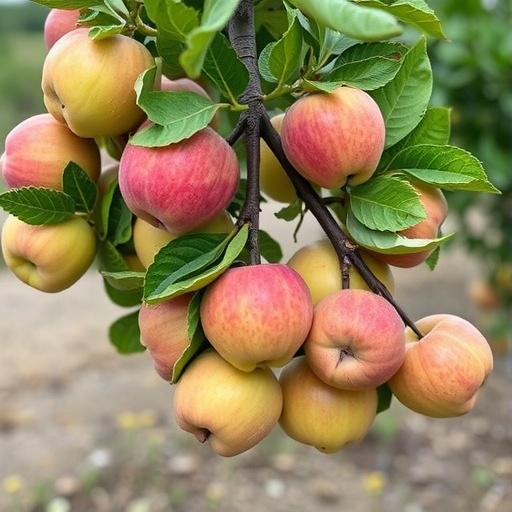
As the world grapples with the escalating challenges posed by climate change, agriculture remains at the frontline of its impacts. Among the most vulnerable are perennial fruit crops, which depend heavily on climatic consistency for their lifecycle processes. A groundbreaking study focusing on the historical apple production across France from 1989 to 2020 reveals a nuanced narrative of resilience and adaptation in the face of warming temperatures. This comprehensive analysis sheds light on how regional apple production systems have adjusted to climatic shifts, exploiting some benefits while confronting emerging challenges in heat stress management.
Perennial fruit crops like apples require precise environmental conditions during crucial phenological phases such as blooming to ensure optimal yield and quality. Historically, the moderate warming trends observed within most apple-growing regions of France have actually coincided with beneficial outcomes. Longer growing seasons and warmer temperatures during the blooming phase have enabled these regions to “harness” certain aspects of climate change, facilitating higher productivity. This phenomenon underscores a key insight: not all climate change effects manifest negatively; adaptation strategies can transform potential stressors into opportunities for enhanced agricultural output.
The study’s detailed regional analysis categorized French apple-growing departments by their climatic conditions. Northern and central departments, which traditionally experienced cooler and more temperate climates, exhibited significant adaptive responses leveraging earlier and more consistent blooming periods fostered by warmer spring temperatures. These adjustments, agricultural innovations, and enhanced management practices culminated in increased apple yields. This adaptation process has been pivotal in offsetting some of the potential adverse effects otherwise expected under warming scenarios.
In stark contrast, apple-producing regions in southern France, particularly those classified within the Mediterranean climatic zone, have faced progressively harsher challenges due to excessive heat during critical developmental stages of apple crops. Here, the benefits observed in cooler regions have been overshadowed by heat stress factors that adversely affect flowering, fruit set, and maturation. Consequently, effective mitigation measures—ranging from modified orchard design, shading techniques, to innovative irrigation protocols—have become essential to safeguard crop viability against rising temperatures.
The reliance on adaptation strategies that mitigate heat stress highlights a crucial pivot point for the future of apple production. While past decades have shown that harnessing the advantages of moderate warming can drive yield improvements, the trajectory towards increased temperature extremes presents a looming threat. Climate projections extending to 2050 indicate that many apple-growing regions will confront temperatures exceeding optimal thresholds for fruit development, potentially reversing the gains achieved through adaptation.
Importantly, the researchers emphasize that without enhanced heat stress mitigation strategies, an increasing number of French apple-producing regions are projected to experience net yield declines by mid-century. This serves as a clarion call for intensified research into cultivar selection, breeding programs emphasizing heat tolerance, and implementation of precision agriculture technologies. Proactive development and dissemination of such innovations will be key to sustaining production levels in the face of intensifying climatic stress.
This investigation also illustrates the complexities inherent in predicting climate impacts on perennial crops. Unlike annual crops, perennial systems have a multi-year developmental timeline and are influenced cumulatively by climatic variables over extended periods. The interaction of temperature, precipitation, and extreme weather events throughout these longer cycles demands more sophisticated modeling approaches. The study leverages high-resolution climatic and agricultural data, integrating phenological modeling with long-term yield records to derive robust insights.
Moreover, the success of adaptation in northern and central France suggests that regional climatic windows for beneficial warming are finite and spatially variable. This heterogeneity must inform localized adaptation policies rather than one-size-fits-all solutions. Tailored interventions that consider microclimatic conditions, soil characteristics, and orchard management will optimize resilience while minimizing resource inputs and environmental footprints.
At the policy level, these findings advocate for increased investment in climate-resilient agriculture. Supporting growers through subsidies for heat mitigation infrastructure, facilitating access to climate-adapted planting materials, and fostering knowledge exchange between researchers and practitioners could enhance adaptive capacity. Aligning agricultural policies with climate action frameworks will be critical to achieving sustainable fruit production under changing climatic realities.
From a broader perspective, the study underscores the dual nature of climate change as a driver of risk and opportunity. Harnessing adaptation to exploit emerging benefits is a pragmatic pathway toward food system resilience. However, it also highlights the limits of adaptation when confronted with intensifying extremes. Addressing the root cause of warming while simultaneously innovating at the farm level represents an integrated strategy for navigating future uncertainties.
This research opens avenues for further investigation into multi-crop and multi-region assessments of climate adaptation. Comparative studies across fruit species and along wider geographic gradients would enrich understanding of adaptive mechanisms and vulnerabilities. Additionally, exploring socio-economic dimensions such as grower decision-making, market dynamics, and infrastructure development could complement biophysical insights.
For the apple sector in France, the message is clear: adaptive management has thus far cushioned climate impacts and even enabled yield gains, but the horizon is shifting. Continued vigilance, research, and proactive adaptation—especially focused on heat stress mitigation—are indispensable. Integrating emerging technologies like remote sensing, climate-smart breeding, and precision irrigation could form the next frontier in resilient fruit production.
This nuanced portrait of French apple production underlines the dynamic interaction between climate and agriculture. It demonstrates that while warming may open doors for increased productivity in cooler regions, the cumulative burden of heat stress in warmer zones signals an urgent need for strategic adaptation investment. The study’s foresight to 2050 provides vital direction for stakeholders aiming to secure the future of perennial fruit agriculture amid accelerating climate change.
In conclusion, this landmark analysis offers a framework for understanding how perennial fruit crops respond to complex climatic patterns over decades. By capturing the adaptive strategies that maximize gains and mitigating emerging pressures, it guides the sector towards sustainable practices. The findings compellingly argue that the balance between harnessing adaptation and mitigating heat stress will define the viability of apple production in France and similar temperate regions worldwide.
As global warming intensifies, agricultural resilience hinges not only on scientific innovation but also on institutional support, farmer engagement, and societal investment in sustainable food systems. The lessons gleaned from French apple orchards may well serve as a bellwether for other perennial crops and temperate agricultural landscapes facing the dual challenge of climate change and food security.
Cite Scienmag News
Sloane Callahan. (March 31, 2026). Adapting boosts French apples; heat stress looms. Scienmag. https://scienmag.com/adapting-boosts-french-apples-heat-stress-looms/
Sloane Callahan. "Adapting boosts French apples; heat stress looms." Scienmag, 31 March 2026, https://scienmag.com/adapting-boosts-french-apples-heat-stress-looms/. Accessed 5 September 2026.
Sloane Callahan. "Adapting boosts French apples; heat stress looms." Scienmag. March 31, 2026. https://scienmag.com/adapting-boosts-french-apples-heat-stress-looms/


