


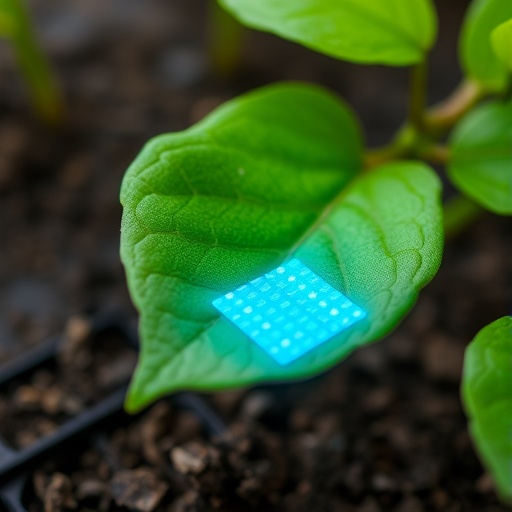
In a groundbreaking advancement poised to transform precision agriculture, researchers from the Institute of Science Tokyo have unveiled a novel class of ultrathin, transparent nanofilm electrodes capable of monitoring plant electrophysiology with unprecedented fidelity. These carbon nanotube-based films, thinner than a single micrometer, are uniquely engineered to seamlessly integrate with the intricate surface of plant leaves, including those bearing dense trichomes—microscopic hair-like structures that serve vital physiological roles in many important crops. Their innovative design circumvents longstanding challenges faced by conventional electrodes, offering a nondestructive, water-resistant, and highly transparent solution that allows continuous, long-term assessment of plant stress signals.
As agricultural systems worldwide grapple with mounting pressures from climate change, pest resistance, and resource limitations, the early detection of crop stress emerges as a critical frontier. Plants, much like animals, respond to environmental stimuli and damaging agents with electrical signaling, manifesting as bioelectric potentials measurable at the leaf surface. Harnessing this subtle physiological language promises to offer farmers real-time insights into plant health, enabling interventions before stress escalates to yield-compromising stages. However, traditional electrode technologies fall short: many are opaque, impeding photosynthesis, or insufficiently durable against moisture exposure, and are often incompatible with the delicate and irregular topography of trichome-rich foliage.
The team led by Professors Toshinori Fujie and Shinji Masuda, alongside graduate student Yusuke Hori and Assistant Professor Tatsuhiro Horii, tackled these multifaceted challenges by engineering flexible nanofilms comprising conductive single-walled carbon nanotubes layered atop compliant elastomers. The resulting films measure between 70 and 320 nanometers in thickness, thin enough to allow trichomes to penetrate rather than be smothered, maintaining their physiological function while the electrode melds intimately with the leaf epidermis. This “trichome-piercing” phenomenon was consistently observed across diverse crop species, addressing a critical impediment to deploying sensor arrays on commercially relevant plants such as soybeans, tomatoes, and eggplants.
Transparency is of paramount importance in preserving the leaf’s photosynthetic activity. The newly developed nanofilm electrodes transmit over 80% of incident light, ensuring that sunlight penetration remains largely unaltered despite sensor presence. This characteristic differentiates them markedly from prior opaque sensors that inadvertently impede energy assimilation, potentially inducing unintended physiological stress. Additionally, the films demonstrated remarkable resilience under simulated rainfall and humid conditions, countering the limitations of hydrogel-based sensors that degrade rapidly when exposed to water, thereby proving suitable for real-world agricultural environments where long-term durability is essential.
Extensive experimental validation affirmed the electrodes’ capacity to record stable bioelectric signals for periods extending up to several weeks, with some devices maintaining operational integrity and adhesion for as long as ten months. This longevity marks a significant leap forward, presenting an authentic platform for continuous plant health monitoring that can inform management decisions throughout lengthy growing seasons. The electrodes’ flexibility and self-adhering properties obviate the need for additional adhesives, which can damage leaves or interfere with natural physiological processes.
In practical applications, the research team demonstrated the sensors’ ability to detect specific physiological stresses, such as herbicide damage. Upon exposure to phytotoxic chemicals, the electrodes recorded distinct alterations in the bioelectric potential waveforms, correlating with stress responses triggered by light irradiation. These electrophysiological markers emerged prior to visible damage, thereby validating the sensors’ potential for preemptive disease or stress detection that could revolutionize crop protection strategies.
The implications of this breakthrough extend beyond mere symptom monitoring. By enabling non-invasive, continuous capture of electrophysiological responses, the technology opens avenues for elucidating complex plant-environment interactions at unprecedented temporal resolutions. This could facilitate advances in both fundamental plant science and practical agronomy, enhancing our ability to breed or engineer crops with optimized stress resilience and resource efficiency.
Looking ahead, networks of these nanofilm electrodes could be deployed across agricultural fields, integrating seamlessly into the fabric of smart farming ecosystems. Coupled with wireless data transmission and advanced analytics, such sensor arrays could furnish farmers with real-time dashboards of plant health metrics, enabling precision interventions that conserve inputs, minimize environmental impact, and maximize yields. This confluence of nanotechnology, plant physiology, and information sciences portends a new era in sustainable agriculture.
The research, published in the journal Advanced Science on March 23, 2026, represents a collaboration among experts in life science and technology at the Institute of Science Tokyo, an institution born from the union of Tokyo Medical and Dental University and Tokyo Institute of Technology. This interdisciplinary synergy exemplifies how converging scientific domains can address pressing global challenges with innovative solutions.
Underpinning this innovation is a solid foundation of materials science, polymer mechanics, and biointerface engineering. The choice of single-walled carbon nanotubes confers exceptional electrical conductivity and mechanical durability, while the elastomer substrate imparts flexibility and conformability critical for adhering to the complex architecture of leaf surfaces. The ultrathin morphology not only facilitates trichome penetration but also minimizes mechanical stress on plant tissues, preserving their integrity over extended monitoring periods.
The team’s methodological rigor encompassed a suite of experimental assays, including optical transparency measurements, electrical signal characterization under variable environmental conditions, and stress simulation protocols. These comprehensive evaluations reinforce the technology’s readiness for translational research and eventual commercialization within the rapidly evolving domain of agricultural biotechnology.
This pioneering work also holds promise for broader applications in plant sciences, including the study of circadian rhythms, water use efficiency, and pathogen interactions, where continuous electrophysiological monitoring could yield novel insights. Moreover, the principles driving this sensor design might inspire analogous tools for monitoring other biological systems where delicate interfacing with living tissues is paramount.
As global food systems face escalating vulnerabilities, innovations like the transparent, durable, and water-resistant nanofilm electrodes underscore the vital role of cutting-edge materials engineering in fostering sustainable agricultural futures. By equipping crops with an electrophysiological “voice,” this technology could enable farmers and scientists alike to listen, interpret, and respond to plant needs with unprecedented precision and timeliness.
Cite Scienmag News
Alan Morgan. (March 31, 2026). Advancing Smart Agriculture: Durable Nanofilm Electrodes for Real-Time Leaf Health Monitoring. Scienmag. https://scienmag.com/advancing-smart-agriculture-durable-nanofilm-electrodes-for-real-time-leaf-health-monitoring/
Alan Morgan. "Advancing Smart Agriculture: Durable Nanofilm Electrodes for Real-Time Leaf Health Monitoring." Scienmag, 31 March 2026, https://scienmag.com/advancing-smart-agriculture-durable-nanofilm-electrodes-for-real-time-leaf-health-monitoring/. Accessed 4 September 2026.
Alan Morgan. "Advancing Smart Agriculture: Durable Nanofilm Electrodes for Real-Time Leaf Health Monitoring." Scienmag. March 31, 2026. https://scienmag.com/advancing-smart-agriculture-durable-nanofilm-electrodes-for-real-time-leaf-health-monitoring/


