


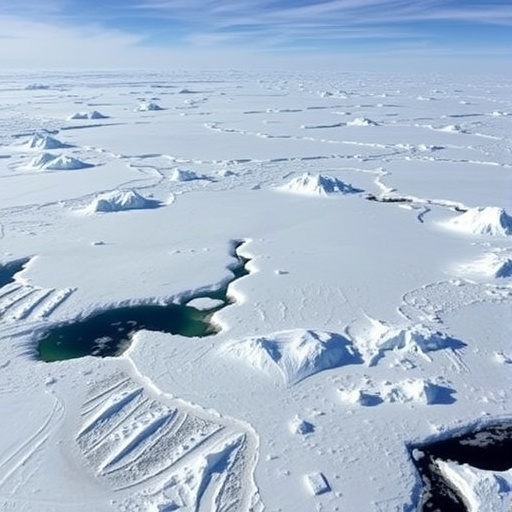
Antarctica, the vast white wilderness that has long epitomized Earth’s polar extremes, is on the brink of a dramatic transformation. Recent research published in Nature Communications projects a significant expansion of surface melt across the Antarctic ice sheet throughout the 21st century, a finding that carries profound implications for global sea level rise and climate dynamics. This extensive investigation, conducted by Zheng, Golledge, Gossart, and colleagues, utilizes sophisticated climate models to paint a sobering picture of the continent’s future under continuing global warming.
Traditionally, Antarctica has been envisioned as an unyielding bastion of ice and cold, with surface melt largely restricted to coastal fringes and sporadic areas during brief summer periods. However, this paradigm is rapidly shifting. The team’s simulations reveal an expanding area of surface melt that will increasingly affect vast portions of the ice sheet, driven by rising atmospheric temperatures and complex feedback mechanisms. Their projections depict not just an increase in melt intensity but a spatial proliferation of melt zones that were once frozen year-round.
The study’s core methodology revolves around the integration of high-resolution regional climate models coupled with ice sheet process simulations. By bridging the gap between atmospheric dynamics and glaciological responses, the researchers crafted a nuanced forecast of melt patterns. These models incorporate critical parameters such as temperature variability, atmospheric moisture content, radiation fluxes, and the albedo effect—the reflectivity of the ice surface, which diminishes dramatically as meltwater accumulates and darkens the ice.
One of the pivotal revelations from the research is the potential for newly formed meltwater ponds and streams on the ice surface to accelerate melt rates further. This self-reinforcing cycle, where meltwater reduces surface reflectivity and increases heat absorption, could lead to episodic melt events occurring earlier and lasting longer into the Antarctic summer season. Such changes fundamentally alter how the ice sheet interacts with its environment and energy inputs.
Moreover, the study indicates that not all regions of Antarctica will experience melt expansion uniformly. The Antarctic Peninsula and West Antarctica are forecasted to witness the most substantial increases in melt area, consistent with current warming trends. East Antarctica, traditionally more stable and colder, will also see notable melt increases, particularly around coastal slopes and areas of thinner ice. This geographic variability is crucial for understanding future ice dynamics and regional vulnerabilities.
Another dimension of the research focuses on the hydrological consequences of increased meltwater. The formation of subglacial lakes and drainage pathways beneath the ice sheet could intensify, potentially destabilizing ice flow and contributing to glacier acceleration. The presence of meltwater at the ice-bed interface reduces basal friction, enabling faster ice discharge into the ocean, which in turn exacerbates sea level rise. This process represents a critical nonlinear feedback that previous models may have underestimated.
The implications of these findings extend well beyond Antarctica itself. The projected expansion of surface melt will add significant quantities of freshwater to the Southern Ocean, influencing ocean circulation patterns, water salinity, and marine ecosystems. Disruptions to the Antarctic ice sheet also hold the potential to affect global climate teleconnections, impacting weather patterns far from the poles. As such, Antarctic melt dynamics emerge as a vital component in the broader climate system.
Importantly, the researchers emphasize the temporal scale and urgency of these changes. Surface melt expansion is not a distant or speculative phenomenon but one that will manifest progressively throughout the current century. With greenhouse gas emissions trajectories remaining on a high path, the pace of melt increase could overwhelm adaptive responses. This timeframe requires policymakers and scientists to integrate ice sheet melt risk into sea level rise projections urgently.
The study also advocates for enhanced observational networks in Antarctica. Satellite monitoring, airborne surveys, and in situ measurements are indispensable for validating and refining model projections. Understanding surface energy budgets, meltwater routing, and basal hydrology in finer detail will improve predictive capabilities and support timely interventions. Investment in polar research infrastructure will be crucial to track these rapidly evolving processes.
While the findings strike a cautionary tone, they also illuminate pathways for mitigation and adaptation. Reducing global carbon emissions remains paramount to limit atmospheric warming and subsequently surface melt extent. Concurrently, expanding international collaboration to protect polar environments, foster open data sharing, and deploy cutting-edge technologies will strengthen global responses. The Antarctic surface melt story, though daunting, is not yet written in stone.
This investigation serves as a clarion call to the scientific and global communities about the fragility of the Antarctic ice sheet under anthropogenic climate change. It challenges the outdated notion of Antarctica as an immutable frozen desert and instead positions it as an active, sensitive component of the Earth system imperiled by human activity. As surface melt areas expand, so too does the urgency for concerted climate action.
In sum, the expansion of Antarctic surface melt throughout the 21st century represents one of the most consequential climate phenomena unfolding today. This research illustrates the intricate feedbacks and regional heterogeneity that drive melt patterns and ultimately influence global sea levels and climate stability. It demands a reevaluation of ice sheet resilience and underscores the interconnectedness of polar processes with global environmental health.
Looking forward, integrating these advanced melt projections into projection frameworks will enrich understanding of Antarctic contributions to sea level rise. Continuous improvement in coupled climate-ice sheet models, alongside empirical observations, promises to refine future forecasts. As the evidence mounts, so does the imperative to act decisively, recognizing Antarctica’s central role in our planet’s changing climate narrative.
The findings also highlight the potential for unprecedented challenges in managing coastal vulnerabilities worldwide. Enhanced surface melt will likely accelerate ice mass loss, directly feeding into the oceans and threatening low-lying communities globally. This research underscores the need for holistic climate strategies that encompass polar science, coastal engineering, urban planning, and social resilience.
Ultimately, the expansion of Antarctic surface melt is a story of transformation—a shift from cold permanence to dynamic change driven by warming. It reveals the interconnectedness of atmospheric chemistry, cryospheric physics, oceanography, and ecology. The study by Zheng et al. adds a critical piece to our understanding of global climate trajectories and serves as a powerful reminder of the complexities underpinning Earth’s rapidly evolving system.
Cite Scienmag News
Violet Maxwell. (March 30, 2026). Antarctic Surface Melt Predicted to Expand This Century. Scienmag. https://scienmag.com/antarctic-surface-melt-predicted-to-expand-this-century/
Violet Maxwell. "Antarctic Surface Melt Predicted to Expand This Century." Scienmag, 30 March 2026, https://scienmag.com/antarctic-surface-melt-predicted-to-expand-this-century/. Accessed 3 September 2026.
Violet Maxwell. "Antarctic Surface Melt Predicted to Expand This Century." Scienmag. March 30, 2026. https://scienmag.com/antarctic-surface-melt-predicted-to-expand-this-century/


