


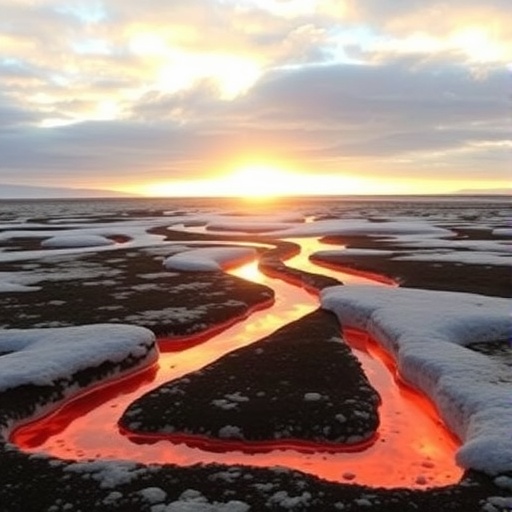
A groundbreaking study conducted by researchers at the University of Leeds, recently published in the American Geophysical Union’s journal Earth’s Future, reveals that thawing permafrost increases its permeability by an astonishing factor ranging from 25 to 100. This dramatic rise in permeability means that previously trapped greenhouse gases—such as carbon dioxide and methane—can escape into the atmosphere at much higher rates than previously anticipated, fueling an accelerated pace of climate change.
Permafrost, a layer of soil that remains frozen for extended periods—often thousands of years—is a defining feature of the Arctic landscape that has historically served as a massive carbon storage reservoir. Globally, permafrost soils are estimated to contain around 1,700 billion metric tons of carbon, roughly equivalent to three times the total carbon contained in Earth’s atmosphere today. This monumental carbon bank, locked away beneath icy soils, has until now acted as a vital buffer moderating the global climate system.
However, the relentless rise in global temperatures has begun to disrupt this delicate balance. As Arctic air and soil temperatures climb, permafrost thaws, creating pathways for gases once securely trapped to migrate upward. The Leeds team’s research highlights how thaw dynamics lead to a steep increase in permeability, essentially turning these frozen soils into porous conduits that funnel greenhouse gases into the atmosphere. This process creates a dangerous positive feedback loop where warming intensifies carbon release, which further drives warming.
The experimental work, meticulously conducted in the advanced Petrophysics Laboratory at the University of Leeds, examined frozen soil samples subjected to controlled thawing conditions. By gradually heating samples from -18°C to +5°C and carefully measuring gas flow and concentration at each temperature increment, the researchers pinpointed that permeability spikes sharply between temperatures of -5°C and +1°C. This critical thermal window reveals the threshold at which permafrost transitions from a nearly impermeable barrier to a highly permeable medium.
Professor Paul Glover, Chair of Petrophysics at Leeds, who led the study, emphasized the urgency of understanding these permeability changes in permafrost. He stated, “The Arctic Circumpolar Permafrost Region is expected to lose 42% of its frozen soil coverage by 2050 due to warming. This projected thaw represents a massive, largely untapped source of carbon emissions that could further exacerbate global warming trends.” His comments underscore the significance of the permafrost-carbon feedback mechanism and forecast a future where Arctic thaw substantially accelerates anthropogenic climate warming.
Adding further context, Co-author Dr. Roger Clark, Senior Lecturer at Leeds, explained how the team utilized novel experimental approaches derived from industry methodologies commonly applied in fossil fuel exploration. “These advanced techniques allowed us to quantitatively measure gas permeability with exceptional precision, enabling a more granular understanding of gas transport mechanisms within thawing soils,” noted Dr. Clark. The application of such state-of-the-art laboratory techniques represents a critical breakthrough in climate change research.
Importantly, the implications of this study extend beyond just carbon and methane emissions. The researchers also draw attention to the increased release of radon gas, a radioactive and carcinogenic element historically trapped within Arctic permafrost soils. As thaw progresses, radon release may pose significant public health risks to vulnerable northern communities, illuminating yet another intersection between climate dynamics and human well-being.
The combination of enhanced permeability and rising gas fractions in thawing permafrost illustrates the complex interplay of physical and chemical processes at work beneath the Arctic surface. Previously frozen soil matrices experience structural changes that increase pore connectivity and create pathways for gas diffusion and advection. This evolution transforms permafrost from an effective trap into a significant emission source, with profound ramifications for atmospheric chemistry and climate feedback loops.
The research team’s findings also provide crucial data to enhance climate models, which have historically struggled to integrate detailed permafrost dynamics and gas migration behavior accurately. These new experimental insights will improve predictions of carbon and methane fluxes, thereby refining projections of future climate scenarios and aiding in the development of mitigation strategies.
Professor Glover cautioned that while these results mark a vital step forward, this field is still evolving. “Our published findings are the beginning,” he said. “We continue to corroborate and expand upon these measurements with ongoing experiments, aimed at deepening our comprehension of permafrost’s role in the Earth system.” The team’s dedication speaks to the urgent need for detailed multidisciplinary efforts to unravel the mechanisms driving feedbacks between permafrost and global climate.
This study reinforces the concept that Arctic warming operates at an accelerated pace—approximately four times faster than the global average—magnifying the risks of sudden and severe climatic shifts. The rapidly thawing permafrost presents a pressing challenge to climate stability, requiring immediate attention from scientific, policy, and public spheres to address its cascading impacts effectively.
In summary, the University of Leeds research illuminates a previously underappreciated mechanism through which climate change could hasten itself via enhanced gas permeability in thawing permafrost. The perilous feedback loop of frozen carbon release demands enhanced global awareness and action to mitigate the consequences of Arctic thaw for Earth’s climate system and human health.
News Publication Date: 24-Mar-2026
Web References:
- https://agupubs.onlinelibrary.wiley.com/doi/10.1029/2025EF007232
- http://dx.doi.org/10.1029/2025EF007232
Cite Scienmag News
Russell Cooper. (March 30, 2026). Melting Permafrost Speeds Up Release of Greenhouse Gases. Scienmag. https://scienmag.com/melting-permafrost-speeds-up-release-of-greenhouse-gases/
Russell Cooper. "Melting Permafrost Speeds Up Release of Greenhouse Gases." Scienmag, 30 March 2026, https://scienmag.com/melting-permafrost-speeds-up-release-of-greenhouse-gases/. Accessed 5 September 2026.
Russell Cooper. "Melting Permafrost Speeds Up Release of Greenhouse Gases." Scienmag. March 30, 2026. https://scienmag.com/melting-permafrost-speeds-up-release-of-greenhouse-gases/


