


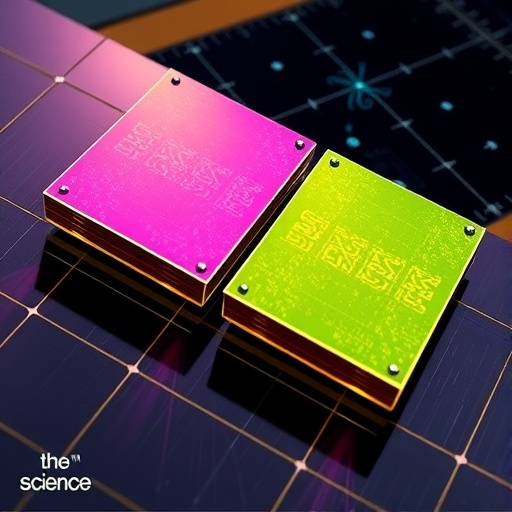
In a groundbreaking advance poised to reshape the landscape of photovoltaic technology, researchers from the Ningbo Institute of Materials Technology and Engineering, Chinese Academy of Sciences, have unveiled an innovative approach to large-scale all-perovskite tandem solar cells, achieving record-breaking efficiencies and stability. Their pioneering work, recently published in the prestigious journal Joule, delves deep into colloidal chemistry to expertly tune nucleation kinetics—a critical factor that has historically limited the performance of all-perovskite tandem solar cells.
Tandem solar cells (TSCs) are lauded for their potential to surpass the efficiency limitations of conventional single-junction solar devices by stacking two subcells with different bandgaps. Each subcell absorbs distinct segments of the solar spectrum, enabling more effective harnessing of sunlight. In the realm of all-perovskite tandem solar cells, however, practical implementation has faced formidable hurdles. Central among these challenges is the mismatched crystallization kinetics between the wide-bandgap (WBG) and narrow-bandgap (NBG) perovskite layers. This imbalance often leads to phase segregation and defect proliferation, detracting significantly from device efficiency and operational longevity.
To overcome these intrinsic difficulties, Professors GE Ziyi and LIU Chang, along with their research team, have devised a unified colloidal chemistry strategy that strikes a delicate balance in crystallization dynamics between the WBG and NBG perovskite subcells. This breakthrough leverages a meticulously designed modulation system based on graded carboxylate anions—specifically tartrate (Ta-) and citrate (Cit-) ions—that exert precise control over nucleation and crystal growth pathways in both subcells.
In the WBG subcell, the introduction of tartrate anions proves instrumental by stabilizing the coordination environment of Pb2+ ions. This stabilization suppresses unwanted phase segregation, fostering a more uniform and controlled crystalline lattice arrangement. Such uniformity is vital because it minimizes defect sites that can act as recombination centers for charge carriers, thus preserving the solar cell’s photovoltaic performance.
Conversely, in the NBG subcell—which typically suffers from Sn2+ defect states that act as non-radiative recombination centers—citrate anions play a dual role. They optimize Sn-I bonding within the colloidal precursor environment, effectively passivating the vulnerable Sn2+ defects. This passivation enhances the charge transport properties of the NBG layer, which is fundamental to maximizing the overall current output of the tandem device.
Amplifying the stabilizing effect, choline cations are introduced as synergistic agents, passivating undercoordinated metal ions at the interfaces between the crystal and colloid phases. This interface passivation is crucial for constructing a robust stabilization matrix that maintains heterojunction integrity during the critical nucleation and growth phases. The tailored colloidal precursor solution thus orchestrates a harmonized crystallization process across the tandem structure, ensuring optimized electronic and structural properties.
The resultant tandem solar cells demonstrate a phenomenal power conversion efficiency (PCE) of 29.76%, a value that is among the highest recorded for all-perovskite tandem architectures. Notably, this outstanding performance was independently certified with a measured PCE of 29.22%, underscoring the reproducibility and credibility of the method. The devices also showcase remarkable operational stability, sustaining over 90.2% of their initial efficiency after more than 700 hours of continuous exposure under maximum power point tracking—a rigorous test indicative of commercial viability.
Scaling up from lab-scale testing, the team fabricated a 1 cm² large-area tandem cell using their colloidal chemistry methodology. This larger device achieved a commendable PCE of 28.87%, demonstrating the strategy’s potential for practical deployment in industrial-scale photovoltaic manufacturing processes. The scalability factor is particularly significant because it addresses a fundamental bottleneck in transitioning high-efficiency perovskite technology from academic laboratories to accessible green energy solutions.
Beyond immediate performance gains, this research contributes a universal framework for tuning multijunction crystallization kinetics via chemical modulation. By aligning nucleation rates and mechanisms between the dissimilar perovskite layers, the approach mitigates deleterious defects while enhancing crystallinity and charge carrier dynamics. Such control at the colloidal precursor level marks a paradigm shift in perovskite processing, offering a path toward commercial all-perovskite tandem cells that can consistently deliver high efficiency with long-term stability.
The implications of this work resonate through the broader field of optoelectronics and renewable energy. With theoretical efficiencies for all-perovskite tandem solar cells predicted to exceed 40%, strategies like those pioneered here are vital stepping stones to surpassing current photovoltaic technology thresholds. Moreover, the chemical insight gained through the interplay of tartrate and citrate anions, coupled with choline cation synergy, reveals a new dimension of colloid chemistry manipulation that may inspire innovations beyond photovoltaics, potentially touching other areas such as light-emitting diodes and photodetectors.
Financial support for this landmark study was provided by prominent Chinese national initiatives, including the National Key Research and Development Program, the Young Scientists Fund of the National Natural Science Foundation of China, and the National Natural Science Foundation of China. This backing underlines the strategic importance attributed to cutting-edge energy materials research in addressing global energy challenges.
In summary, the integrated colloidal chemistry approach to tuning nucleation kinetics in all-perovskite tandem solar cells embodies a significant technological leap. By resolving the crystallization mismatches that have historically hampered tandem device performance, the team’s work not only pushes conversion efficiencies near the 30% mark but also lays the foundation for stable, scalable, and commercially viable perovskite photovoltaics. This development signals a hopeful horizon for next-generation solar technology poised to deliver affordable, high-efficiency renewable energy worldwide.
Cite Scienmag News
Bethany Barker. (March 27, 2026). Innovative Approach Achieves 29.76% Efficiency in All-Perovskite Tandem Solar Cells. Scienmag. https://scienmag.com/innovative-approach-achieves-29-76-efficiency-in-all-perovskite-tandem-solar-cells/
Bethany Barker. "Innovative Approach Achieves 29.76% Efficiency in All-Perovskite Tandem Solar Cells." Scienmag, 27 March 2026, https://scienmag.com/innovative-approach-achieves-29-76-efficiency-in-all-perovskite-tandem-solar-cells/. Accessed 5 September 2026.
Bethany Barker. "Innovative Approach Achieves 29.76% Efficiency in All-Perovskite Tandem Solar Cells." Scienmag. March 27, 2026. https://scienmag.com/innovative-approach-achieves-29-76-efficiency-in-all-perovskite-tandem-solar-cells/


