


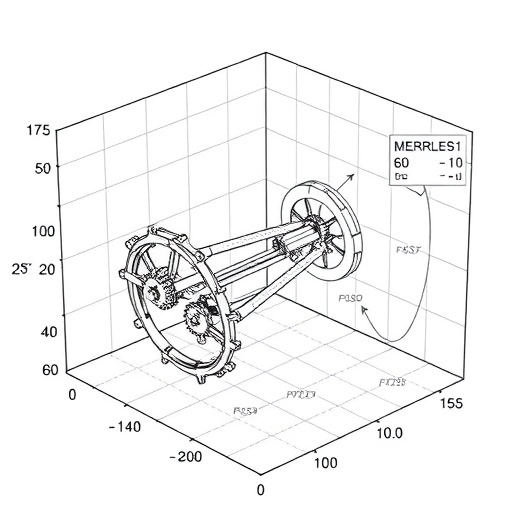
In the evolving realm of mechanical engineering, precision and accuracy remain paramount, especially in the design and operation of synchronous cam-linkage mechanisms. These intricate systems, widely used in automated machinery and robotics, have their efficiency often hampered by subtle errors that propagate through their interconnected components. Addressing this challenge with unprecedented depth, a groundbreaking study by Wang, Q., Deng, B., He, P. et al., published in Scientific Reports, introduces a novel sensitivity-based modeling framework that revolutionizes our understanding of error transfer in these mechanisms by employing a dual-measurement-point approach.
At the heart of their research lies the fundamental problem of error accumulation in synchronous cam-linkage mechanisms, where slight deviations in one part of the system can lead to significant operational inaccuracies. Previous models primarily relied on single-point measurement strategies, which, while useful, lacked the comprehensiveness to capture the full spectrum of error dynamics. The new dual-measurement-point methodology ingeniously circumvents these limitations by monitoring error propagation at two critical points simultaneously. This duality not only enhances the resolution of error detection but also provides a richer data set for modeling and prediction.
The study meticulously constructs a sensitivity-based model that quantifies how minute mechanical imperfections impact the overall performance of synchronous cam-linkage systems. Sensitivity analysis is crucial here; it elucidates which components or interfaces most significantly influence error propagation, enabling targeted improvements in design and maintenance. By identifying these sensitive nodes within the mechanism, engineers can prioritize interventions that yield the most substantial gains in operational fidelity.
One of the remarkable aspects of this research is the integration of theoretical modeling with practical measurement techniques. Utilizing precise instrumentation at the two designated measurement points, the researchers gathered empirical data reflecting real-world operational variability. This data informed the model calibration process, ensuring the simulated error transfer closely mirrors actual system behavior under variable loads and operational conditions. The synergy between theory and experimentation embodies a robust approach to tackling complex mechanical challenges.
Moreover, the adoption of a dual-point measurement strategy marks a paradigm shift in mechanism diagnostics. It empowers engineers with the ability to dissect error trajectories during machine motion rather than merely aggregating errors post-operation. This dynamic insight facilitates preemptive diagnostics and upgrades, fostering more reliable and resilient synchronous cam-linkage systems. The implications extend to fields reliant on high-precision mechanics, such as aerospace, automotive manufacturing, and robotics.
Beyond the primary findings, the researchers delve into the mathematical underpinning of error transfer within these mechanisms. They derive sensitivity coefficients that relate geometrical and kinematic parameters to output errors, employing advanced differential calculus and matrix analysis techniques. This mathematical rigor offers a versatile framework adaptable to various types of cam-linkage configurations, making the model a broadly applicable tool for engineers worldwide.
The dual-measurement-point model also underscores the stochastic nature of mechanical errors, recognizing that environmental factors, material fatigue, and assembly tolerances introduce variability into system performance. By incorporating probabilistic methods within their sensitivity analysis, the model accounts for uncertainties, predicting a range of possible outcomes rather than a single deterministic scenario. This probabilistic perspective is vital when designing fail-safe systems under diverse operational stresses.
Practical applications of this research are manifold. The enhanced error mapping capability assists in the design phase of synchronous cam-linkage mechanisms, guiding engineers toward configurations inherently less susceptible to error amplification. In the maintenance sphere, it enables more accurate condition monitoring and early detection of wear or misalignment, substantially reducing downtime and operational costs. Additionally, the methodology can be integrated into real-time monitoring systems, facilitating adaptive control strategies that compensate for identified errors on-the-fly.
Importantly, this work sets a new benchmark for interdisciplinary collaboration in mechanical systems research. By weaving together expertise from mechanical engineering, applied mathematics, instrumentation technology, and control theory, the study exemplifies how complex industrial problems can be addressed through integrated approaches. The success of the dual-measurement-point sensitivity-based model paves the way for future innovations harnessing data-rich analytics in mechanical system diagnostics.
The study also raises intriguing prospects for the extension of its framework into the domains of smart manufacturing and Industry 4.0. By embedding such sensitivity analysis models into cyber-physical systems, factories of the future can achieve unprecedented precision in machine operation, error prediction, and self-correction. This aligns with the broader move toward automation and intelligent machinery, where minimal error margins are crucial for scaling performance and ensuring safety.
Further research inspired by this work could explore the adaptation of the model to other mechanisms characterized by complex linkage systems, such as robotic arms and multi-joint conveyor setups. Expanding the model’s applicability through simulation and experimental validation in these contexts could unlock improvements across a wide range of industrial applications, advancing the state-of-the-art in mechanical system reliability.
Intrinsically, the dual-measurement-point approach not only improves error detection but also offers engineers a new lens through which to visualize the intricate dance of components within synchronous cam-linkage mechanisms. This enhanced transparency fosters deeper insights into system behavior, stimulating innovative thinking about mechanism design principles and error mitigation techniques.
In conclusion, the study by Wang, Q., Deng, B., He, P., and colleagues represents a significant leap forward in mechanical engineering diagnostics. Their sensitivity-based modeling complemented by dual-point error measurement provides a sophisticated, accurate, and practical tool to understand and control error transfer in synchronous cam-linkage mechanisms. As industries demand ever-greater precision and dependability from automated systems, such breakthroughs illuminate the path toward smarter, more resilient machinery and manufacturing ecosystems.
The impact of this research will undoubtedly reverberate through both academic circles and industry sectors, inspiring novel applications and further investigation. Its methodological innovations and practical applications underscore the critical role of precision modeling in the advancement of modern mechanical systems, ensuring that the complex symphony of machine components operates with harmony and exactitude like never before.
Cite Scienmag News
Denise Maddox. (March 26, 2026). Dual-Point Sensitivity Modeling of Cam-Linkage Errors. Scienmag. https://scienmag.com/dual-point-sensitivity-modeling-of-cam-linkage-errors/
Denise Maddox. "Dual-Point Sensitivity Modeling of Cam-Linkage Errors." Scienmag, 26 March 2026, https://scienmag.com/dual-point-sensitivity-modeling-of-cam-linkage-errors/. Accessed 4 September 2026.
Denise Maddox. "Dual-Point Sensitivity Modeling of Cam-Linkage Errors." Scienmag. March 26, 2026. https://scienmag.com/dual-point-sensitivity-modeling-of-cam-linkage-errors/


