


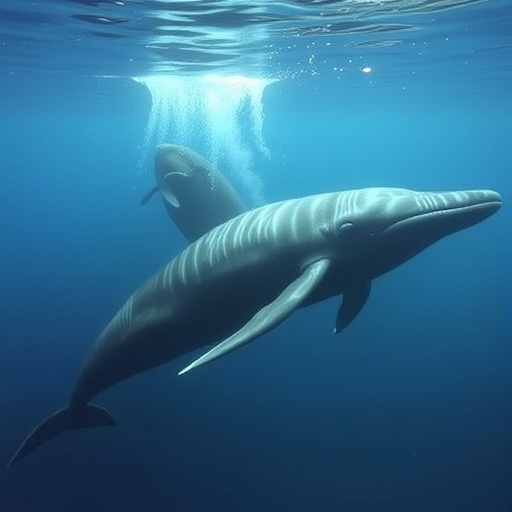
In a groundbreaking breakthrough that reshapes our understanding of marine mammal social behavior, Project CETI (Cetacean Translation Initiative) has unveiled two monumental studies chronicling an unprecedented sperm whale birth event. Published in the esteemed journals Science and Scientific Reports, these studies provide the deepest and most comprehensive insight into sperm whale parturition ever recorded, simultaneously presenting the first quantitative evidence of cooperative birth assistance among non-primate species.
The research stems from over six hours of meticulously gathered underwater acoustic data combined with high-resolution aerial drone footage captured in the pristine waters off Dominica on July 8, 2023. This site has been the focus of more than two decades of continuous, intensive fieldwork by researchers dedicated to unraveling the complex social structures of sperm whale families. Their persistence and long-term engagement with these cetaceans have yielded an extraordinary glimpse into one of the most intimate and vulnerable moments in a whale’s life cycle: birth.
At the heart of this study lies the intricate choreography of a socially complex sperm whale unit, spanning multiple generations of females across two unrelated matrilines. These females—including grandmothers, mothers, daughters, and sisters—were observed engaging in coordinated behaviors that actively supported the laboring female and her newborn calf. Movements such as synchronized lifting and physical support exemplify a level of cooperative caregiving previously undocumented in marine mammals at this scale and resolution. Such social cooperation during birth not only reinforces the tight-knit bonds within these large sperm whale societies but also suggests a foundational mechanism for trust and reciprocal altruism among unrelated individuals.
The rarity of observing wild cetacean births cannot be overstated, with such events documented in less than 10% of all cetacean species. This positions Project CETI’s detailed documentation as both exceptional and vital to understanding social evolution within marine mammals. The Science article entitled Cooperation by non-kin during birth underpins sperm whale social complexity employs a sophisticated blend of technologies, including advanced drone imaging, cutting-edge computer vision algorithms, and multiscale network analyses. These tools were integrated within custom-built software platforms specifically engineered to quantify and analyze complex caregiving behaviors across kinship boundaries, corroborated by extensive longitudinal behavioral datasets. The findings conclusively demonstrate that not only related females but also unrelated individuals from distinct matrilines participate equally in birth assistance, rotating caregiving roles and directly attending the newborn calf.
Complementing these behavioral observations, the accompanying Scientific Reports article titled Description of a collaborative sperm whale birth and shifts in coda vocal styles during key events delves into the acoustic dimension of the birth process. Detailed spectrographic analyses of the audio recordings reveal nuanced shifts in sperm whale vocalizations coinciding with critical phases of labor and neonatal adjustment. Remarkably, these calls exhibit vowel-like acoustic structures hitherto unseen in cetacean communication, augmenting Project CETI’s broader efforts to decode the linguistic complexity embedded within sperm whale codas. Such vocal modulations likely serve as communicative signals to coordinate group action and reinforce social bonds during this vulnerable time.
These discoveries have profound implications for evolutionary biology, suggesting that the roots of cooperative caregiving during birth extend deep into mammalian history. Phylogenetic reconstructions imply that the observed behavior of collective newborn lifting may trace back over 36 million years to the most recent common ancestor of toothed whales. This ancient trait highlights the role of birth assistance as a selective force shaping social complexity and cognitive evolution within cetaceans. By fostering cooperation among unrelated individuals, these behaviors help establish enduring social networks that fortify group cohesion and collective survival strategies in the expansive and dynamic oceanic environment.
The study’s lead scientist, Dr. David Gruber, National Geographic Explorer and Project CETI founder, emphasizes that these findings redefine long-held assumptions about whale society. The observed social care manifests as remarkably coordinated and intentional acts during a critical life event, shedding light on sophisticated altruistic behavior far beyond simple kin-based frameworks. Close observation of the matrilineal family unit, which included the mother known as Rounder from Unit A, her mother Lady Oracle, and Rounder’s daughter Accra, revealed multigenerational interaction underscoring the social depth within these whale clans.
Highlighting the significance of longitudinal inquiry, Dr. Diana Reiss of Hunter College underscores the importance of having built profound trust with the whales over many years. This unique rapport enabled intimate observation rarely possible in wild cetaceans, facilitating detailed study without disturbing normal social dynamics. This closeness between researchers and their subjects is crucial in uncovering subtle, context-dependent behaviors such as birth assistance that otherwise remain elusive.
Shane Gero, the Biology Lead for Project CETI and founder of The Dominica Sperm Whale Project, remarks on how this encounter offers the most detailed behavioral window ever obtained on the birthing process in sperm whales. The multi-generational insights provide a rich social context, allowing researchers to chart individual contributions from grandmother to newborn, painting a vivid picture of collective maternal care and sibling involvement.
The integration of advanced machine learning and engineering teams on-site during the birth permitted real-time collection and analysis of intricate behavioral and acoustic datasets. This multidisciplinary effort combined marine biology, artificial intelligence, natural language processing, and robotics, driving forward Project CETI’s ambitious mission to decode sperm whale communication and social interaction with unprecedented technical rigor.
Collectively, these findings situate sperm whale birth behaviors among the most complex observed in terrestrial mammals, including humans. They prompt compelling questions about the neural, cognitive, and communicative capacities required to enable such coordinated social care. The studies build upon prior discoveries including the identification of a phonetic-like alphabet and vowel/diphthong spectral patterns within sperm whale codas, expanding our understanding of the sophistication embedded within cetacean languages.
Project CETI, a nonprofit collaborative initiative partnered with the National Geographic Society, continues to lead this frontier by applying cutting-edge computational and acoustic technologies to unravel cetacean communication. By charting these complex social behaviors in wild sperm whales off the coast of Dominica and beyond, Project CETI not only reveals new dimensions of marine mammal intelligence but also advocates for enhanced conservation efforts aimed at protecting these magnificent, socially intricate giants of the deep.
The detailed documentation of cooperative birth assistance in sperm whales provides a compelling model that challenges anthropocentric views of social care and evolutionary progression. This research spotlights the rich behavioral repertoires that emerge in species exhibiting high degrees of sociality and cognitive complexity, reinforcing the interconnectedness of cooperative social evolution across both terrestrial and marine domains.
Cite Scienmag News
Courtney Benton. (March 26, 2026). Rare Sperm Whale Birth and Ancient Cooperative Care Documented in New Study. Scienmag. https://scienmag.com/rare-sperm-whale-birth-and-ancient-cooperative-care-documented-in-new-study/
Courtney Benton. "Rare Sperm Whale Birth and Ancient Cooperative Care Documented in New Study." Scienmag, 26 March 2026, https://scienmag.com/rare-sperm-whale-birth-and-ancient-cooperative-care-documented-in-new-study/. Accessed 4 September 2026.
Courtney Benton. "Rare Sperm Whale Birth and Ancient Cooperative Care Documented in New Study." Scienmag. March 26, 2026. https://scienmag.com/rare-sperm-whale-birth-and-ancient-cooperative-care-documented-in-new-study/


