


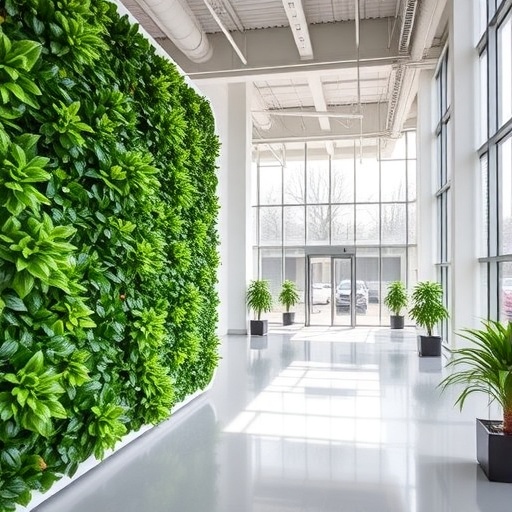
In the quest for sustainable and energy-efficient indoor environments, a groundbreaking innovation emerges from the Hebrew University of Jerusalem that promises to revolutionize how we integrate nature into our living and working spaces. Traditionally, indoor air quality management in modern buildings demands substantial energy consumption, relying heavily on mechanical ventilation, air filtration, and climate control systems. Against this backdrop, vertical green walls—living plant installations affixed to interior surfaces—offer an attractive, nature-based alternative. However, despite their aesthetic appeal and theoretical benefits, these green walls have faced significant barriers to widespread adoption owing to unpredictable performance and challenging maintenance.
Addressing this critical gap, researchers Yehuda Yungstein and Dr. David Helman present VertINGreen, an advanced web-based platform unveiled in a recent publication in the journal Indoor Air. VertINGreen transcends the conventional role of green walls as passive decoration, transforming them into dynamic, data-driven environmental systems that intelligently interact with indoor climates. The platform leverages cutting-edge remote sensing technologies paired with sophisticated machine learning algorithms, creating a tool that not only forecasts green wall performance prior to installation but also monitors the health and functionality of the living plants in real time throughout their lifecycle.
The foundation of VertINGreen is rooted in extensive empirical data derived from nearly two thousand meticulous measurements tracking how common indoor plants process gases. This includes quantifying carbon dioxide absorption rates and water vapor release under varying climatic conditions, effectively capturing the respiratory mechanics of plants within artificial indoor ecologies. By ingesting this data, the platform trains predictive models capable of accurately estimating a plant wall’s contribution to improving air quality and reducing the energy footprint by modulating indoor ventilation needs.
Integral to the promise of VertINGreen is its capacity to answer pivotal, previously unaddressed questions for architects, engineers, and facility managers: What tangible environmental benefits will a vertical green wall deliver in my specific building context? How can I predict its influence on carbon sequestration and humidity regulation? VertINGreen equips professionals with scientifically validated insights, eliminating guesswork and enabling evidence-based decision-making during the design and construction phases.
Beyond planning, the platform’s real-time monitoring capability signifies a paradigm shift in green wall maintenance. Employing hyperspectral imaging—an advanced remote sensing technique that captures data across multiple wavelengths beyond visible light—VertINGreen detects nuanced physiological changes in plants that escape the human eye. This spectral insight, combined with machine learning pattern recognition, empowers the system to identify early signs of stress such as water deficiency, nutrient imbalances, or disease, well before symptoms manifest visibly. Consequently, interventions become proactive rather than reactive, significantly decreasing maintenance costs and enhancing the durability and efficacy of green wall installations.
Remarkably, this sophisticated spectral analysis is achieved without the need for prohibitively expensive equipment. By optimizing detection through just a select few spectral bands, VertINGreen democratizes access to plant health surveillance, making the technology feasible for a broad spectrum of building projects. This accessibility bodes well for scaling the integration of vegetation in urban interiors, supporting the vision of adaptive, living architectures.
VertINGreen is emblematic of a broader shift towards embedding living systems within urban infrastructure, where biologically active components harmonize with digital intelligence. This integration marks a confluence of botany, environmental engineering, and data science, culminating in indoor environments that are cleaner, healthier, and more energy-efficient. It challenges the prevailing paradigm dominated by mechanical systems, suggesting a future where buildings are not just spaces enclosed by walls but are vibrant ecosystems sustained through technological symbiosis with nature.
The implications extend beyond air quality and energy consumption. By delivering a reliable framework for sustainable indoor vegetation management, VertINGreen promotes resilient green infrastructure in the face of growing urbanization and climate change. As cities densify, the necessity for scalable, low-impact solutions to maintain air health becomes increasingly urgent. Vertical green walls, augmented by VertINGreen’s intelligent control systems, could become an indispensable component of this urban resilience strategy.
Enabling a seamless transition from experimental concepts in plant physiology to practical, impactful applications in building design and operations, VertINGreen bridges a crucial divide. The platform signifies a transformative moment where scientific understanding is operationalized within everyday contexts, empowering decision-makers to harness living walls’ full potential. It fosters trust in the biological systems embedded indoors, underpinning their function with robust data analytics and predictive modeling.
In articulating their vision, Yungstein and Helman underscore the importance of interdisciplinary collaboration, melding insights from plant sciences, remote sensing, and AI. Their work stands as a testament to how technology can rehabilitate and elevate natural processes within anthropogenic environments. This synthesis facilitates a new era in green building strategy, where sustainability is measured not just by energy metrics but by the symbiotic vitality of the ecosystems buildings embody.
Looking forward, VertINGreen’s novel approach signals a future in which the very fabric of indoor spaces participates actively in environmental stewardship. The walls surrounding us may soon transcend their traditional roles—serving simultaneously as guardians of air purity and as living interfaces that adapt and respond to the climatic and physiological demands of their inhabitants. This paradigm, catalyzed by the innovative synergy of AI, remote sensing, and botanical science, holds the promise of more harmonious, sustainable urban environments where technology and nature coexist productively.
News Publication Date: 28-Jan-2026
Web References: https://dx.doi.org/10.1155/ina/5782002
Cite Scienmag News
Courtney Benton. (March 26, 2026). VertINGreen Transforms Indoor Green Walls into Smart, Living Systems That Revitalize Buildings. Scienmag. https://scienmag.com/vertingreen-transforms-indoor-green-walls-into-smart-living-systems-that-revitalize-buildings/
Courtney Benton. "VertINGreen Transforms Indoor Green Walls into Smart, Living Systems That Revitalize Buildings." Scienmag, 26 March 2026, https://scienmag.com/vertingreen-transforms-indoor-green-walls-into-smart-living-systems-that-revitalize-buildings/. Accessed 4 September 2026.
Courtney Benton. "VertINGreen Transforms Indoor Green Walls into Smart, Living Systems That Revitalize Buildings." Scienmag. March 26, 2026. https://scienmag.com/vertingreen-transforms-indoor-green-walls-into-smart-living-systems-that-revitalize-buildings/


