


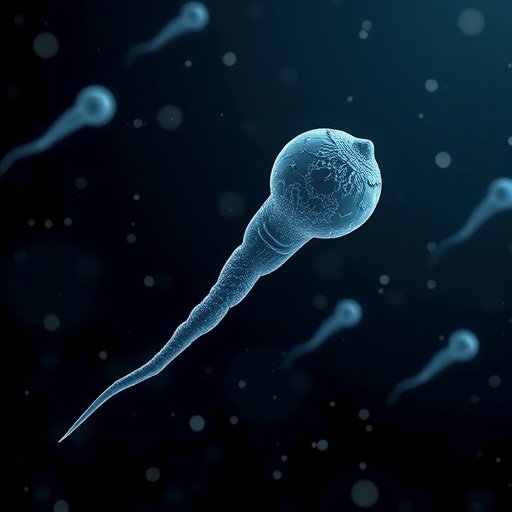
As humanity sets its ambitions on long-term space travel and extraterrestrial colonization, profound questions arise about the feasibility of natural human reproduction beyond Earth. Groundbreaking research from Adelaide University now reveals that sperm navigation—the critical first step in fertilization—is significantly impaired in microgravity environments. This discovery shines new light on the complexities of reproductive biology in space, emphasizing the intricate challenges that zero gravity poses to conception and early embryonic development.
Researchers from the Robinson Research Institute, in collaboration with the School of Biomedicine and the Freemasons Centre for Male Health and Wellbeing, have spearheaded an experimental study simulating space-like gravitational conditions to explore how the absence of Earth’s gravity interferes with sperm behavior. Using a state-of-the-art 3D clinostat machine developed by Dr. Giles Kirby at Firefly Biotech, sperm cells from humans and two other mammalian species were exposed to a simulated microgravity environment. This device rotates cells in multiple axes to neutralize the directional cues that gravity normally provides, effectively recreating the disorienting conditions sperm would face in space.
After this microgravity simulation, sperm were guided through a maze engineered to replicate the complex environment of the female reproductive tract. Scientists observed a marked decline in the sperm’s ability to successfully navigate toward the fertilization site. Notably, this navigational failure was not owing to diminished motility; the sperm’s physical movement capabilities remained unchanged. Instead, it appeared that the lack of a gravitational frame of reference critically disrupted the sperm’s internal guidance mechanisms, which likely depend on gravity cues to calibrate their trajectory and navigate correctly.
The study’s senior author, Dr. Nicole McPherson, highlights the significance of gravity in sperm navigation: “This is the first definitive evidence that gravity is a fundamental factor helping sperm orient themselves as they traverse reproductive pathways. Our findings suggest that in microgravity, sperm lose their directional sense despite maintaining normal motility.” This insight not only challenges earlier assumptions that sperm function would be largely unaffected by zero gravity but underscores gravity’s subtle yet essential role in early reproductive stages.
Intriguingly, the hormone progesterone — a key biochemical signal released by the egg that facilitates fertilization — was found to partially counteract the navigational impairments induced by microgravity. When human sperm were exposed to progesterone during their journey through the simulated reproductive maze, a higher proportion successfully reached their target destination. This finding suggests progesterone’s signaling function could provide an auxiliary navigational beacon in space, a hypothesis that warrants deeper investigation. Future research could explore progesterone augmentation as a potential strategy to enhance reproductive success during space missions.
Beyond sperm navigation, the research team examined the direct impact microgravity exerts on fertilization efficacy and subsequent embryo development. Mouse egg cells subjected to zero-gravity conditions for several hours showed a dramatic 30% drop in successful fertilization rates compared to counterparts in normal gravity. Prolonged exposure to simulated microgravity also led to developmental delays in embryos and a reduction in cells destined to form critical fetal structures during the earliest embryonic stages. These findings underline the layered effects microgravity can have, extending from sperm navigation to post-fertilization embryogenesis.
Dr. McPherson elaborates on the gravity-dependent complexity of early reproduction: “Our data reveal that microgravity disrupts not only fertilization rates but also the progression of embryonic development. These developmental perturbations raise concerns about the viability of natural conception processes in extraterrestrial environments.” The breadth of impact stresses the need to dissect and understand every phase of reproduction under space conditions to mitigate risks and design supportive interventions for spacefarers.
While previous investigations have explored sperm motility beyond Earth — mainly focusing on swimming speed and flagellar movement — this is the inaugural study to evaluate navigational capability within an anatomically inspired channel that mimics the female reproductive tract under simulated microgravity. This distinction is crucial; motility alone does not inform whether sperm can effectively orient and reach the egg, which is vital for fertilization success.
The study’s publication in Communications Biology underscores its scientific importance and opens new avenues for multidisciplinary collaboration. Adelaide University’s Andy Thomas Centre for Space Resources—dedicated to solving challenges tied to sustainable off-world living—contributed expertise to this project, highlighting its relevance for future space habitat design and resource planning.
Associate Professor John Culton, Director of the Centre, emphasizes the broader implications: “As humanity prepares to become a multi-planetary species, understanding how microgravity alters foundational biological functions like reproduction is paramount. This knowledge will shape everything from mission planning to the development of life-support systems capable of fostering healthy human generation beyond Earth.”
Looking ahead, the researchers are gearing up to study sperm and embryonic development under varying gravitational fields akin to those on the Moon and Mars, as well as in artificial gravity environments created by rotational spacecraft. A pivotal question the team aspires to answer is whether reproductive disruptions scale gradually with decreasing gravitational force or if there exists a critical threshold effect—an all-or-none phenomenon—which could define the limits of natural reproduction in space.
Understanding this gradation is not just academic; it informs whether partial gravity environments might mitigate risks or if specific gravity levels must be met to ensure reproductive viability. Moreover, the findings will guide the engineering of artificial gravity habitats, aiming to mimic Earth-like conditions essential for healthy conception and fetal development.
Despite the challenges identified, the research also brings a message of cautious optimism. Many embryos studied under microgravity conditions still reached healthy developmental milestones, suggesting that while microgravity complicates reproductive processes, it does not render them impossible. With targeted interventions and refined spacefaring technologies, successful human reproduction in off-world colonies may one day be achievable.
In conclusion, the intricate dance of sperm navigation, fertilization, and embryo development is profoundly influenced by gravity. This pioneering research spotlights the necessity for comprehensive biological studies in space to anticipate and overcome the hurdles of human reproduction beyond Earth. As humanity ventures deeper into the cosmos, safeguarding the continuity of life hinges on unraveling these fundamental space biology mysteries.
News Publication Date: 27-Mar-2026
Web References:
https://doi.org/10.1038/s42003-026-09734-4
References:
Communications Biology (Nature Portfolio), 27 March 2026.
Cite Scienmag News
Drew Townsend. (March 26, 2026). Human sperm could drift aimlessly in space, new research suggests. Scienmag. https://scienmag.com/human-sperm-could-drift-aimlessly-in-space-new-research-suggests/
Drew Townsend. "Human sperm could drift aimlessly in space, new research suggests." Scienmag, 26 March 2026, https://scienmag.com/human-sperm-could-drift-aimlessly-in-space-new-research-suggests/. Accessed 5 September 2026.
Drew Townsend. "Human sperm could drift aimlessly in space, new research suggests." Scienmag. March 26, 2026. https://scienmag.com/human-sperm-could-drift-aimlessly-in-space-new-research-suggests/


