


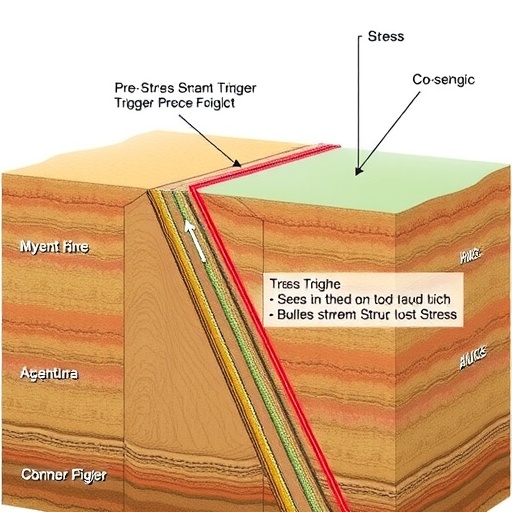
In a groundbreaking advancement for seismic science, recent research has unveiled the complex dynamics behind the M_w 7.1 earthquake that struck Tingri in 2025, a region fraught with geophysical intricacies. The study sheds light on the pivotal role played by both pre-seismic and co-seismic stress loading in activating a low-angle splay fault, a phenomenon that has profound implications for our understanding of fault mechanics and earthquake genesis.
The Tingri earthquake presented a particularly challenging case due to the tectonic configuration of the Himalayan region, where multiple fault systems interact beneath the Earth’s surface. Traditional models primarily focused on high-angle faulting mechanisms; however, this new research underscores how low-angle splay faults can be critically stressed and subsequently ruptured, adding a nuanced layer to our seismic hazard assessment frameworks.
Central to the findings is the concept of stress transfer and accumulation. Prior to the main event, stress had been gradually building in the crust due to ongoing tectonic forces associated with the Indian-Eurasian plate collision, which is responsible for elevating the Himalayas. This pre-seismic stress loading incrementally weakened the rock formations along the low-angle splay fault. The subsequent co-seismic stress release during the earthquake further mobilized this fault, allowing it to slip and propagate seismic energy over a wider area than previously anticipated.
Utilization of multi-disciplinary data integration was key in this research. State-of-the-art seismic tomography, satellite-based interferometry, and detailed aftershock distribution analyses combined to provide a comprehensive picture of the fault activation process. Notably, satellite radar images revealed subtle ground deformations occurring weeks before the quake, indicative of the slow accumulation of strain that primed the fault for rupture.
These observations are pivotal because low-angle splay faults, often considered less likely to slip compared to their steeper counterparts, are now recognized as capable of generating significant seismic hazards under favorable stress conditions. Their geometry, which angles shallowly relative to the Earth’s surface, allows for distinctive slip behaviors and energy release patterns that challenge established seismic prediction models.
By examining the seismic waveforms and the spatial-temporal distribution of tremors, the researchers were able to correlate pre-seismic stress anomalies with fault slip timing. This linkage provides predictive potential, highlighting the importance of monitoring subtle stress changes over extended periods, which could serve as precursors to major earthquake events in similarly complex geological settings.
The implications of this study reach beyond the Himalayan region. Other convergent plate boundaries, especially those characterized by complex fault networks and active splay faults, may exhibit analogous pre-seismic stress buildup and co-seismic triggering mechanisms. As such, this research calls for a re-evaluation of seismic risk paradigms globally, incorporating low-angle fault behavior into hazard models.
Moreover, the coupling between low-angle splay faults and main thrust faults suggests a cascading rupture potential. The interplay between these structures implies that an event on a primary fault might not only redistribute stress but actively cause secondary fault activation. This mechanistic insight changes how aftershock sequences and seismic hazard zones are interpreted in post-earthquake scenarios.
In a broader context, these findings provide valuable directions for earthquake preparedness strategies. Enhanced monitoring of geodetic signals and real-time seismic data could enable the detection of precursory stress patterns, offering critical lead times for early warning systems. This is particularly crucial in densely populated mountainous regions like Tingri, where tectonic activity poses persistent threats to millions.
The study also advances theoretical models of fault friction and rock rheology under varying pressure-temperature conditions. By linking laboratory-derived frictional properties with observed field phenomena, the research bridges microscopic processes with macroscopic fault behavior, offering a holistic understanding of earthquake mechanics.
Furthermore, the role of fluid pressure along the fault plane emerged as a significant factor influencing fault strength and slip propensity. Fluid infiltration can lower effective normal stress on the fault, facilitating rupture even at comparatively low levels of tectonic stress. This insight emphasizes the necessity to integrate hydrological parameters into seismic hazard assessments.
The 2025 Tingri earthquake has revitalized interest in low-angle fault systems, which had been historically underestimated due to observational challenges and model simplifications. This comprehensive investigation, therefore, not only elucidates the conditions that led to this substantial seismic event but also opens new avenues for research and risk mitigation.
In conclusion, the synthesis of pre- and co-seismic stress loading effects on low-angle splay fault activation marks a substantial leap forward in earthquake science. It compels geoscientists to rethink traditional paradigms and enriches the toolkit available for forecasting and understanding seismic hazards in tectonically active regions worldwide.
Cite Scienmag News
Violet Maxwell. (March 26, 2026). Pre- and Co-Seismic Stress Trigger Low-Angle Fault. Scienmag. https://scienmag.com/pre-and-co-seismic-stress-trigger-low-angle-fault/
Violet Maxwell. "Pre- and Co-Seismic Stress Trigger Low-Angle Fault." Scienmag, 26 March 2026, https://scienmag.com/pre-and-co-seismic-stress-trigger-low-angle-fault/. Accessed 3 September 2026.
Violet Maxwell. "Pre- and Co-Seismic Stress Trigger Low-Angle Fault." Scienmag. March 26, 2026. https://scienmag.com/pre-and-co-seismic-stress-trigger-low-angle-fault/


