


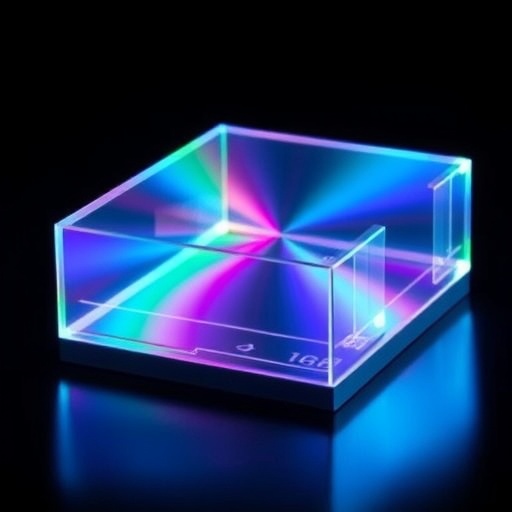
In a groundbreaking advancement at the intersection of optics and data storage technology, researchers from Fujian Normal University in China have unveiled a novel holographic data storage system that exploits the three-dimensional nature of light more comprehensively than ever before. This innovative methodology encodes and decodes information by harnessing three intrinsic properties of light—amplitude, phase, and polarization—ushering in a new era of ultra-dense data storage. By interlacing these parameters to store data within volumetric media, this approach significantly outperforms conventional storage techniques that rely on surface-level data encoding, promising monumental gains in both storage capacity and data throughput.
Traditional holographic data storage captures information through laser light patterns imposed within a photosensitive material. Rather than limiting data to a single plane as in magnetic or optical disks, holography records complex light interference patterns throughout the volumetric medium, allowing multiplexed data pages to coexist within the same physical space. While existing methods have managed to employ amplitude or phase modulations—sometimes a combination of both—this new system transcends these constraints by integrating polarization as an independent axis of information. The researchers achieved this by leveraging the principles of tensor polarization holography coupled with sophisticated deep learning tools, specifically convolutional neural networks, to successfully decode the otherwise elusive polarization state.
The groundbreaking technique was detailed in a recent publication in Optica, the prestigious journal from the Optica Publishing Group known for disseminating cutting-edge peer-reviewed research in optics and photonics. The research team, led by Professor Xiaodi Tan, explained that conventional holography typically treats polarization either as a fixed parameter or neglects it altogether due to the technical challenges in encoding and decoding phase and polarization simultaneously. The introduction of a novel 3D modulation encoding scheme utilizing two orthogonal polarization states controlled by intensity and phase marks a transformative leap. This approach uses a double-phase hologram methodology, cleverly implemented on a single phase-only spatial light modulator, to encode multidimensional optical fields.
Decoding this wealth of encoded data posed formidable challenges, as standard optical sensors primarily capture light intensity and inherently lack the capacity to directly measure phase changes or polarization states. To overcome this, the team conceptualized and trained an advanced convolutional neural network model capable of inferring the complex multi-parameter information from complementary intensity-based diffraction images, one filtered through a vertical polarizer and the other unfiltered. This neural network synchronously retrieves amplitude, phase, and polarization information from the diffraction patterns with impressive accuracy, effectively bridging the gap between theoretical multidimensional encoding and practical data retrieval.
The researchers constructed a compact, polarization-sensitive holographic system to experimentally verify the theory and demonstrate practical decoding. The hologram records intricate interference patterns modulated with amplitude, phase, and polarization information. Decoding unfolds by analyzing diffraction intensity images, extracting subtle intensity variations tied to polarization signatures, and feeding these into the neural network. This results in a comprehensive reconstruction of three-dimensional optical data pages from intensity-only measurements—an achievement that reduces reliance on complex, multi-step reconstruction procedures typical of existing holographic storage systems.
This advancement dramatically elevates the information content per holographic data page, multiplying storage density beyond what previous technologies could achieve. The neural network not only accelerates the decoding process but simplifies it, enabling cost- and complexity-effective readout mechanisms. Consequently, multidimensional holographic data storage stands poised to contribute substantially to reducing the physical footprint of data centers, enhancing archival storage solutions, and boosting efficiency in large-scale data processing and transmission.
The multifaceted implications of this technology extend beyond mere storage. Professor Tan highlighted its potential impact on data security through optical encryption schemes grounded in polarization complexity. Furthermore, the approach may catalyze advancements in optical imaging technologies by exploiting richer information channels in light fields, making possible new imaging modalities with increased detail and resilience to noise.
Despite this milestone, the research remains in the experimental phase. The team recognizes the necessity of refining the system for real-world deployment, focusing on increasing the grayscale levels in encoding to expand capacity further. Enhancing the long-term stability, uniformity, and repeatability of the holographic recording media is also paramount to commercial viability. Additionally, integrating volumetric holographic multiplexing techniques holds promise for enabling multi-page, multi-channel storage frameworks, amplifying throughput and robustness.
A key element of future work involves the seamless integration of optical hardware with the sophisticated neural network decoding algorithms for real-time data retrieval under practical conditions. This co-optimization is critical to overcoming noise, material imperfections, and environmental variability that typically challenge holographic storage systems outside controlled laboratory environments.
Given the astounding data explosion fueled by artificial intelligence, cloud computing, and the Internet of Things, technologies offering drastic improvements in storage density and read/write speeds are urgently needed. This multidimensional holographic data storage approach, by leveraging the full spectrum of light’s degrees of freedom, represents a quantum leap toward addressing these escalating demands. If scalable and manufacturable at industrial scale, this technology could revolutionize data centers and archival storage, making them more compact, efficient, and capable of handling tomorrow’s massive datasets.
This stirring scientific advancement epitomizes the fusion of physical optics innovations with artificial intelligence, demonstrating how machine learning can unlock new potentials in classical physical phenomena. The collaboration of theoretical insight, experimental precision, and computational ingenuity offers a promising pathway to the future of data storage, where light’s full complexity is marshaled to meet humanity’s insatiable appetite for information.
Web References:
- Optica journal homepage: https://opg.optica.org/optica/home.cfm
- DOI link to article: https://opg.optica.org/optica/abstract.cfm?doi=10.1364/OPTICA.586593
References:
Chen, R., Wang, J., Wu, H., Song, M., Yang, Y., Lin, D., Tan, X. (2026). Encoding and decoding of multidimensional optical field modulation in holographic data storage. Optica, 13. DOI: 10.1364/OPTICA.586593.
Keywords
Holographic data storage, multidimensional modulation, polarization holography, amplitude-phase-polarization encoding, convolutional neural networks, tensor polarization, volumetric data storage, optical encryption, spatial light modulator, machine learning in optics, high-density data storage, optical data retrieval.
Cite Scienmag News
Grant Pearson. (March 26, 2026). Innovative Holographic Storage Technique Boosts Data Capacity Without Increasing Space. Scienmag. https://scienmag.com/innovative-holographic-storage-technique-boosts-data-capacity-without-increasing-space/
Grant Pearson. "Innovative Holographic Storage Technique Boosts Data Capacity Without Increasing Space." Scienmag, 26 March 2026, https://scienmag.com/innovative-holographic-storage-technique-boosts-data-capacity-without-increasing-space/. Accessed 4 September 2026.
Grant Pearson. "Innovative Holographic Storage Technique Boosts Data Capacity Without Increasing Space." Scienmag. March 26, 2026. https://scienmag.com/innovative-holographic-storage-technique-boosts-data-capacity-without-increasing-space/


