


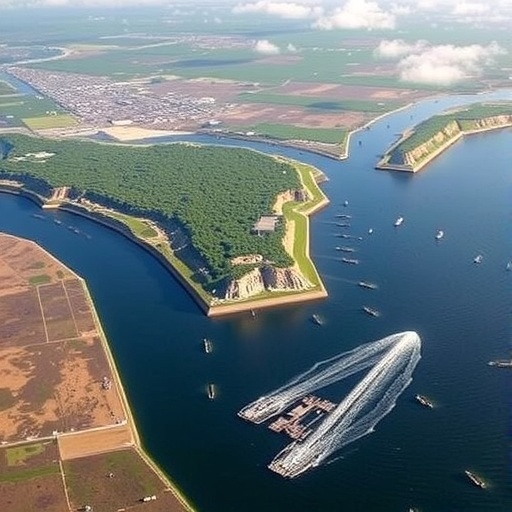
In a groundbreaking global assessment, researchers from Utrecht University and Deltares have uncovered the physical bounds and possibilities of sea-level rise adaptation across nearly 800 river deltas, representing approximately 96% of the world’s deltaic land area and home to around 350 million individuals. Employing a comprehensive analysis of each delta’s unique physical characteristics—such as coastline geometry, river discharge, and sediment availability—they meticulously mapped the “physical solution space” available for adaptation, revealing a nuanced landscape of opportunities and constraints that challenge prior assumptions about our capacity to combat the encroaching threats posed by climate change.
River deltas, delicate and dynamic landscapes where rivers meet oceans, are inherently vulnerable to the impacts of rising sea levels driven by global warming. The research uniquely assesses the physical feasibility of current adaptation measures, leveraging the state-of-the-art technological capabilities accessible today and projecting their limits through the lens of three distinct future sea-level rise scenarios proposed by the Intergovernmental Panel on Climate Change (IPCC). This novel methodological framework enables a multidimensional understanding of how deltas might respond physically to the urgent need for flood risk mitigation, infrastructure resilience, and community safety.
The study categorizes five primary adaptation strategies, defining the spectrum of viable responses deltas can employ based on their geomorphological and hydrological conditions. These strategies include constructing protective levees both along rivers and coastlines complemented by storm surge barriers; severing direct connections to the sea through engineered closures supported by pumping systems to manage river flow; elevating existing infrastructure to keep pace with rising waters; extending coastlines seaward via sediment nourishment or artificial land creation; and finally, the retreat inland, involving sociotechnical approaches such as relocation of populations and assets away from flood-prone zones.
Within this framework, the investigation emphasizes that not all adaptation measures are universally applicable or equally feasible. Physical limitations play a defining role; for instance, low flood depths and adequate spatial availability may allow for elevating homes or relocating populations in smaller rural deltas. In contrast, heavily urbanized and low-lying deltas with limited space, such as the Rhine-Meuse delta in the Netherlands, face stringent constraints that preclude widespread levee construction or comprehensive population relocation. These insights illuminate the critical differentiation between adaptation measures that are simply theoretically possible versus those achievable given the physical realities on the ground.
One profound implication of this work lies in its explicit recognition of constraints affecting pump capacities necessary to manage excessive river discharges in large deltas. Current technological thresholds limit the ability to construct pumping infrastructures capable of handling extreme volumes of water, pointing to a need for technological innovation or alternative approaches to managing hydrodynamic stresses. This technical bottleneck highlights a crucial area where future research and engineering breakthroughs could reshape the adaptation landscape, expanding the feasible solution space and bolstering resilience against intensifying flood risks.
The study illuminates an essential dichotomy between large, densely populated deltas and their smaller, less developed counterparts. Larger deltas, often economic and population hubs, face compounded challenges due to extensive flood risks coupled with limited physical room for engineered defenses or relocation. Conversely, smaller deltas, with more available land and relatively moderate flood risks, can implement lower-resource strategies more flexibly, making them adaptable to current technological offerings without necessitating substantial innovation or resource use.
A particularly insightful contribution of this research is the observation that while all deltas globally possess at least one physically viable adaptation strategy under every IPCC sea-level rise scenario projected to 2100, the breadth and flexibility of these options vary dramatically. For example, the Mississippi delta features promising avenues for low-resource adaptation measures, such as localized relocation to non-flooded urban sectors and targeted storm surge barriers at river mouths, which align with practices already underway. In stark contrast, the Netherlands’ Rhine-Meuse delta, despite its world-class flood defenses, has a surprisingly narrow range of scalable physical solutions due to its complex hydrology and population density, necessitating hybrid approaches blending multiple strategies.
Compounding the complexity of delta adaptation is the potential for resource competition on a global scale, given that many deltas worldwide will need to pursue adaptation simultaneously. This dynamic underscores the necessity for enhanced coordination and knowledge sharing among delta management authorities and communities internationally. By fostering collaborative innovation and resource pooling, the physical solution space available to individual deltas could be substantially expanded, offering new pathways to resilience that transcend regional limitations.
Furthermore, the research stresses that while rising sea levels will inevitably reduce the physical solution space for many deltas, constricting their options, ongoing technological innovation and adaptive management hold promise for reshaping this future. The expansion of adaptation possibilities will depend on integrating advancements in engineering, material sciences, and adaptive governance, with local contextualization playing a key role in ensuring that strategies are not only technically feasible but also socioeconomically and environmentally sustainable.
Understanding the physical limits of adaptation measures is a vital step towards informed decision-making. As Kiara Lasch, the study’s lead author, articulates, we cannot halt the global rise in sea levels, but by clarifying what is physically feasible, we provide essential insights enabling targeted technical innovation and coordinated action. These insights are instrumental in creating adaptive responses that are rooted in reality, optimizing investments, and safeguarding populations residing in these critical regions.
The study’s methodological approach, combining geospatial data analysis with hydrological and technological capability assessments, represents a pioneering effort to bridge the gap between theoretical adaptation potential and practical implementation constraints. Its findings not only serve as a guide for policy makers, engineers, and urban planners but also provide a scalable framework to assess adaptation solution spaces at finer local scales, where community-specific nuances further dictate feasible intervention pathways.
As global climate challenges intensify, this research offers a beacon of understanding—the physical solution space concept crystallizes the complex interplay of nature, technology, and human settlement in the face of rising seas. By illuminating what is possible and where critical bottlenecks lie, this work charts a clearer path to safeguarding the world’s river deltas, ensuring that they remain vibrant centers of biodiversity, culture, and human enterprise amid the inevitable tides of change.
News Publication Date: 25-Mar-2026
Web References: http://dx.doi.org/10.1038/s41467-026-69517-7
Keywords
Sea-level rise, delta adaptation, flood risk, river deltas, climate change, physical solution space, coastal resilience, storm surge barriers, levees, delta infrastructure, technological innovation, flood defense
Cite Scienmag News
Violet Maxwell. (March 26, 2026). Most Deltas Can Adapt to Rising Seas—At Least for Now, Study Shows. Scienmag. https://scienmag.com/most-deltas-can-adapt-to-rising-seas-at-least-for-now-study-shows/
Violet Maxwell. "Most Deltas Can Adapt to Rising Seas—At Least for Now, Study Shows." Scienmag, 26 March 2026, https://scienmag.com/most-deltas-can-adapt-to-rising-seas-at-least-for-now-study-shows/. Accessed 3 September 2026.
Violet Maxwell. "Most Deltas Can Adapt to Rising Seas—At Least for Now, Study Shows." Scienmag. March 26, 2026. https://scienmag.com/most-deltas-can-adapt-to-rising-seas-at-least-for-now-study-shows/


