


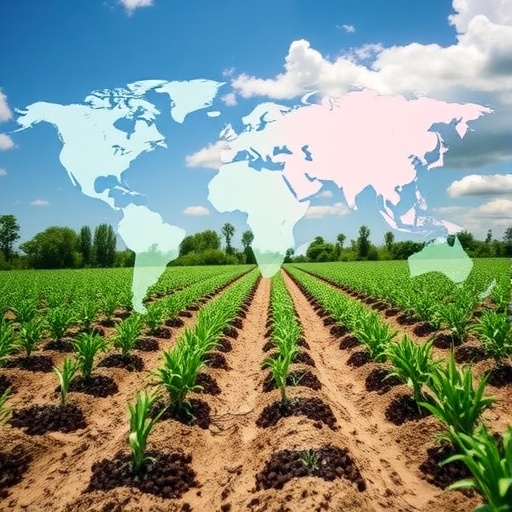
As the global population continues its inexorable rise, the pressure on agriculture to meet increasing food demands has never been more intense. In this context, the promise of regenerative farming practices emerges not only as a beacon of hope but also as a scientifically grounded approach to reconciling yield enhancement with environmental sustainability. A groundbreaking new study published in npj Sustainable Agriculture presents a meticulously detailed global assessment of where regenerative agriculture could meaningfully boost crop production. This research provides an enlightening discourse that could potentially revolutionize farming systems worldwide.
Regenerative agriculture refers to a suite of farming methods aimed at restoring soil health, increasing biodiversity, sequestering carbon, and ultimately enhancing ecosystem resilience. Unlike conventional agriculture, which often relies heavily on chemical inputs and monocultures, regenerative approaches encourage practices such as cover cropping, reduced tillage, crop diversification, and integrated livestock management. The critical question tackled by this recent study is not whether regenerative agriculture is beneficial in theory, but where on the planet it can significantly improve yields under real-world conditions.
The researchers, led by Hounkpatin and colleagues, leveraged global datasets to perform an unprecedented spatial analysis. They combined climatic, soil, and crop data with empirical yield response functions derived from field trials to map potential gains from implementing regenerative practices across diverse agroecological zones. This method allowed them to identify hotspots where regenerative methods could not only sustain but increase productivity, even in regions challenged by climate variability and soil degradation.
One of the most striking revelations from the study is the pronounced variability in yield gains across different crop types and geographic regions. For instance, cereal crops such as maize and wheat show substantial yield improvements under scenarios of optimized regenerative practices, particularly in temperate zones of Europe and North America. Conversely, certain tropical regions demonstrate more nuanced outcomes, with soil type and rainfall patterns playing decisive roles in mediating the benefits of regenerative farming.
The study emphasizes soil health restoration as the cornerstone of yield enhancement through regenerative practices. Improved soil organic matter content enhances moisture retention, nutrient cycling, and microbial biodiversity, collectively fostering a hospitable environment for plant growth. Particularly in degraded or marginal lands, regenerative practices can reverse decades of soil depletion, unleashing latent productivity potentials that conventional methods cannot achieve sustainably.
Another pivotal aspect is the interplay between regenerative agriculture and climate resilience. The researchers found that by increasing soil carbon stocks and improving root systems, regenerative farming could buffer crops against drought and heat stress. This dual function of yield improvement and adaptation is crucial for future-proofing global food systems facing increasingly erratic weather patterns driven by climate change.
Importantly, the study signals that regenerative agriculture is not a one-size-fits-all solution. Successful implementation requires local adaptation based on detailed assessments of soil properties, crop species, and socio-economic contexts. For example, integrating legumes into crop rotations appears particularly effective in nitrogen-poor soils, whereas cover cropping benefits are more pronounced in areas with distinct wet and dry seasons.
The data-driven approach in this work marks a significant advancement over previous studies that typically relied on localized trials or theoretical models. By synthesizing global datasets with empirical yield response parameters, the authors offer policymakers and practitioners a robust spatial decision-making tool. This precision agriculture perspective enables targeted deployment of regenerative practices where they can deliver the largest impact on food security and environmental stewardship.
Moreover, the research underscores ancillary benefits beyond yields. Enhanced biodiversity, reduced greenhouse gas emissions, improved water quality, and better livelihoods for farmers often accompany successful regenerative systems. These co-benefits strengthen the argument for multisectoral investments supporting the adoption of such practices, particularly in smallholder farming landscapes vulnerable to poverty and ecological degradation.
Technological innovations also play a critical role in advancing regenerative agriculture. The researchers highlight how remote sensing, soil sensors, and machine learning can enable real-time monitoring of soil health and crop performance, further enhancing the adaptive management of regenerative systems. This integration of digital tools with traditional ecological knowledge represents a future-forward pathway for sustainable intensification in agriculture.
Despite its promise, the research acknowledges considerable challenges in scaling regenerative farming globally. Institutional inertia, fragmented land tenure systems, lack of technical knowledge among farmers, and short-term economic constraints often hinder widespread adoption. Therefore, the authors advocate for coordinated policy frameworks, extension services, and financial incentives that lower adoption barriers and promote knowledge exchange.
Importantly, this global assessment contributes a vital piece to the sustainability puzzle by quantifying not only where regenerative agriculture could help yield increases but also where these strategies could be synergistically combined with other sustainable intensification approaches. This complements broader efforts to align agriculture with the United Nations Sustainable Development Goals, particularly those targeting zero hunger and climate action.
The authors also note the necessity for continuous research, emphasizing that on-the-ground validations and long-term monitoring remain essential to refine models and understand context-specific responses. Ecosystem dynamics and socio-economic variables add layers of complexity that global-scale analyses alone cannot fully capture. Nonetheless, this study lays foundational groundwork for integrating regenerative agriculture into national and international agricultural development agendas.
As climate change, biodiversity loss, and land degradation threaten future food production robustness, the findings presented by Hounkpatin et al. exemplify an actionable, science-based pathway forward. By highlighting geographic zones where regenerative farming can meaningfully enhance yields and environmental outcomes, this research charts a course to harmonize agricultural productivity with planetary health imperatives. The widespread adoption of such practices could herald a paradigm shift toward more resilient, equitable, and sustainable food systems worldwide.
In conclusion, this comprehensive global assessment offers compelling evidence that regenerative agriculture holds transformative potential beyond its current niche applications. Its capacity to boost yields while rejuvenating ecosystems makes it an essential strategy for the agriculture of tomorrow. The challenge now lies in translating these insights into practice at scale through concerted efforts by researchers, policymakers, farmers, and the private sector united by a shared vision for regenerative food futures.
Cite Scienmag News
Alan Morgan. (March 25, 2026). Global Assessment: Regenerative Farming Boosts Crop Yields. Scienmag. https://scienmag.com/global-assessment-regenerative-farming-boosts-crop-yields/
Alan Morgan. "Global Assessment: Regenerative Farming Boosts Crop Yields." Scienmag, 25 March 2026, https://scienmag.com/global-assessment-regenerative-farming-boosts-crop-yields/. Accessed 3 September 2026.
Alan Morgan. "Global Assessment: Regenerative Farming Boosts Crop Yields." Scienmag. March 25, 2026. https://scienmag.com/global-assessment-regenerative-farming-boosts-crop-yields/


