


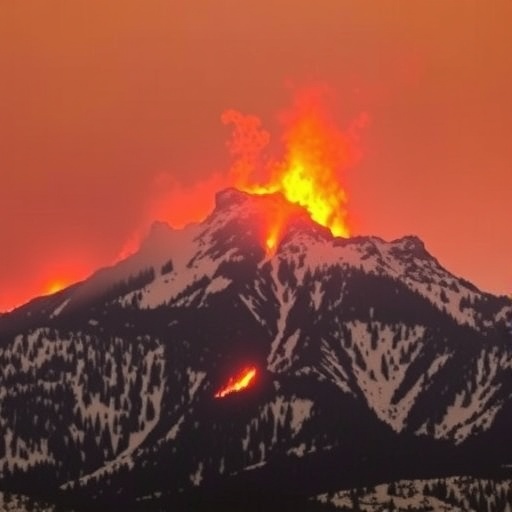
In recent years, the Rocky Mountain West has experienced a winter marked by extraordinary climatic conditions: record-breaking high temperatures coupled with historically low snowfall. This anomalous combination has not only altered water availability but has also added new dimensions to the looming wildfire threats expected in the forthcoming summer. Emerging research from Western Colorado University sheds light on the critical role of snowpack in influencing wildfire behavior, demonstrating that diminished snowpack can significantly exacerbate fire severity across western U.S. forests.
A team of researchers from Western’s acclaimed Clark School of Environment and Sustainability has rigorously analyzed 36 years of data spanning snowpack measurements and wildfire incident records. Their comprehensive meta-analysis reveals two interrelated but distinct patterns: firstly, early snowmelt precipitates an earlier onset of the wildfire season and increases the total area subjected to burning. Secondly, and perhaps more alarmingly, a low snow water equivalent (SWE)—which quantifies the volume of water stored in the snowpack—correlates with heightened fire severity, leading to greater tree mortality and irreversible impacts on ecosystem functions.
Dr. Jared Balik, the lead research scientist on this study, explains the fundamental significance of snowpack as a “seasonal water savings account” for forested landscapes. When snowpack volumes decline, the natural reservoir that sustains soil moisture into the growing season is depleted. This depletion causes soils to desiccate earlier than usual, vegetation to lose vital moisture, and forests to become critically vulnerable to intense wildfire events. The implications extend far beyond mere fire incidence, encompassing forest ecosystem health, biodiversity conservation, and long-term watershed resilience.
Previous studies established a link between rising temperatures, earlier snowmelt, and extended fire seasons. However, this new body of work advances understanding by emphasizing that reduced snow storage directly influences not only the timing but the destruction potential of wildfires. The researchers found consistent associations between years of low snowpack and elevated fire burn severity across multiple watersheds studied from 1985 through 2021. This correlation is particularly concerning given that, this year, nearly all western river basins are experiencing below-average snowpack levels.
The research focal points traverse some of the most ecologically and hydrologically critical watersheds in the southwestern United States, including the Rio Grande and Colorado River basins. In these areas, long-term snowpack losses are pronounced and have already led to tangible shifts in fire regimes and forest conditions. Such trends underscore an urgent need to reconceptualize forest fire risk assessments and mitigation strategies under shifting hydroclimatic regimes.
A salient aspect of the study highlights the influence of global climate oscillations—specifically the El Niño Southern Oscillation (ENSO) phenomena, comprising El Niño and La Niña phases. Regional variations in ENSO conditions modulate winter snowfall patterns and consequently dictate wildfire severity in subsequent seasons. While these climate patterns introduce interannual variability, the overarching trajectory remains dominated by anthropogenic warming, driving consistently reduced snowpack, earlier melts, and greater wildfire vulnerability.
One of the gravest concerns with increasing fire severity pertains to cascading ecological consequences. High-severity wildfires not only decimate tree cover but can trigger secondary disturbances such as post-fire flooding, debris flows, and soil erosion. Moreover, these disturbances increase the chances that forests will fail to regenerate adequately, possibly shifting biome compositions toward shrubland or grassland ecosystems. This potential biome conversion represents a profound transformation of western U.S. landscapes, with deep implications for carbon cycling, habitat structures, and regional climate feedbacks.
The research team recommends leveraging snowpack conditions as an early-warning indicator for fire severity risk, providing a critical tool for land managers and policymakers. By integrating real-time snowpack data into fire preparedness plans, forestry professionals can optimize thinning operations, prescribed burns, and allocation of firefighting resources. These proactive interventions can mitigate the impact of wildfires, preserving both human and ecological communities.
Dr. Jonathan Coop, a professor involved in the study, emphasizes that as snowpack declines persist, wildfire frequency and severity will rise commensurately. This understanding compels a paradigm shift in forest management—embracing active interventions such as prescribed burns to reduce the accumulation of combustible materials, thereby diminishing the intensity of inevitable wildfires.
Despite the alarming projections, there remains cautious optimism. Dr. Balik notes that the current situation is still early in the year, and a wetter spring season could replenish soil moisture reserves and snowpack, potentially offsetting some of the fire severity risks. Such seasonal variations underscore the importance of continuous monitoring and adaptability in wildfire risk assessment frameworks.
This transformative research not only enriches scientific understanding of the interconnectedness between snowpack dynamics and wildfire severity but also provides actionable insights for communities wrestling with increasingly severe wildfire regimes. The evidence presented obliges us to acknowledge the intimate relationship between winter climatic conditions and summer fire disasters, urging adaptive management strategies that account for imminent hydroclimatic changes.
For those interested in an in-depth exploration of the study, the full research paper is accessible via the Environmental Research Letters journal, providing detailed methodology, regional analyses, and comprehensive discussions on forest fire ecology in the context of snowpack trends.
Cite Scienmag News
Gavin Prescott. (March 25, 2026). Study Reveals Low Snowpack Fuels More Intense Wildfires in the West. Scienmag. https://scienmag.com/study-reveals-low-snowpack-fuels-more-intense-wildfires-in-the-west/
Gavin Prescott. "Study Reveals Low Snowpack Fuels More Intense Wildfires in the West." Scienmag, 25 March 2026, https://scienmag.com/study-reveals-low-snowpack-fuels-more-intense-wildfires-in-the-west/. Accessed 3 September 2026.
Gavin Prescott. "Study Reveals Low Snowpack Fuels More Intense Wildfires in the West." Scienmag. March 25, 2026. https://scienmag.com/study-reveals-low-snowpack-fuels-more-intense-wildfires-in-the-west/


