


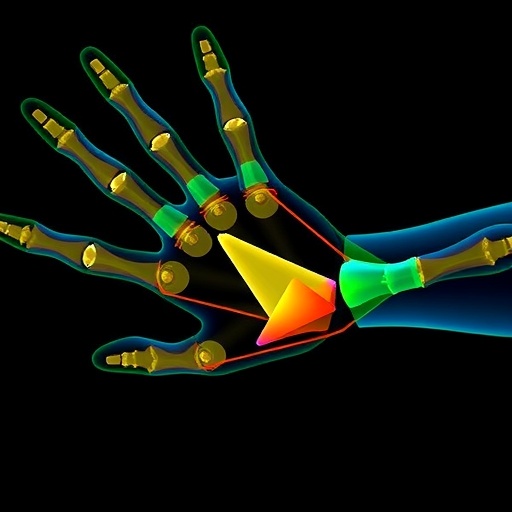
In a groundbreaking advancement poised to redefine human–machine interaction, researchers have unveiled a fully integrated, wireless, and wearable ultrasound imaging wristband capable of dynamically tracking the intricate movements of the human hand in real time. Unlike prior attempts reliant on cameras, inertial sensors, or electromyography (EMG), this novel device employs ultrasound imaging to capture detailed spatial data from the wrist, enabling continuous, high-fidelity monitoring of arbitrary hand configurations involving all five fingers along with the palm. This breakthrough could lead to transformative applications spanning spatial computing, virtual and augmented reality environments, advanced robotics, and prosthetics.
The human hand’s dexterity and versatility serve as fundamental resources for interacting with both the physical and virtual worlds. Capturing subtle hand motions during daily activities enables nuanced and intuitive control, boosting the efficacy of systems designed to augment human capabilities. Yet, traditional technologies—including vision-based systems, strain gauges, inertial measurement units (IMUs), and surface EMG—each suffer from inherent limitations that restrict their practical scope. Cameras, for example, often face constrained field-of-view challenges and occlusion problems, especially when hands move outside the sensor’s line of sight or adopt unusual poses. Meanwhile, strain and inertial sensors depend on fixed placement and can only handle limited gestures, while EMG sensors provide discrete signals that seldom translate into continuous and robust tracking of complex hand postures.
The research team, led by Lu et al., introduces a wearable wristband embedding an ultrasound transducer array that, in concert with a sophisticated artificial intelligence (AI) algorithm, continuously monitors internal muscle and tendon movements beneath the skin. This real-time imaging approach circumvents many of the shortcomings characteristic of other modalities. By capturing volumetric ultrasound data with high temporal resolution, the wristband reconstructs dynamic hand configurations as users freely perform everyday activities without constraints or unnatural positioning. This design eliminates dependency on optical line-of-sight and mitigates the noise issues that often plague EMG or inertial sensor readings.
One of the most remarkable achievements of this technology lies in its low latency: the system processes and updates hand positioning information within less than 120 milliseconds, enabling fluid interaction that approaches natural hand motion speed. This rapid feedback loop is essential for seamless user experiences, particularly in applications like virtual reality (VR) where timing and accuracy significantly impact immersion and usability. The wristband’s wireless architecture further promotes ergonomics and user convenience, allowing untethered activity without compromising signal integrity.
The researchers showcase the wristband’s versatility by integrating it into multiple demonstration scenarios, including controlling virtual environments and operating robotic hands. Within VR, the device enables users to manipulate digital objects, select interface elements, or perform complex gestures with precision and immediacy, reshaping how immersive experiences can adapt to human intent. For robotics, the wristband facilitates intuitive teleoperation: motor functions of a robotic hand mirror the wearer’s natural movements, offering new possibilities for remote manipulation in hazardous or inaccessible environments. Such synergy between wearable ultrasound sensing and AI-driven interpretation paves the way for advanced prosthetics that respond organically to the user’s thoughts and physical commands.
Underpinning this technological progress is the AI model that interprets the substantial and complex ultrasound data stream generated by the wristband. Through intensive training on vast datasets encapsulating myriad hand postures and dynamic patterns, the algorithm learns to map ultrasound signals to corresponding finger and palm positions with great fidelity. This model generalizes well even with inter-user variability and slight positional shifts of the wristband itself, addressing challenges of robustness and adaptability that often constrain wearable sensor solutions.
The use of ultrasound imaging as a non-invasive, safe, and comparatively low-cost modality provides an attractive alternative to more cumbersome or intrusive methods. Unlike cameras sensitive to lighting and visibility, or electrodes prone to skin impedance issues, ultrasound probes tissues directly beneath the skin, offering rich biomechanical insights impervious to external visual obstructs. Moreover, the device’s compact and wearable form factor integrates seamlessly into daily life, encouraging continuous usage without discomfort or interruption.
A further dimension of this innovation is its potential impact on the burgeoning field of spatial computing—the merger of physical and digital realms into a coherent, interactive landscape. Accurate hand tracking forms the backbone of user interfaces in this domain, enabling natural gesture-based controls that eliminate traditional hardware barriers like controllers or keyboards. By delivering real-time, reliable data on subtle finger articulations, the wristband could catalyze next-generation software experiences that respond intelligently and fluidly to human motion.
The implications for prosthetics are similarly profound. Current prosthetic hands often suffer from limited dexterity or require cumbersome calibration, impairing user satisfaction and functionality. With wearable ultrasound sensing, prosthetic devices could receive continuous, intuitive input correlated directly to residual muscle activity or intended finger movements, restoring a spectrum of nuanced manual capabilities. This advancement promises improved quality of life for amputees and individuals with motor impairments, reinforcing the symbiosis of biomedicine and machine learning.
Robotic applications extend beyond teleoperation to autonomous systems designed for fine manipulation tasks. By integrating ultrasound-based hand tracking data, robots can better understand human intent and cooperate more naturally within collaborative workspaces. Such enhanced human–robot interaction frameworks may revolutionize manufacturing, surgery, logistics, and more, where dexterity plays a critical role.
Despite its transformative potential, deploying ultrasound sensing for continuous hand tracking presents technical hurdles, including hardware miniaturization, power efficiency, and signal interpretation complexity. The research team’s success in embedding a multilayer transducer array along with onboard processing unit within a compact wristband addresses these concerns pragmatically. Additionally, AI-driven reconstruction of hand poses from high-dimensional ultrasound input demands computationally efficient algorithms optimized for embedded systems, underscoring advances in machine learning architectures as crucial enablers.
Looking forward, integrating this technology into consumer-grade wearable devices presents exciting challenges and opportunities. Mass production, cost reduction, and further refinement could usher in ubiquitous hand tracking wearables, transforming interface design paradigms across entertainment, health care, robotics, and beyond. Furthermore, combining ultrasound data with complementary sensing modalities like inertial measurement and bioelectrical signals may enhance robustness and versatility.
This pioneering research by Lu and colleagues exemplifies the convergence of biomedical engineering, artificial intelligence, and human–computer interaction. By leveraging wrist-worn ultrasound imaging for continuous, real-time hand tracking, it addresses longstanding limitations in gestural sensing, opening new frontiers for interactive technologies that resonate intuitively with human motor capabilities. The measured latency below 120 milliseconds and capability to capture arbitrary five-finger configurations mark a critical leap toward truly seamless, wearable spatial computing.
As virtual and augmented reality experiences increasingly permeate entertainment, education, and professional settings, tools that empower users to manipulate virtual objects naturally will be in high demand. This wristband stands as a harbinger of a future where human intention translates effortlessly into digital action. Likewise, the robust robotic teleoperation afforded by this development holds promise for remote manipulation in hazardous environments, enhancing safety and precision.
In summary, the introduction of a wearable ultrasound imaging device for hand tracking represents a major leap forward in enabling continuous, accurate, and latency-minimized monitoring of complex hand movements. Its wireless, ergonomic design, coupled with powerful AI-driven interpretation, transcends the limitations of older sensing techniques, providing a versatile platform adaptable to diverse applications. Given the human hand’s pivotal role in interaction, control, and communication, this innovation promises profound ripple effects across spatial computing, prosthetics, robotics, and human–machine interfaces for years to come.
Cite Scienmag News
Denise Maddox. (March 25, 2026). Wrist Imaging Revolutionizes Hand Tracking Technology. Scienmag. https://scienmag.com/wrist-imaging-revolutionizes-hand-tracking-technology/
Denise Maddox. "Wrist Imaging Revolutionizes Hand Tracking Technology." Scienmag, 25 March 2026, https://scienmag.com/wrist-imaging-revolutionizes-hand-tracking-technology/. Accessed 4 September 2026.
Denise Maddox. "Wrist Imaging Revolutionizes Hand Tracking Technology." Scienmag. March 25, 2026. https://scienmag.com/wrist-imaging-revolutionizes-hand-tracking-technology/


