


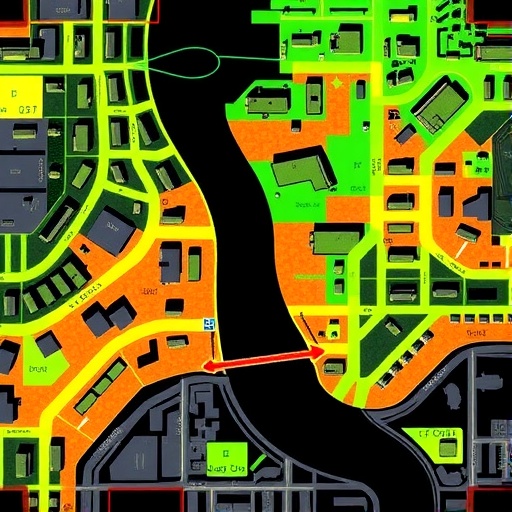
In an era where urban soundscapes are increasingly scrutinized for their impact on health and quality of life, a pioneering study has emerged proposing a sophisticated methodology to model the acoustic environment of cities. This novel approach combines the intricate analysis of land use patterns with the power of gradient boosting machine learning algorithms, promising groundbreaking advancements in the precision and utility of urban noise mapping. The study, led by researchers Haselhoff, Moebus, and Jedrusiak, lays the foundation for more effective urban planning and public health strategies, leveraging computational intelligence to decode the complex urban acoustic fabric.
City dwellers are persistently exposed to a plethora of sound sources—ranging from traffic to construction, recreational activities to industrial noise—which amalgamate to form unique auditory environments. Consequently, accurately capturing and predicting these sound environments is crucial for mitigating negative health implications including stress, cardiovascular diseases, and auditory impairments. Traditional acoustic modeling approaches often rely on simplistic noise propagation models which inadequately account for the heterogeneous and dynamic nature of urban landscapes. The recent study addresses this gap by integrating detailed land use data into a machine learning framework, specifically employing gradient boosting techniques, to elevate the modeling fidelity of urban noise distributions.
Gradient boosting, a state-of-the-art ensemble learning method, iteratively refines predictive performance by focusing on data points misrepresented by previous model iterations. When applied to land use data—which encapsulates detailed categorizations such as residential zones, commercial districts, green spaces, and industrial areas—this method excels at capturing nonlinear relationships and complex interactions that dictate urban acoustic profiles. By training the model on vast datasets encompassing myriad land use types in conjunction with measured acoustic levels, the researchers have unlocked new predictive capabilities unmatched by conventional, physics-based noise models.
One remarkable aspect of the study lies in the granularity and scope of the employed datasets. The researchers collated high-resolution geospatial land cover information alongside meticulously gathered in-situ acoustic measurements, ensuring the model was both data-rich and contextually anchored. This comprehensive approach allowed the model to discern subtle yet significant variations in noise levels attributable not merely to the physical presence of noise sources but also to their interplay with environmental characteristics such as vegetation density, building configuration, and land cover heterogeneity. The fusion of big data and machine learning, therefore, facilitated a holistic understanding of urban sound propagation.
The implications of accurately modeling soundscapes extend far beyond academic curiosity. Urban planners and policymakers can harness these advanced predictive models to identify noise hotspots and evaluate the potential impact of developmental projects before implementation. For instance, the model can simulate how introducing a new commercial complex or modifying green spaces might influence surrounding noise levels, enabling informed decisions that prioritize both economic growth and public welfare. This capability to forecast sound environment changes with high precision introduces a paradigm shift in urban development practices focused on creating healthier, more livable cities.
Notably, the model’s adaptability to diverse urban contexts stands as one of its most important features. The study demonstrates that, with appropriate data inputs, the gradient boosting framework remains robust across different city typologies, scales, and cultural settings. This generalizability encourages wide application, from densely populated megacities grappling with chronic noise pollution to emerging urban centers seeking sustainable growth trajectories. As a consequence, the research establishes a universal tool that, when properly calibrated, can serve cross-continental environmental assessment and planning needs.
Alongside predictive accuracy, the interpretability of the model’s output remains a central concern, particularly for stakeholders without extensive technical expertise. Fortunately, the researchers have incorporated mechanisms to extract feature importance metrics and decision pathways within the gradient boosting framework. These insights elucidate which land cover variables and configurations most significantly influence noise levels, empowering urban planners with actionable intelligence rather than inscrutable black-box predictions. Such transparency is critical in building trust and facilitating the translation of model results into policy and design interventions.
Beyond urban planning, the health implications of modeling the acoustic environment accurately are profound. Epidemiologists and public health officials can leverage these predictive noise maps to correlate noise exposure with health outcomes more precisely, thus strengthening causal inferences and tailoring interventions. Enhanced exposure assessments can improve the targeting of noise mitigation efforts, maximizing their effectiveness and cost-efficiency. Furthermore, such detailed models could inform urban acoustic regulations by providing scientifically grounded thresholds and zoning recommendations based on empirical data rather than outdated heuristic standards.
Underpinning this research is an interdisciplinary fusion of expertise, combining environmental science, geospatial analytics, machine learning, and public health. The integrative approach demonstrates the power of collaborative science when addressing complex urban challenges. It also sheds light on the evolving role of artificial intelligence in environmental monitoring—transitioning from purely observational roles to prescriptive tools that can dynamically inform and optimize human decisions impacting urban ecosystems.
The study’s success also invites reflections on future research directions. Integrating temporal dynamics, such as diurnal and seasonal variations in noise patterns, into the gradient boosting framework could further enhance predictive power and application scope. Additionally, exploring synergistic modeling that incorporates social behavior, traffic patterns, and meteorological variables might yield even more nuanced insights into the urban acoustic ecology. This trajectory heralds a new frontier in acoustic environment modeling, where multidisciplinary data streams converge via advanced computation to capture the vibrancy and complexity of city life.
Ethical considerations surrounding data privacy and algorithmic fairness also come to the fore with the deployment of such detailed urban models. While the study does not directly address these matters, the researchers advocate for transparent data governance and community engagement to ensure that modeling efforts benefit all city residents equitably. By fostering inclusivity and accountability, future implementations of this technology can avoid exacerbating existing urban inequalities linked to environmental exposure disparities.
Technologically, the study equips urban stakeholders with a potent decision-support tool that balances computational intensity with practical usability. Gradient boosting models, while computationally intensive, have matured through software optimizations and cloud computing accessibility, enabling their deployment in real-world settings beyond research labs. This democratization of advanced analytics is pivotal in bridging the gap between scientific innovation and tangible societal impact, facilitating proactive urban noise management strategies that resonate with contemporary sustainability goals.
Moreover, this research underscores a broader trend towards exploiting land use data’s potential beyond traditional urban analysis. As cities increasingly digitize and collect multifaceted spatial data, harnessing these resources through machine learning unlocks an array of novel environmental applications. From air quality monitoring to heat island mitigation, the convergence of geospatial intelligence and algorithmic modeling defined by this study exemplifies the future direction of smart, resilient urban ecosystems.
In summary, Haselhoff and colleagues have positioned their work on urban acoustic environment modeling at the cutting-edge intersection of environmental science and artificial intelligence. By judiciously leveraging land use-based gradient boosting methods, they offer a robust, interpretable, and universally applicable framework for understanding and managing urban soundscapes. As cities worldwide grapple with the challenges posed by noise pollution amid rapid urban expansion, such technological advances promise to enhance public health, urban livability, and sustainability in profound and lasting ways.
Cite Scienmag News
Ophelia Keating. (March 25, 2026). Mapping Urban Soundscapes with Land Use Gradient Boosting. Scienmag. https://scienmag.com/mapping-urban-soundscapes-with-land-use-gradient-boosting/
Ophelia Keating. "Mapping Urban Soundscapes with Land Use Gradient Boosting." Scienmag, 25 March 2026, https://scienmag.com/mapping-urban-soundscapes-with-land-use-gradient-boosting/. Accessed 3 September 2026.
Ophelia Keating. "Mapping Urban Soundscapes with Land Use Gradient Boosting." Scienmag. March 25, 2026. https://scienmag.com/mapping-urban-soundscapes-with-land-use-gradient-boosting/


