


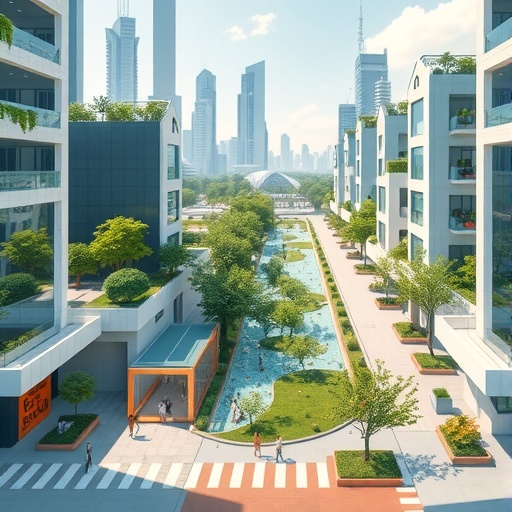
In a groundbreaking study set to redefine the trajectory of urban development, researchers Tong, Wang, Wang, and their colleagues have unveiled a sophisticated multi-agent recommendation system that marries the principles of urban theory with cutting-edge artificial intelligence. Their work, published in the prestigious journal npj Urban Sustainability in 2026, heralds a new era where sustainable city development is no longer a distant ideal but an achievable, data-driven reality. This fusion of disciplines brings profound implications for policymakers, city planners, and technologists alike, setting the stage for smarter, more adaptive urban environments worldwide.
The challenges facing modern cities are multifaceted and complex, ranging from rapid population growth to environmental degradation and strained infrastructure. Traditional urban planning methodologies, while foundational, often struggle to cope with the dynamic, interconnected nature of contemporary urban ecosystems. This research addresses these limitations by employing a multi-agent system, where numerous artificial intelligence agents operate concurrently, each simulating various facets of urban life and governance. This framework allows for robust modeling and scenario testing, providing nuanced recommendations that prioritize sustainability without compromising urban functionality.
At the core of this system lies an innovative AI architecture designed to interpret and apply urban theoretical concepts in real-world contexts. The researchers implemented heterogeneous agents, each specialized in domains such as transportation, energy management, waste reduction, and social equity. By combining their insights through a collaborative decision-making process, the system transcends single-issue optimization. Instead, it delivers holistic recommendations that reflect the intricate interdependencies that characterize sustainable urban growth.
One of the technical hallmarks of this study is the integration of reinforcement learning algorithms within each agent. These algorithms empower agents to continuously learn from environmental feedback and adapt their strategies accordingly. This dynamic learning capability ensures that the recommendation system remains relevant over time, capable of adjusting to new data inputs such as demographic shifts, climate variables, or policy changes. Consequently, urban planners are equipped with an evolving decision-support tool rather than a static prescriptive model.
The system’s application is demonstrated through a series of simulations based on real-world data drawn from rapidly expanding metropolitan areas. By simulating different intervention scenarios—ranging from modifying public transit routes to optimizing green space allocation—the multi-agent framework illustrates its capacity to predict potential outcomes with remarkable accuracy. These simulations also underscore the importance of balancing economic growth with environmental stewardship and social inclusion, reinforcing the necessity of comprehensive strategies in urban planning.
Importantly, the study highlights the role of inter-agent communication protocols that coordinate the diverse agents’ efforts. These protocols employ consensus-building mechanisms that reconcile competing objectives, such as economic development versus carbon footprint reduction, without privileging one at the expense of another. This balance is crucial to fostering sustainable cities that are resilient, inclusive, and economically vibrant, reflecting a sophisticated understanding of trade-offs inherent in urban policy decisions.
The multi-agent recommendation system also incorporates explainability features, a critical factor for adoption by human stakeholders. By providing transparent rationale behind its recommendations, the system mitigates the black-box issues that often accompany AI-driven tools. Urban policymakers can thus engage more confidently with the AI outputs, scrutinizing and validating suggested interventions before implementation—an essential step in bridging the gap between AI-generated insights and actionable urban strategies.
A pivotal innovation in the system is its capacity to integrate diverse data sources with varying temporal and spatial resolutions. From satellite imagery to socioeconomic statistics and real-time sensor data across the urban fabric, this data fusion capability enhances the granularity and reliability of the system’s recommendations. Such comprehensive data integration ensures that the tool can accommodate both macro-level policy frameworks and micro-level interventions, adapting its advice to the specific scale of the planning challenge.
The interdisciplinary nature of the research team is evident in the design philosophy of the system. Urban theorists contributed conceptual frameworks defining the sustainability dimensions, while AI specialists developed the technical backbone enabling complex multi-agent interactions. This collaboration epitomizes the emerging paradigm in urban studies where technological innovation and social science insights synergize to confront urbanization’s pressing challenges effectively.
Beyond theoretical and methodological contributions, the study provides practical guidelines for deploying such AI-driven recommendation systems in real-world city planning contexts. These guidelines address challenges like data privacy, ethical considerations in automated decision-making, and the importance of stakeholder engagement. The researchers emphasize that technology must augment rather than replace human judgment, advocating for collaborative governance models where AI acts as an intelligent partner in participatory urban planning processes.
The implications of this research extend beyond sustainability itself, offering pathways toward ‘smart cities’ that leverage real-time data analytics, predictive modeling, and adaptive policy formulation. The integration of multi-agent AI recommendation platforms represents a tangible step toward cities that not only respond to current needs but proactively anticipate future scenarios—whether related to climate resilience, economic shifts, or demographic transformations.
Critically, the research also tackles the scalability challenges inherent in urban AI applications. Their modular system design allows for incremental expansion and customization tailored to city-specific characteristics. This flexible architecture means that smaller municipalities with limited resources can adopt simplified versions, while megacities can harness the full spectrum of capabilities to navigate their complex socio-environmental landscapes.
Looking forward, the study identifies avenues for further enhancement, including incorporating emerging AI paradigms such as explainable neural-symbolic reasoning and integrating citizen-generated data streams for more democratized and participatory urban planning. The authors also foresee potential integration with autonomous infrastructure management systems, creating feedback loops that tighten the connection between planning, implementation, and monitoring.
In sum, Tong and colleagues’ work represents a vital milestone demonstrating that advanced AI methodologies can concretely contribute to overcoming the persistent challenges of sustainable city development. By bridging the theoretical and technological divides, their multi-agent recommendation system offers a compelling blueprint for future urban planning that is smarter, more responsive, and fundamentally aligned with the sustainability imperatives of the 21st century.
This research marks not just a technical achievement but a beacon illustrating the transformative potential of interdisciplinary collaboration in shaping cities that are resilient, equitable, and thriving—testaments to the power of intelligent systems when deployed thoughtfully and ethically in service of humanity’s urban future.
Cite Scienmag News
Courtney Benton. (March 25, 2026). AI-Driven Multi-Agent System Fuels Sustainable Cities. Scienmag. https://scienmag.com/ai-driven-multi-agent-system-fuels-sustainable-cities/
Courtney Benton. "AI-Driven Multi-Agent System Fuels Sustainable Cities." Scienmag, 25 March 2026, https://scienmag.com/ai-driven-multi-agent-system-fuels-sustainable-cities/. Accessed 3 September 2026.
Courtney Benton. "AI-Driven Multi-Agent System Fuels Sustainable Cities." Scienmag. March 25, 2026. https://scienmag.com/ai-driven-multi-agent-system-fuels-sustainable-cities/


