


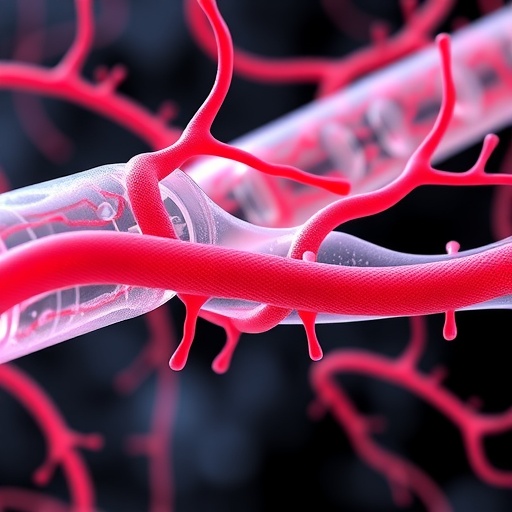
In a groundbreaking advancement that could redefine the future of cardiovascular surgery, a team of researchers led by Cheng, Zhi, and Midgley has introduced reinforced biotubes as a transformative approach to vascular grafting. Published in Nature Communications in 2026, their research meticulously details the development and clinical potential of these biotubes, designed to overcome the persistent challenges of conventional vascular grafts. As cardiovascular diseases remain the leading cause of death worldwide, innovations that can simplify and improve vascular replacement therapies are critically needed, making this work both timely and revolutionary.
At the heart of the study is the concept of “reinforced biotubes” — bioengineered vascular conduits derived from living cells and extracellular matrices, yet mechanically strengthened to withstand physiological pressures and stresses. Traditional vascular grafts, whether autografts, allografts, or synthetic materials, exhibit limitations including poor availability, immune rejection, thrombogenicity, and insufficient long-term durability. The reinforced biotubes developed by the authors present a promising solution that integrates the biological functionality of natural vessels with the structural robustness required for implantation.
The researchers embarked on a multi-dimensional strategy, beginning with the biofabrication of cell-laden tubular structures using biocompatible scaffolds. Leveraging state-of-the-art tissue engineering techniques, they seeded vascular smooth muscle cells and endothelial progenitors onto biodegradable polymeric frameworks, then cultivated these constructs within dynamic bioreactor systems that mimic physiological mechanical forces. This cultivation period proved critical for promoting cellular organization, extracellular matrix deposition, and initial biomechanical integrity.
What distinguishes these reinforced biotubes from earlier iterations is the implementation of a novel reinforcement methodology. The team incorporated aligned nanofibrous layers generated through electrospinning, which were intricately integrated with the living tissue matrix. This reinforcement not only enhanced tensile strength but also imparted elasticity and compliance that closely matched native arteries. This biomimetic mechanical profile is essential for graft patency and long-term function, as mismatched vessel compliance can lead to turbulent flow, intimal hyperplasia, and graft failure.
To evaluate performance, extensive in vitro mechanical testing was undertaken, simulating physiological pressures and pulse frequencies. The reinforced biotubes demonstrated burst pressures exceeding those of human saphenous veins by a significant margin, alongside favorable suture retention and fatigue resistance. Importantly, endothelial cell lining remained intact after mechanical loading cycles, indicating preservation of a functional anti-thrombogenic surface critical for graft success.
Moving beyond bench-top analysis, the team conducted preclinical animal studies using well-established small and large animal models. Implanted as arterial substitutes, the reinforced biotubes exhibited rapid endothelialization, reduced inflammatory response, and remarkable integration with host tissues. Over extended follow-ups, no signs of aneurysm formation, stenosis, or thrombosis were observed. These outcomes underscore the regenerative capabilities of the biotubes, as they serve not merely as passive conduits but as living implants capable of remodeling and adapting within the vascular system.
A particularly innovative aspect of the study is the biotubes’ readiness for “off-the-shelf” availability. Unlike autologous grafts that require harvesting from the patient, involving additional surgery and delay, these grafts can be manufactured, stored, and distributed widely. The researchers devised preservation protocols ensuring cell viability and matrix integrity during cryopreservation. This feature has the potential to drastically reduce surgical preparation time and accessibility hurdles, especially in emergency or resource-limited settings.
The translational impact of this technology is multifaceted. Cardiologists, vascular surgeons, and patients could soon benefit from grafts that not only replace damaged vessels efficiently but actively contribute to vascular regeneration, reducing the need for repeated interventions. Moreover, the adaptability of the biotube fabrication process suggests that customized grafts tailored to patient-specific anatomy and pathology could become feasible, pushing the envelope towards personalized vascular medicine.
In dissecting the biological functionality, the study also sheds light on the molecular interactions at the interface of the graft and host environment. The researchers employed advanced imaging and histological analyses to demonstrate the seamless integration of host endothelial cells migrating onto the graft surface, facilitated by biochemical cues embedded within the extracellular matrix. This dynamic crosstalk is pivotal in maintaining graft patency and preventing adverse remodeling phenomena that plague synthetic grafts.
The team did not overlook the immunological implications, thoughtfully incorporating immunomodulatory strategies into their design. By utilizing allogeneic cells with low immunogenic profiles and employing surface modification techniques to reduce antigenicity, they achieved markedly subdued immune activation post-implantation. This immunoprivileged environment promotes graft tolerance and longevity, obviating the need for long-term immunosuppression often associated with organ transplants.
From an engineering perspective, the manufacturing pipeline demonstrates scalability and reproducibility, attributes essential for clinical translation. The integration of automated bioreactors, quality control checkpoints, and modular reinforcement technologies signals the capacity of this approach to meet regulatory standards and mass production demands while preserving the nuanced biological functions inherent in the biotubes.
This work also opens exciting avenues for future research, including potential applications beyond vascular grafting. The principles of reinforced biotube fabrication could be adapted for other tubular organs, such as tracheae, ureters, or bile ducts, where similar biomechanical and biological demands exist. Furthermore, combining this platform with gene editing or drug delivery capabilities could yield multifunctional grafts capable of not just structural support but active therapeutic functions.
The societal implications of widely available regenerative vascular grafts could be profound. Millions of patients worldwide suffer from peripheral artery disease, coronary artery occlusions, and aneurysms that necessitate vascular reconstruction. Current surgical options are limited by graft availability and associated complications, but reinforced biotubes could reduce healthcare costs, minimize surgical risks, and improve postoperative outcomes on a global scale.
In essence, this landmark study by Cheng, Zhi, Midgley, and colleagues marks a significant leap forward in regenerative medicine. Their reinforced biotubes elegantly merge biology and engineering to create next-generation vascular grafts that are biologically active, mechanically robust, and readily accessible. This innovation not only addresses longstanding challenges in vascular surgery but also exemplifies the transformative potential of biofabrication technologies.
As cardiovascular diseases continue to impose an enormous health burden, such pioneering solutions may well herald a new era where tissue-engineered constructs become standard tools in clinical practice. The reinforced biotubes embody a convergence of scientific insight, technological prowess, and clinical vision, illustrating the power of interdisciplinary collaboration to solve some of medicine’s most intractable problems.
Time will tell how quickly this technology moves from preclinical promise to widespread clinical adoption, but the foundational work laid by this team provides an inspiring blueprint. Ongoing clinical trials, regulatory approvals, and further optimization will be crucial next steps, yet the horizon looks notably brighter for patients requiring vascular reconstruction.
Ultimately, the study not only contributes a novel biomaterial platform but also pushes the boundaries of what is possible in regenerative therapies. Reinforced biotubes epitomize a future where synthetic and biological realms harmonize to restore function, heal injury, and enhance quality of life — a true milestone in the journey toward regenerative cardiovascular medicine.
Cheng, Q., Zhi, D., Midgley, A.C. et al. Reinforced biotubes as readily available and regenerative vascular grafts.
Nat Commun (2026). https://doi.org/10.1038/s41467-026-70799-0
Cite Scienmag News
Ophelia Keating. (March 23, 2026). Reinforced Biotubes: Readily Available Regenerative Vascular Grafts. Scienmag. https://scienmag.com/reinforced-biotubes-readily-available-regenerative-vascular-grafts/
Ophelia Keating. "Reinforced Biotubes: Readily Available Regenerative Vascular Grafts." Scienmag, 23 March 2026, https://scienmag.com/reinforced-biotubes-readily-available-regenerative-vascular-grafts/. Accessed 3 September 2026.
Ophelia Keating. "Reinforced Biotubes: Readily Available Regenerative Vascular Grafts." Scienmag. March 23, 2026. https://scienmag.com/reinforced-biotubes-readily-available-regenerative-vascular-grafts/


