


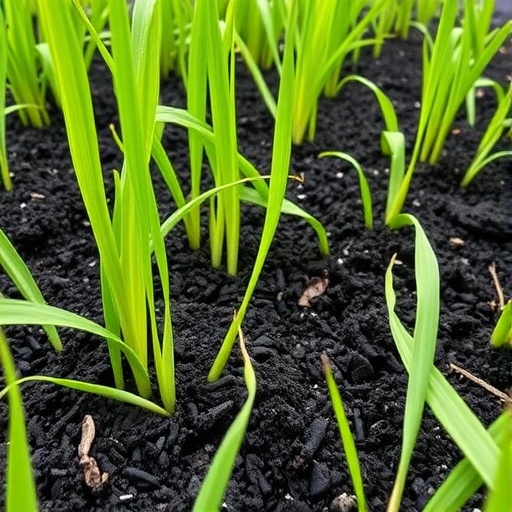
In recent years, the contamination of agricultural soils with toxic heavy metals has emerged as a critical challenge to global food safety and environmental health. Among these pollutants, cadmium (Cd) poses a significant threat due to its high mobility in soil and propensity for accumulation in staple crops like rice, which forms a dietary cornerstone for over half of the world’s population. Addressing cadmium contamination while simultaneously enhancing crop yield is a formidable task. However, innovative research now unveils a promising approach leveraging micro- to nanoscale bone char derived from animal bone waste, showing substantial reductions in cadmium uptake by rice coupled with notable yield improvements.
Cadmium enters agricultural ecosystems primarily through anthropogenic inputs such as phosphate fertilizers, industrial emissions, and sewage sludge application. Once introduced, cadmium’s bioavailability in soil becomes a key determinant of its uptake into plant tissues. Rice, in particular, possesses physiological and molecular mechanisms that facilitate cadmium accumulation, creating pronounced health risks upon consumption. Mitigating cadmium bioavailability without compromising nutrient availability or soil health thus remains a paramount goal for sustainable agriculture.
Addressing this challenge, a multidisciplinary team of scientists developed a novel soil amendment from pork bone waste, processed into micro- and nanoscale biochar particles through controlled pyrolysis and mechanical milling. This process results in a highly reactive bone char with extensive surface area, abundant active functional groups, and substantial adsorption capacity. Unlike conventional biochars, this micro-nano bone char uniquely couples physicochemical properties adept at sequestering cadmium ions with the capacity to modulate soil nutrient dynamics, making it an ideal candidate for dual-function soil remediation and fertility enhancement.
Over a full 140-day rice growth cycle conducted in greenhouse conditions employing cadmium-contaminated soil, the researchers meticulously tracked agronomic metrics alongside soil chemistry and microbial community dynamics. The amendment’s impact was profound: rice grain yield increased nearly fifty percent in treated pots, accompanied by a rise exceeding twenty percent in productive tiller counts. These yield gains emerged simultaneously with a dramatic reduction in cadmium concentration in polished rice grains—up to 68% lower than untreated controls—significantly diminishing health risks associated with rice consumption.
The underlying mechanisms of this remediation strategy are multifaceted. Primarily, the micro-nano bone char adsorbs cadmium ions in the soil matrix, drastically reducing their bioavailability and thus limiting root uptake. The amendment also induces a noticeable increase in soil pH, which further immobilizes cadmium by precipitating less soluble metal complexes. Additionally, the bone char enriches phosphorus availability—a critical macronutrient for rice growth—by releasing phosphate groups integrated within its porous structure, thereby supporting enhanced plant nutrition and vigor.
Intriguingly, metagenomic analyses revealed that the introduction of this amendment reshapes the rhizosphere microbial ecosystem. Populations of beneficial microbes linked to carbon, nitrogen, and phosphorus cycling expanded significantly, fostering a more robust nutrient turnover. Moreover, functional genes associated with phosphorus solubilization and bioavailability were markedly upregulated, signaling enhanced microbial facilitation of nutrient acquisition. These biological shifts likely underpin the improved nutrient status of treated plants and contribute to the observed growth and yield enhancements.
At the metabolic level, treated rice grains exhibited altered biochemical profiles, particularly in carbohydrate and amino acid metabolism. The amendment appeared to slow the decomposition of key carbohydrates and amino acids, which could translate into improved grain nutritional quality. This metabolic modification hints at systemic physiological effects induced by soil amendment, extending beyond mere pollutant sequestration to overall enhancement of grain composition and potentially, consumer health benefits.
Sustainability is a cornerstone of this innovation. The raw material—animal bone waste—is an abundant byproduct of the agricultural and food industries, typically discarded and underutilized. Transforming this biomass into a valuable soil amendment exemplifies circular economy principles, reducing waste streams and generating high-value products that address environmental and agricultural challenges simultaneously. This valorization of waste aligns with broader goals of resource efficiency and sustainable food production.
Economic considerations also favor this strategy. Preliminary cost-benefit analyses indicate that while the production and application of micro-nano bone char carry associated expenditures, the resultant yield increases and mitigation of cadmium-contaminated grains offer substantial net economic gains for farmers. Reduced contamination also lowers health risks and potential regulatory burdens, creating an attractive value proposition for stakeholders in agricultural supply chains.
This cutting-edge research underscores the power of integrating waste recycling, nanotechnology, and microbial ecology in developing next-generation soil remediation tools. By addressing cadmium contamination while enhancing nutrient cycling and crop productivity, micro-nano bone char presents a viable, scalable solution toward safer and more sustainable rice production systems worldwide. Future studies targeting field-scale validation and optimization will be critical to translating these promising results into practical agricultural applications.
Ultimately, this work exemplifies a paradigm shift in soil remediation, moving from solely contaminant removal toward multifunctional amendments that simultaneously restore soil health and boost crop quality. Such innovations are vital as the planet confronts increasing food demands, environmental pollution, and the need for resilient agroecosystems. The convergence of nanomaterials, biochar science, and microbial functional genomics opens new frontiers to safeguard both human health and global food security.
As cadmium contamination remains a pervasive hazard, the development of micro-nanoscale bone char represents a hopeful breakthrough. This approach not only offers an effective mitigation strategy but also fosters value creation from waste, supporting circular bioeconomy models. By harnessing natural materials and processes at the micro- and nanoscale, agriculture can progress toward sustainability benchmarks while meeting the nutritional needs of billions.
The success of this innovative biochar amendment lays the groundwork for transformative agricultural practices. Further interdisciplinary collaborations combining soil chemistry, plant physiology, microbiology, and nanotechnology hold the promise to enhance crop safety, productivity, and ecosystem health on a global scale. This research marks a significant stride toward resilient and sustainable food systems of the future.
News Publication Date: 9-Feb-2026
Web References: http://dx.doi.org/10.1007/s42773-025-00548-x
References: Liang, A., Hao, Y., Cai, Z. et al. Micro-nanoscale bone char alters Cd accumulation and rhizosphere functional genes to enhance rice yield and quality. Biochar 8, 45 (2026).
Cite Scienmag News
Alan Morgan. (March 20, 2026). Transforming Waste into Innovation: Micro-Nano Bone Biochar Enhances Rice Yield and Reduces Toxic Cadmium. Scienmag. https://scienmag.com/transforming-waste-into-innovation-micro-nano-bone-biochar-enhances-rice-yield-and-reduces-toxic-cadmium/
Alan Morgan. "Transforming Waste into Innovation: Micro-Nano Bone Biochar Enhances Rice Yield and Reduces Toxic Cadmium." Scienmag, 20 March 2026, https://scienmag.com/transforming-waste-into-innovation-micro-nano-bone-biochar-enhances-rice-yield-and-reduces-toxic-cadmium/. Accessed 6 September 2026.
Alan Morgan. "Transforming Waste into Innovation: Micro-Nano Bone Biochar Enhances Rice Yield and Reduces Toxic Cadmium." Scienmag. March 20, 2026. https://scienmag.com/transforming-waste-into-innovation-micro-nano-bone-biochar-enhances-rice-yield-and-reduces-toxic-cadmium/


