


In a groundbreaking leap for biomimetic technology, researchers from The Hong Kong Polytechnic University (PolyU), alongside collaborators at the City University of Hong Kong and Huazhong University of Science and Technology, have unveiled a fascinating mechanoelectrical perception mechanism embedded within the skeletal structure of sea urchin spines. This discovery not only challenges long-held assumptions about the passive defensive role of these spines but also opens doors to next-generation sensor technologies rooted in natural design principles. The research, spearheaded by Prof. WANG Zuankai—Associate Vice President (Research and Innovation) and Chair Professor of Mechanical Engineering at PolyU—delves into the unique gradient porous architecture within the spines, illuminating how it translates mechanical stimuli into electrical signals with remarkable sensitivity and immediacy.
At the heart of this investigation lies the long-spined sea urchin (Diadema setosum), whose defensive spines serve a dual purpose: protection and sensory detection. The team observed that when a seawater droplet impacts the spine tip, a rapid rotational response occurs within a second. Further electrochemical measurements revealed that this mechanical interaction generates an electric potential approximating 100 millivolts. Moreover, when subjected to sustained water flow, the spines produce voltages of several tens of millivolts, signifying a consistent mechanoelectrical response. Notably, this phenomenon persists even in non-living spines, thereby suggesting that the underlying mechanism is structurally inherent rather than biologically driven.
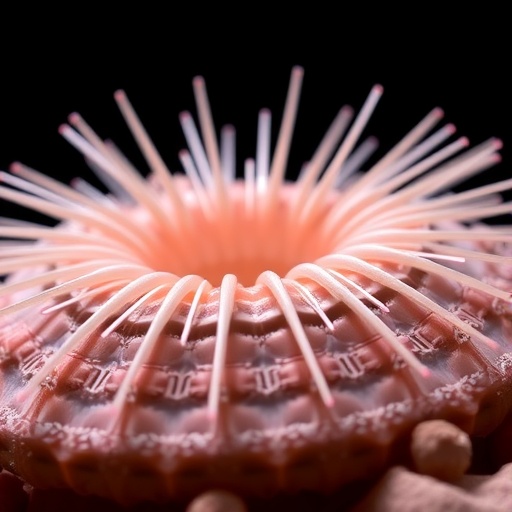
This intriguing capability is attributed to the stereom, the spine’s internal skeleton, which exhibits a complex porous network with a gradient pore size distribution. Pores vary from larger and more loosely packed at the base to smaller and denser toward the tip, forming a bicontinuous gradient porous structure. Such gradation profoundly impacts how seawater interacts with the microarchitecture, allowing for enhanced solid-liquid interfacial effects. As the fluid navigates through these pores, shear forces act upon the electric double layer at the interfaces, prompting separation and redistribution of charges along the surfaces. This charge displacement consequently generates a voltage difference measurable across the spine.
To translate this natural marvel into a practical technological platform, the research team employed state-of-the-art vat photopolymerisation 3D printing approaches. Using polymer and ceramic precursors, they successfully fabricated synthetic structures mimicking the stereom’s gradient porous morphology. Experimentation on these bioinspired prototypes revealed a striking amplification in sensory response—a voltage output roughly three times greater and an oscillation amplitude almost eightfold higher than non-gradient counterparts under equivalent water flow stimulation. These findings compellingly argue that it is the intricate gradient architecture, rather than the specific material composition, that drives the spine’s mechanoelectrical sensitivity.
Expanding on this success, a bionic 3D metamaterial mechanoreceptor was engineered, constructed as a 3 × 3 matrix of individual units featuring gradient porous designs. This array is capable of detecting and recording electrical signals generated in real time from localized water flow impacts underwater without requiring external electrical power supplies. This autonomous sensing capability not only underscores the functional efficiency of the gradient-designed metamaterials but also promises versatile applications in underwater robotics and sensor networks that demand low-power, high-sensitivity detection.
The potential applications of this biomimetic system transcend mere water flow sensing. Prof. Wang’s team envisages these gradient porous materials as a versatile platform capable of transducing various mechanical stimuli into measurable electrical signals. This can encompass pressure variations, vibrational waves, and even electromagnetic influences. Such adaptability carries profound implications for emerging technologies across disciplines, especially in neurotechnology where enhancing brain-computer interface sensitivity could revolutionize neural signal acquisition and interpretation.
What sets this research apart is not only the biomimetic insight but also the manufacturability and tunability enabled through advanced 3D printing methods. Flexibility in material choice, pore architecture, and device geometry allows for precise tailoring of sensor characteristics to meet diverse operational requirements. Such control fosters the development of bespoke metamaterials capable of targeting specific sensing environments, offering considerable advantages over traditional sensor fabrication that often involves homogeneous materials and fixed structures.
Prof. Wang contextualizes this work within a broader research trajectory focused on nature-inspired engineering innovations. His team previously developed surfaces mimicking lotus leaves that exhibit rapid water repellency and self-cleaning, materials inspired by Araucaria leaves that facilitate self-propelled liquid transport, and anti-icing architectures based on fungal spore-shooting mechanisms that enable spontaneous freezing droplet ejection. These explorations not only advance material science but also underscore the vast untapped potential residing within natural porous structures.
Delving deeper into natural porous materials, the research challenges conventional perceptions that prioritize mechanical strength as the primary functional attribute. Instead, it posits that many properties arise as by-products of intricate biomineralisation processes. Understanding these secondary functionalities—like mechanoelectrical transduction—enriches our comprehension and opens avenues for more versatile utilization of such natural resources. This paradigm shift is critical to propelling biomimetic sensor development beyond emulation towards integration with real-world technological needs.
The paper detailing these results, titled “Echinoderm stereom gradient structures enable mechanoelectrical perception,” has been published in the prestigious journal Nature. The collaborative effort involved co-leadership by Prof. LU Jian at City University of Hong Kong and Professors YAN Chunze and SU Bin at Huazhong University of Science and Technology. Their combined expertise seamlessly bridges marine biology, materials science, and mechanical engineering, culminating in this landmark contribution to both fundamental understanding and applied sensor technology.
Looking ahead, this advancement in mechanoelectrical perception heralds a new class of nature-inspired sensors with self-powered operation, enhanced sensitivity, and spatial localization of stimuli in complex aquatic environments. Such devices could vastly improve monitoring systems of underwater infrastructure and environmental conditions, crucial for offshore engineering, ecological conservation, and maritime operations. Moreover, the principles established here may fuel innovations in sectors requiring delicate mechanical sensing such as aerospace instrumentation and biomedical devices, marking a transformative step towards smarter, more adaptive sensor platforms.
News Publication Date: 25 February 2026
Web References:
– https://www.nature.com/articles/s41586-026-10164-9
– http://dx.doi.org/10.1038/s41586-026-10164-9
References:
– Wang, Z., Lu, J., Yan, C., Su, B. (2026). Echinoderm stereom gradient structures enable mechanoelectrical perception. Nature. https://doi.org/10.1038/s41586-026-10164-9
Cite Scienmag News
Violet Maxwell. (March 20, 2026). PolyU Researchers Discover Mechanoelectrical Sensing in Sea Urchin Spines, Paving the Way for Advanced Biomimetic Sensors. Scienmag. https://scienmag.com/polyu-researchers-discover-mechanoelectrical-sensing-in-sea-urchin-spines-paving-the-way-for-advanced-biomimetic-sensors/
Violet Maxwell. "PolyU Researchers Discover Mechanoelectrical Sensing in Sea Urchin Spines, Paving the Way for Advanced Biomimetic Sensors." Scienmag, 20 March 2026, https://scienmag.com/polyu-researchers-discover-mechanoelectrical-sensing-in-sea-urchin-spines-paving-the-way-for-advanced-biomimetic-sensors/. Accessed 4 September 2026.
Violet Maxwell. "PolyU Researchers Discover Mechanoelectrical Sensing in Sea Urchin Spines, Paving the Way for Advanced Biomimetic Sensors." Scienmag. March 20, 2026. https://scienmag.com/polyu-researchers-discover-mechanoelectrical-sensing-in-sea-urchin-spines-paving-the-way-for-advanced-biomimetic-sensors/


