


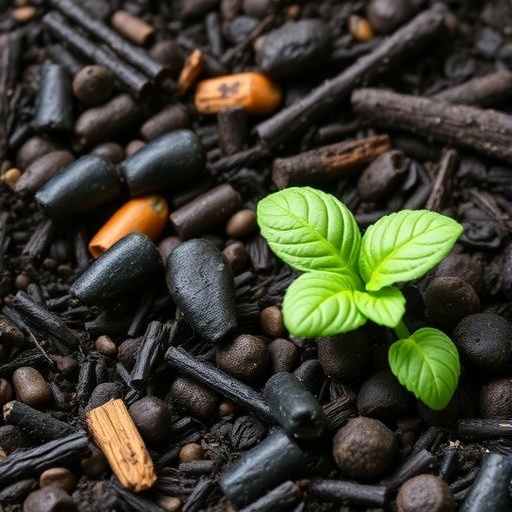
In a groundbreaking advancement for sustainable agriculture, researchers have pioneered a novel method to convert sewage sludge waste into a highly effective biochar capable of significantly enhancing crop growth through improved nitrogen assimilation. This innovative approach not only recycles a substantial environmental pollutant but also transforms it into a valuable agricultural input, thereby addressing critical challenges linked to both waste management and food production.
Biochar, a carbon-rich product derived from the pyrolysis of organic materials under limited oxygen conditions, has long been recognized for its beneficial effects on soil structure, moisture retention, and nutrient availability. However, one of the persistent limitations in biochar utilization has been its inconsistent ability to serve as a viable carrier for beneficial soil microbes. Many traditional biochars fail to provide an optimal habitat or nutritional support for these microorganisms, limiting their potential impact on soil fertility and plant growth.
Seeking to overcome these challenges, the research team engineered a specialized sewage sludge-based biochar, designated SSBC37, through a meticulously designed multistep thermal and chemical process. The initial step involved extracting nutrient-rich dissolved organic compounds from a low-temperature biochar matrix. Subsequent high-temperature carbonization improved the biochar’s porosity and physical robustness. Critically, the previously extracted nutrients were reintroduced, resulting in a biochar with balanced physicochemical properties tailored to enhance microbial colonization and metabolic activity.
This refined biochar was then inoculated with Bacillus velezensis, a plant-growth-promoting bacterium well-documented for its positive impacts on nutrient cycling, pathogen suppression, and plant hormone production. Application of this biochar-bacteria formulation to cabbage crops led to an impressive increase in aboveground dry biomass by nearly 40% relative to untreated controls. Remarkably, the synergistic effect observed with the combined treatment substantially exceeded growth benefits recorded when either biochar or bacterial inoculants were applied independently.
At the core of this enhanced performance lies the dual function of the engineered biochar as both a microbial habitat and nutrient reservoir. Chemical analyses revealed certain biochar-derived compounds that effectively stimulated Bacillus metabolic pathways, enabling rapid colonization and persistent root association. This fortified microbial presence reshaped the rhizosphere microbial community, fostering beneficial interactions that further optimized nutrient availability.
Crucially, the research highlighted significant improvements in nitrogen cycling dynamics within the treated soils. The biochar-microbe synergism elevated populations of nitrogen-transforming microorganisms, enhanced enzymatic activities linked to nitrogen metabolism, and increased soil concentrations of ammonium nitrogen—a form readily assimilated by plant roots. Consequently, cabbage plants exhibited markedly improved nitrogen uptake efficiency, translating into robust vegetative growth and potentially higher yields.
The study also delved into the ecological interplay between introduced Bacillus strains and native soil microbial populations. The presence of Bacillus velezensis modulated soil microbial community structure by suppressing certain fungal taxa while simultaneously promoting beneficial bacterial groups. This modulation cultivated a rhizosphere environment more conducive to plant development and resilience, underpinning the functional benefits observed.
Beyond its immediate agricultural implications, the work demonstrates how intentional biochar design can harness complex soil microbiome interactions to produce sustainable biofertilizers that reduce dependence on synthetic chemical inputs; a pressing concern given the environmental toll of conventional fertilizers. Strategic engineering of biochar matrices to support microbial viability marks a pivotal step toward next-generation soil amendments that integrate waste valorization, microbial ecology, and crop productivity.
Addressing the global issue of sewage sludge disposal, which poses significant environmental hazards, this technology offers a transformative waste management pathway by converting sludge into value-added products that promote ecological and economic sustainability. The process effectively closes nutrient cycles by redirecting waste nutrients back into croplands in a bioavailable form, mitigating pollution while supporting food security.
As global agriculture faces unprecedented pressures from climate change, soil degradation, and resource constraints, innovations like the SSBC37 biochar-bacteria system reveal new strategies for sustainable intensification. This integrated technology showcases the potential for engineered biochars to act as bioactive platforms that synergize with microbial communities to restore soil health and enhance crop nutrition.
Looking forward, the research paves the way for broader applications of engineered biochars paired with tailored microbial consortia across diverse crops and environmental conditions. Continued exploration of the mechanistic underpinnings governing biochar-microbe-plant interactions will be vital to optimize formulations and achieve scalable deployment of these sustainable biofertilizers globally.
In sum, the study exemplifies a paradigm shift in agronomic practices by turning problematic sewage waste into ecosystem services that boost nitrogen assimilation and plant growth. By bridging material science, microbiology, and agronomy, this work heralds a promising future where waste-to-resource technologies contribute significantly to sustainable food production systems.
News Publication Date:
5 February 2026
Web References:
http://dx.doi.org/10.1007/s42773-025-00561-0
References:
Liu, Z., Yu, B., Xu, Y. et al. Bacillus-functionalized sewage sludge biochar boosts cabbage growth through improved nitrogen assimilation. Biochar 8, 42 (2026).
Cite Scienmag News
Alan Morgan. (March 19, 2026). Biochar and Beneficial Bacteria Join Forces to Enhance Crop Growth. Scienmag. https://scienmag.com/biochar-and-beneficial-bacteria-join-forces-to-enhance-crop-growth/
Alan Morgan. "Biochar and Beneficial Bacteria Join Forces to Enhance Crop Growth." Scienmag, 19 March 2026, https://scienmag.com/biochar-and-beneficial-bacteria-join-forces-to-enhance-crop-growth/. Accessed 4 September 2026.
Alan Morgan. "Biochar and Beneficial Bacteria Join Forces to Enhance Crop Growth." Scienmag. March 19, 2026. https://scienmag.com/biochar-and-beneficial-bacteria-join-forces-to-enhance-crop-growth/


