


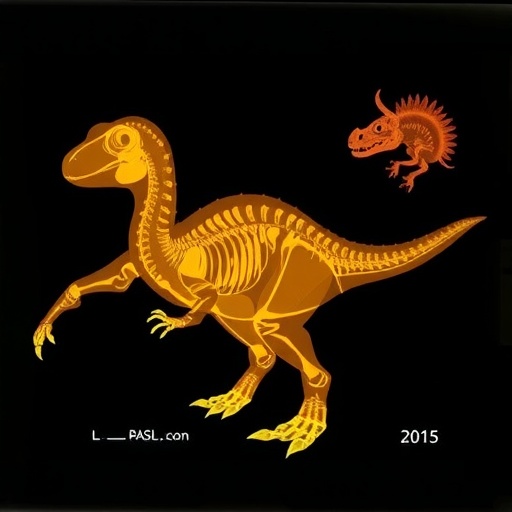
In an extraordinary paleontological breakthrough, researchers from The University of Texas at Austin and the Korean Dinosaur Research Center have unveiled a new dinosaur species from Korea, captivating the scientific community with insights into early-diverging neornithischian diversity. The newly discovered dinosaur, named Doolysaurus huhmini, honors a beloved cultural icon from South Korea — a mischievous baby dinosaur named Dooly — while also paying tribute to Min Huh, a pioneering Korean paleontologist whose dedication has shaped decades of dinosaur research in the region.
The specimen is remarkable not only for its novelty as a species but also because it is the first dinosaur fossil found in Korea in 15 years to include parts of its skull — an element seldom discovered due to the difficulty of fossil preservation in the region’s geology. The fossil, unearthed on Korea’s Aphae Island, was subjected to cutting-edge micro-computed tomography (micro-CT) scanning at The University of Texas High-Resolution X-ray Computed Tomography (UTCT) facility, revealing a trove of anatomical details previously obscured by the encasing rock matrix.
Initial visual examination of the fossil suggested only a handful of leg bones and vertebrae were preserved. However, the micro-CT scans shattered these expectations, unveiling substantial portions of the skull and numerous small bones concealed within the hard rock. This allowed researchers to conduct a comprehensive anatomical analysis that would have taken nearly a decade to accomplish by conventional mechanical preparation alone.
Doolysaurus huhmini lived approximately 113 to 94 million years ago during the mid-Cretaceous period, a pivotal epoch marking significant evolutionary radiations among dinosaurs and other terrestrial vertebrates. The species is classified as a thescelosaurid, a group of relatively small-bodied, bipedal ornithischians known to inhabit East Asia and North America. Thescelosaurids are of particular interest to paleontologists because many are hypothesized to have had a primitive, fuzzy integument, and Doolysaurus may well have sported such a filamentous covering — evocative of a juvenile bird or a lamb-like appearance.
The fossil specimen represents a juvenile estimated to be about two years old at the time of death and approximately the size of a modern turkey. Growth markers visible on a microscopic thin section of the femur verified its ontogenetic stage, emphasizing that Doolysaurus had not yet reached full adult size, which scientists project could have been roughly double that of the specimen examined.
Beyond the skeletal remains, a cluster of gastroliths — small stones swallowed during the animal’s life — was found within the fossilized torso. These stones played a crucial role in digestion, indicating that Doolysaurus was omnivorous, feeding on a varied diet of plants, insects, and small animals. The presence of gastroliths in situ was one of the reasons the research team suspected additional fossilized material might be preserved inside the matrix, prompting the detailed micro-CT scanning.
The implementation of micro-CT technology marked a critical methodological advancement in this discovery. Traditionally, excavation and preparation of dinosaur fossils embedded in dense rock is painstakingly slow and carries a significant risk of damaging delicate features. Non-destructive imaging allowed the researchers to explore the internal fossil layout virtually, enabling targeted study without physical interference. Julia Clarke, professor at the Jackson School of Geosciences, underlined the transformative impact of CT scanning in paleontology — particularly for examining fragile fossils obscured by tough lithologies, including small non-avian dinosaurs and early birds.
This discovery not only enriches the known diversity of neornithischians but also highlights Aphae Island as a significant yet underexplored fossil frontier. While South Korea has long been renowned for fossilized dinosaur tracks, nests, and eggs, actual bone fossils have been scarce and difficult to extract from hard rock substrates. The Doolysaurus fossil suggests that further finds may be concealed underground, awaiting modern imaging technologies to unlock their secrets.
Co-lead researchers Jongyun Jung and Hyemin Jo emphasize their plans for future expeditions back to Aphae Island with hopes of uncovering additional specimens. The integration of skills in CT scanning and fossil analysis, honed at UT Austin’s Jackson School, sets a new standard for Korean paleontology research. The team’s multidisciplinary collaboration exemplifies how global scientific partnerships can accelerate discoveries and deepen understanding of prehistoric ecosystems.
The dedication of this new species to both a cherished cultural figure and a venerable scientist bridges popular culture with rigorous science, inspiring public interest and deepening appreciation for Korea’s ancient natural heritage. The scientific report detailing Doolysaurus huhmini was published in the journal Fossil Record on March 19, 2026, sparking discussions about the evolution, ecology, and paleobiogeography of early neornithischian dinosaurs across Asia and North America.
In the coming years, advancements in imaging, field exploration, and analytical techniques promise a renaissance in Korean dinosaur paleontology. The Doolysaurus find stands as a testament to the power of innovative technology and international cooperation to illuminate chapters of Earth’s distant past long hidden beneath rock and time.
News Publication Date: 19-Mar-2026
Cite Scienmag News
Violet Maxwell. (March 19, 2026). New Baby Dinosaur Species Discovered Through Fossil X-Ray, Named After Beloved Korean Cartoon. Scienmag. https://scienmag.com/new-baby-dinosaur-species-discovered-through-fossil-x-ray-named-after-beloved-korean-cartoon/
Violet Maxwell. "New Baby Dinosaur Species Discovered Through Fossil X-Ray, Named After Beloved Korean Cartoon." Scienmag, 19 March 2026, https://scienmag.com/new-baby-dinosaur-species-discovered-through-fossil-x-ray-named-after-beloved-korean-cartoon/. Accessed 4 September 2026.
Violet Maxwell. "New Baby Dinosaur Species Discovered Through Fossil X-Ray, Named After Beloved Korean Cartoon." Scienmag. March 19, 2026. https://scienmag.com/new-baby-dinosaur-species-discovered-through-fossil-x-ray-named-after-beloved-korean-cartoon/


