


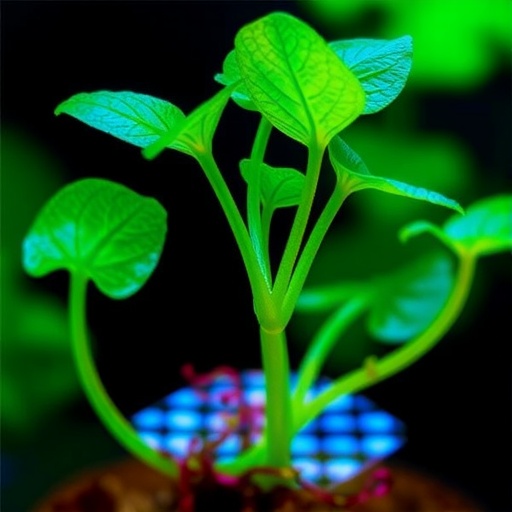
In a breakthrough that could revolutionize the way we monitor plant health and ecosystem dynamics, a novel approach to long-term electrophysiological monitoring of plants directly on their leaves has been introduced. Researchers Crichton, Sharpe, López-Pozo, and their colleagues have developed printed adhesive gel bioelectrodes capable of non-invasive, sustained electrical signal acquisition from plants. This innovative technology promises to unlock unprecedented insights into plant physiology and environmental responses, potentially transforming agricultural practices, environmental monitoring, and botanical research.
Plants, often perceived as passive organisms, actually exhibit complex electrical signaling within their tissues, akin in some ways to neuronal networks in animals. These electrical impulses convey information related to environmental stimuli, stress responses, and internal metabolic activities. Yet capturing and interpreting these signals in situ, particularly over extended periods, has been a formidable challenge. Conventional methods, involving rigid electrodes or invasive probes, risk damaging delicate tissues and often provide only short-term data, constraining both the scope and applicability of plant electrophysiology studies.
Addressing these limitations, the research team engineered printed adhesive gel bioelectrodes specifically designed for on-leaf deployment. These electrodes employ a hydrogel interface that conforms seamlessly to the microstructural irregularities of leaf surfaces, ensuring intimate and stable contact without impairing plant viability. The printed nature of the electrodes, facilitated through advanced deposition techniques, allows for customizable designs that can accommodate diverse plant geometries and sizes, positioning this technology for broad applicability.
The adhesive gel, a core innovation, functions as a soft, conductive medium that bridges the electrical pathways between leaf tissues and external recording apparatus. Unlike traditional metallic or polymer electrodes, the gel’s biocompatibility ensures minimal interference with physiological processes while maintaining stable conductivity. This biointerface facilitates high-fidelity signal transmission, enabling the detection of subtle variations in plant electrical activity indicative of stress, hydration levels, light exposure, or pathogen attack.
Throughout the development process, the researchers emphasized durability and long-term operability. The printed gel bioelectrodes demonstrated remarkable stability, remaining functional and firmly adhered to leaves under varied environmental conditions, including fluctuations in humidity, temperature, and wind exposure. This resilience is critical for real-world applications, where continuous monitoring over days, weeks, or even growing seasons is necessary to capture meaningful plant physiological dynamics and responses to environmental stressors.
Critically, the system’s non-invasive nature represents a paradigm shift in plant electrophysiology research. By eliminating the need for tissue penetration or damage, this technology facilitates longitudinal studies without compromising plant health or growth. This opens the door to experiments correlating electrophysiological data with biochemical, genetic, and environmental variables, enriching our understanding of plant behavior at multiple biological scales.
From a technical standpoint, the integration of the printed electrodes with portable data acquisition units supports real-time monitoring and data transmission. Coupled with machine learning algorithms, the electrical signals harvested can be decoded to identify patterns corresponding to specific environmental conditions or physiological states. Such intelligent monitoring systems have the potential to alert farmers or researchers to early signs of drought stress, nutrient deficiency, or pest infestation, enabling timely and targeted interventions.
Moreover, the scalability of the printing process suggests feasibility for large-scale deployment across agricultural fields or ecological reserves. By equipping plants with these sensors, entire landscapes could be transformed into living sensor networks, delivering continuous, high-resolution environmental data streams. The ecological implications are profound: enhanced tracking of climate change effects, improved habitat conservation strategies, and optimized resource management grounded in precise, real-time plant health metrics.
The research also addresses critical materials science challenges, such as ensuring the longevity and environmental safety of the adhesive gel components. The gels are formulated from biodegradable and non-toxic polymers, mitigating potential ecological impacts upon degradation. This thoughtful material selection underscores the technology’s alignment with sustainability principles, a growing imperative in scientific innovation.
Interdisciplinary collaboration was pivotal to achieving this technological advancement. Contributions from plant physiology, materials chemistry, electronics engineering, and data science converged to create a seamless platform that bridges biological complexity and technological sophistication. This convergence exemplifies the power of integrative approaches in tackling longstanding biological measurement challenges.
While the potential applications are vast, the researchers acknowledge ongoing hurdles that warrant further investigation. Variability among plant species in leaf morphology, cuticle composition, and electrical properties poses challenges in universal electrode design and calibration. Additionally, the interpretation of electrophysiological data in ecologically complex settings requires sophisticated analytic frameworks to discern signal origins and significance.
Looking ahead, the team envisions coupling these bioelectrodes with wireless sensor networks, enabling fully autonomous plant monitoring systems. Such advancements could facilitate precision agriculture practices by integrating plant electrical data with environmental sensors and agronomical models. The anticipated outcomes include reduced resource use, enhanced crop resilience, and improved yield predictability, contributing significantly to global food security.
Furthermore, the ability to detect plant electrophysiological responses to environmental stressors could illuminate fundamental questions in plant biology. For instance, understanding how plants perceive and communicate attacks from herbivores or pathogens via electrical signals could inspire new pest management strategies that harness intrinsic plant defenses rather than relying solely on chemical treatments.
The innovation also holds promise in urban ecology, where monitoring plant health in green spaces can inform urban planning and pollution mitigation efforts. By embedding these sensors in city landscaping, municipalities could track environmental quality indicators such as air pollution or heat stress through plant responses, fostering healthier urban environments.
In summary, the development of printed adhesive gel bioelectrodes for long-term on-leaf electrophysiological monitoring represents a landmark achievement in plant science technology. Through combining biocompatible materials engineering, precise fabrication techniques, and sophisticated data analysis, this approach sets a new standard for non-invasive, durable, and informative plant monitoring systems. Its implications span scientific research, agriculture, environmental stewardship, and beyond, heralding a future where plants themselves become active informants of their health and environment.
The full study by Crichton, Sharpe, López-Pozo, and colleagues appears in the 2026 edition of Communications Engineering and is already generating excitement across plant science and engineering communities. As this technology matures and integrates with broader sensor networks and data systems, it promises to transform our relationship with the green world that sustains life on Earth.
Cite Scienmag News
Denise Maddox. (March 19, 2026). Long-Term Plant Electrophysiology via Printed Gel Electrodes. Scienmag. https://scienmag.com/long-term-plant-electrophysiology-via-printed-gel-electrodes/
Denise Maddox. "Long-Term Plant Electrophysiology via Printed Gel Electrodes." Scienmag, 19 March 2026, https://scienmag.com/long-term-plant-electrophysiology-via-printed-gel-electrodes/. Accessed 4 September 2026.
Denise Maddox. "Long-Term Plant Electrophysiology via Printed Gel Electrodes." Scienmag. March 19, 2026. https://scienmag.com/long-term-plant-electrophysiology-via-printed-gel-electrodes/


