


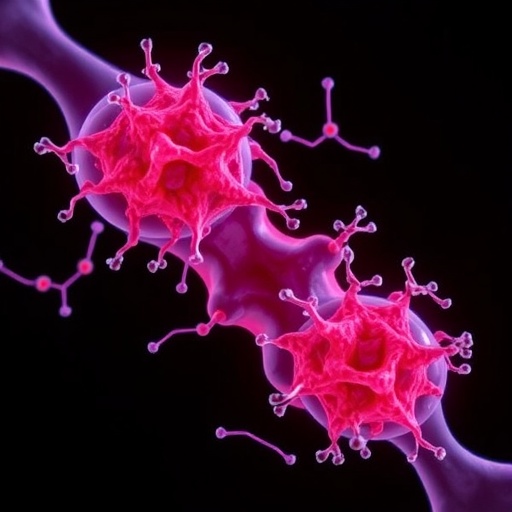
In a groundbreaking advance, researchers at King’s College London and the University of Surrey have pioneered an innovative analytical technique capable of probing the metabolic contents of individual human cells infected with bacterial models of tuberculosis (TB). This novel approach unlocks a previously inaccessible scale of cellular examination, revealing intricate biochemical transformations within single cells that conventional bulk analysis would overlook. Such precise interrogation holds great promise for unraveling the mysteries behind cellular susceptibility and resistance to TB infection.
Tuberculosis continues to be the leading cause of death attributed to a single infectious pathogen worldwide, primarily propagated by the bacterium Mycobacterium tuberculosis. The pathogen predominantly infects macrophages—specialized immune cells designed to engulf and destroy microbes. Intriguingly, not all macrophages become infected when exposed to TB bacteria. Decoding the underlying factors that render certain macrophages vulnerable while others remain unscathed is a critical challenge that could translate directly into more effective therapeutic interventions.
The research team’s innovative method leverages liquid chromatography-mass spectrometry (LC-MS) applied at the single-cell level, a feat previously unattainable due to the diminutiveness of human cells—typically about 10 micrometers in diameter with volumes less than a picoliter, a scale roughly 100 million times smaller than a drop of rain. This technique allows scientists to isolate individual macrophages under a microscope, preserving their native state and immediate microenvironment. Through LC-MS, they then generate a unique metabolic “fingerprint” for each cell, mapping a complex profile of metabolites—the small molecules involved in chemical reactions that sustain life.
This single-cell metabolic fingerprinting provides unparalleled insight into the biochemical landscape inside every cell, highlighting nuanced differences between infected and uninfected macrophages. Such minute differences would invariably be obscured by conventional methods, which typically aggregate and analyze large populations of cells, thereby masking cell-to-cell variability and the heterogeneity fundamental to biological systems.
Unlike previous approaches that analyzed mixed cell populations or sorted groups of cells, this technique maintains spatial context, enabling researchers not only to compare the biochemical states of individual cells but also to understand their positional relationships within tissues. Understanding how infected cells might communicate stress or danger signals to neighboring uninfected cells could illuminate new pathways of immune system coordination or failure during TB infection.
Dr. Abigail Cook, a PhD student and lead author, emphasized the breakthrough’s precision: “We have pushed the limits of detection to explore metabolic differences within single cells, despite their incredibly small volumes. This level of resolution is essential to discerning how infection transforms cellular chemistry at the most fundamental unit of life.”
Central to this technological achievement is the development of a microscopy-coupled LC-MS workflow that delicately isolates single macrophages directly from biological samples. By preserving the metabolic state during extraction, the team ensures accurate representation of intracellular processes without artifacts introduced by batch processing or cell sorting. This meticulous methodology enables the detection of low-abundance metabolites that are crucial indicators of cellular response to TB bacteria.
The implications of this research extend beyond TB. Professor Melanie Bailey, senior author and Professor in the Physical Sciences of Life at King’s College London, notes that the method could revolutionize studies of not only bacterial infections but also viral, fungal, and cancerous conditions. “It’s transformative to link a cell’s visible morphology to its detailed metabolic chemistry,” Bailey explains, “expanding our ability to interrogate fundamental biology and disease mechanisms at single-cell resolution.”
A key collaborative strength underpinning this study lies at the intersection of chemistry and biology. Dr. Dany Beste from the University of Surrey, a microbial metabolism specialist and co-author, remarks on the synergy between disciplines: “Integrating expertise in microbial biochemistry and chemical analysis enabled us to tackle questions impossible to answer from a single viewpoint. Such interdisciplinary collaboration is vital for scientific breakthroughs.”
Looking ahead, the research group plans to harness the capabilities of the SEISMIC Facility at King’s College London, a state-of-the-art center dedicated to single-cell and sub-cellular omics, to extend the application of this technique. Future investigations aim to elucidate how metabolic alterations within infected macrophages influence disease progression, antimicrobial resistance, and immune signaling networks, potentially guiding the development of novel diagnostics and targeted therapies.
Supported by funding from the Doctoral College at the University of Surrey, Yokogawa Electric Corporation, the Engineering and Physical Sciences Research Council (EPSRC), and the Biotechnology and Biological Sciences Research Council (BBSRC), this work represents a significant leap forward in cellular microbiology and analytical chemistry integration.
As the global fight against tuberculosis continues, this pioneering approach equips scientists with a powerful new lens to decode the cellular dialogues that underlie infection and immunity, driving forward hopeful strategies to curb one of humanity’s deadliest infectious diseases.
Cite Scienmag News
Kristina Jarvis. (March 18, 2026). New Single-Cell Method Uncovers How Tuberculosis-Like Bacteria Transform Human Cells. Scienmag. https://scienmag.com/new-single-cell-method-uncovers-how-tuberculosis-like-bacteria-transform-human-cells/
Kristina Jarvis. "New Single-Cell Method Uncovers How Tuberculosis-Like Bacteria Transform Human Cells." Scienmag, 18 March 2026, https://scienmag.com/new-single-cell-method-uncovers-how-tuberculosis-like-bacteria-transform-human-cells/. Accessed 3 September 2026.
Kristina Jarvis. "New Single-Cell Method Uncovers How Tuberculosis-Like Bacteria Transform Human Cells." Scienmag. March 18, 2026. https://scienmag.com/new-single-cell-method-uncovers-how-tuberculosis-like-bacteria-transform-human-cells/


