


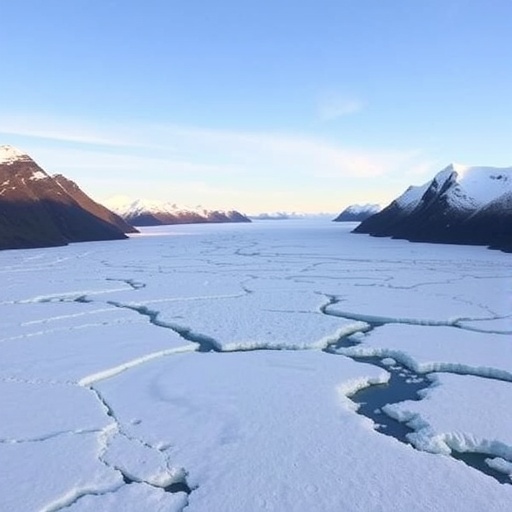
A groundbreaking study published in Communications Earth & Environment unveils the intricate role of oceanic forces in driving the fluctuations of the Patagonian Ice Sheet over the last eight glacial cycles. This work, led by Rigalleau, Arz, Beech, and colleagues, sheds unprecedented light on the far-reaching impacts of ocean-atmosphere interactions on ice sheet dynamics, challenging existing paradigms and potentially transforming our understanding of past and future ice sheet behavior in a warming world.
Spanning approximately 800,000 years, the research harnesses high-resolution paleoceanographic and glaciological data, combining state-of-the-art climate modeling and sediment core analyses extracted from the Southern Ocean and Patagonian margin. Such an extensive time frame allows the authors to trace cyclic patterns in ice sheet extent and thickness alongside variations in ocean temperature, circulation, and salinity, revealing a nuanced and compelling climate-cryosphere relationship rarely accessible in Earth’s deep past.
Crucially, the study demonstrates that shifts in Southern Ocean currents and temperature gradients have historically exerted a dominating influence on the waxing and waning of the Patagonian Ice Sheet. The authors argue that oceanic thermal forcing has driven ice-sheet variability more profoundly than previously acknowledged, with warmer ocean waters eroding ice tongues and modifying accumulation rates through changes in regional atmospheric moisture content.
The interaction between oceanic and atmospheric systems emerged as a complex feedback network, whereby ocean warming influenced atmospheric circulation patterns that governed precipitation and temperature regimes over Patagonia. This interplay generated distinct phases of glacial advance and retreat, punctuated by abrupt transitions corresponding to key oceanic state shifts detected in marine sediment proxies.
Among the most striking revelations is the recognition that ocean-driven mechanisms induced multiple rapid deglaciation events during interglacial intervals. These episodes coincided with strengthened upwelling of warm subsurface waters in the Southern Ocean, enhancing basal melting of the ice sheet’s marine termini and accelerating ice mass loss. Such processes likely contributed to significant global sea level rise documented in other paleoclimate archives.
The high temporal resolution of sediment core records allowed the researchers to identify a series of repetitive oceanic forcing patterns synchronized with Earth orbital cycles affecting insolation, especially eccentricity and obliquity-driven changes. This orbital pacing imposed a rhythm on ocean circulation modes such as the Antarctic Circumpolar Current, which in turn modulated the thermal environment impacting the Patagonian Ice Sheet.
Importantly, the findings illustrate the sensitivity of mid-latitude ice sheets to changes originating remotely within the Southern Ocean, underscoring the need to consider ocean dynamics alongside atmospheric factors in predictive models of ice sheet response to climate change. The complex nature of the ocean-ice linkages discovered here complicates simplistic assumptions about ice sheet stability under increasing global temperatures.
The multidisciplinary approach adopted by Rigalleau et al. involved the integration of isotope geochemistry, sedimentology, and numerical modeling, offering a holistic view of past environmental changes. Oxygen isotope ratios in foraminifera shells served as proxies to reconstruct water mass properties, while accumulation rates and grain size distributions provided clues on glacial sediment delivery tied to ice sheet fluctuations.
By tracing the history of oceanic conditions, such as temperature variability and salinity patterns, the study highlights the pivotal role of thermohaline circulation changes in governing ice sheet behavior. Variations in water mass characteristics associated with the Southern Ocean’s ventilation appeared to regulate nutrient supply and carbon sequestration processes, further linking cryospheric changes to global biogeochemical cycles.
The research also paves the way for reevaluating ice sheet sensitivity in other Southern Hemisphere regions, hinting that similar oceanic forcings may have influenced the West Antarctic Ice Sheet and other glacial systems contemporaneously. This broader context is essential for constructing comprehensive models of past global ice volume variations and sea level fluctuations.
From a geochronological perspective, the precise dating of sediment cores through radiometric and stratigraphic correlation methods fortifies the temporal constraints of observed ice sheet changes. This strengthens causal inferences between oceanic conditions and ice dynamics while mitigating uncertainties that have long plagued paleoenvironmental reconstructions.
In addition, the study offers a cautionary note for projections of future ice sheet stability as modern ocean warming accelerates. The interplay between increasing ocean temperatures and regional circulation shifts may replicate mechanisms from the past, triggering nonlinear ice sheet responses and contributing significantly to future sea level rise, particularly in vulnerable coastal regions worldwide.
The investigators emphasize that observational networks targeting ocean-ice interactions in the Southern Hemisphere are crucial to refine climate predictions. Enhanced monitoring of subsurface ocean temperatures, current pathways, and ice sheet grounding line movements will enable better anticipation of ice sheet tipping points triggered by oceanic perturbations.
Ultimately, this remarkable research represents a vital step toward decoding the intertwined history of the Antarctic’s oceanic environment and mid-latitude ice sheets. It enriches the scientific narrative about how oceanic processes have sustained or destabilized major ice masses through repeated glacial cycles, reinforcing the ocean’s commanding influence on Earth’s climate system.
The implications extend beyond academic circles, informing policymakers and coastal planners worldwide about potential ice mass loss trajectories under continued anthropogenic warming. A deeper appreciation of past oceanic forcing mechanisms heightens our sense of urgency to monitor evolving Southern Ocean conditions as harbingers of future cryosphere transformation.
With its meticulous synthesis of geological evidence and climate modeling, this landmark study sets a new benchmark in paleoclimate research. It highlights how unraveling the complex ocean-ice couplings embedded in Earth’s long-term climate history is indispensable to forecasting the fate of today’s ice sheets amid accelerating environmental change.
Cite Scienmag News
Eleanor C. (March 17, 2026). Ocean Drives Patagonian Ice Sheet Changes Over Glacials. Scienmag. https://scienmag.com/ocean-drives-patagonian-ice-sheet-changes-over-glacials/
Eleanor C. "Ocean Drives Patagonian Ice Sheet Changes Over Glacials." Scienmag, 17 March 2026, https://scienmag.com/ocean-drives-patagonian-ice-sheet-changes-over-glacials/. Accessed 28 August 2026.
Eleanor C. "Ocean Drives Patagonian Ice Sheet Changes Over Glacials." Scienmag. March 17, 2026. https://scienmag.com/ocean-drives-patagonian-ice-sheet-changes-over-glacials/


