

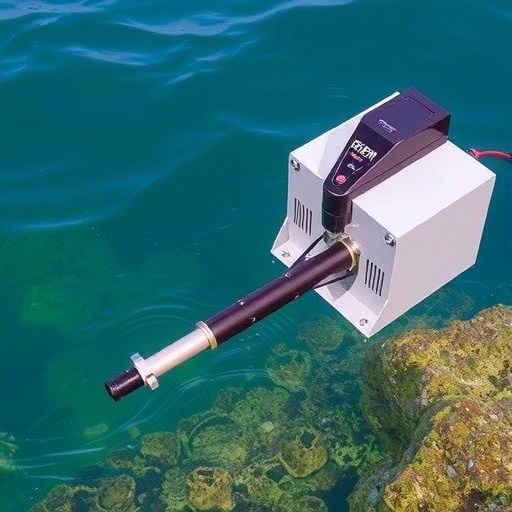
A groundbreaking advancement in seawater electrolysis technology has emerged from the Korea Institute of Energy Research (KIER), promising to revolutionize global hydrogen production. Led by Dr. Ji-Hyung Han at KIER’s Convergence Research Center of Sector Coupling & Integration, the research team has introduced an innovative dual-cathode system that effectively addresses long-standing issues associated with precipitate buildup, a major factor that has hindered the operational efficiency and durability of seawater electrolysis devices.
Electrolysis of water remains a cornerstone technique for generating clean hydrogen fuel, a critical component in the global shift towards sustainable energy. However, conventional methods primarily rely on freshwater sources, which face increasing scarcity worldwide. Seawater electrolysis offers a tantalizing alternative owing to the abundance of seawater but has been plagued by technical challenges, specifically the continuous formation and accumulation of precipitates composed predominantly of magnesium and calcium compounds on electrode surfaces. These deposits result in performance degradation, increased energy demand, and frequent interruptions necessitating chemical or mechanical cleaning.
The pioneering solution from KIER harnesses a novel system architecture featuring two cathodes that alternate roles during operation. One electrode actively catalyzes hydrogen evolution while concurrently being exposed to precipitate accumulation. Simultaneously, the companion electrode undergoes a regeneration phase where hydrogen production is temporarily halted, allowing natural acidification of the adjacent seawater to dissolve the deposits accumulated in prior cycles. This transition between active and regeneration phases occurs every 48 hours, effectively enabling a continuous, self-sustaining cleaning mechanism that circumvents the need for external intervention or maintenance.
Extensive experiments validating this dual-cathode design revealed remarkable improvements. Contrary to traditional single-electrode systems that suffered a 27% spike in energy consumption following roughly 200 hours of operation due to scaling, the dual-cathode platform demonstrated a mere 1.8% increase even after more than 400 hours of continuous use. This longevity and energy stability translate to an extraordinary 15-fold enhancement in long-term performance, a transformative leap for seawater electrolysis technology.
The improvements extend beyond energy metrics; catalyst stability also saw significant augmentation. Analysis revealed that after extensive operation, the hydrogen evolution catalyst’s content decreased by only 20%, in stark contrast to the 53% degradation observed in single-electrode counterparts. This retention of catalytic activity not only ensures prolonged device lifespan but also reduces replacement costs and operational disruptions, factors imperative for commercial viability.
At the core of the system’s success is the exploitation of natural seawater chemistry changes occurring during electrolysis. The researchers identified that during hydrogen production, certain electrochemical reactions acidify localized seawater environments near the electrodes. This localized acidification becomes a self-regenerating cleaning agent, chemically dissolving magnesium and calcium-based precipitates without additional reagents. Integrating this behavior into the dual electrode design allowed the team to conceive a system that inherently cleans itself, a revolutionary approach deviating from existing paradigms reliant on periodic acid washing or mechanical abrasion.
Dr. Han emphasized the fundamental shift in how the precipitate problem is addressed, stating that this advance hinges solely on smart system architecture rather than introducing novel materials or complex additives. The simplicity and elegance of switching electrode roles to harmonize hydrogen production and self-cleaning promise scalability and adaptability across diverse seawater electrolysis setups globally.
Collaborative efforts with Professor Joohyun Lim’s team at Kangwon National University further enriched the study, highlighting synergies between fundamental electrochemical research and applied engineering. The research was supported by the National Research Council of Science & Technology (NST) through the Convergence Research Group Project, enabling a robust interdisciplinary approach. Their efforts culminated in publication within the prestigious Chemical Engineering Journal, signaling widespread recognition by the energy and chemical engineering research communities.
This dual-cathode innovation potentially unlocks long-term operational stability for seawater electrolysis devices, addressing one of the technology’s critical bottlenecks. Given the urgent worldwide demand to scale eco-friendly hydrogen production while conserving precious freshwater resources, this technology could accelerate integration into renewable energy frameworks and industrial applications. Implementation of such systems may dramatically lower costs and environmental footprints of hydrogen fuel, fostering sustainable pathways for energy conversion.
Moreover, by minimizing electrode degradation and maintaining stable energy consumption over extended durations, the new system elevates economic feasibility, paving the way for commercial-scale electrolyzers that are robust, efficient, and low-maintenance. The principles demonstrated by the KIER research team could inspire further innovations, such as optimizing membrane materials, electrode configurations, and operational protocols to enhance performance even further.
In addition to technical breakthroughs, the conceptual introduction of ‘self-cleaning’ electrodes represents a paradigm shift for electrochemical systems broadly. Harnessing inherent chemical processes for maintenance and longevity rather than relying on external interventions can profoundly impact future designs across water electrolysis, fuel cells, and other electrochemical reactors. This advancement resonates beyond hydrogen production, illustrating how system-level engineering can solve longstanding material and operational challenges.
As the world intensifies its focus on clean energy transitions, the significance of sustainably harvesting hydrogen from abundant seawater cannot be overstated. The dual-cathode seawater electrolysis system from KIER exemplifies an elegant yet practical solution to complex electrochemical problems, demonstrating that innovative design and fundamental understanding can deliver real-world breakthroughs. The global scientific and industrial community will watch eagerly as this technology progresses towards commercialization, poised to contribute substantially to a greener and more resilient energy future.
News Publication Date: 19-Feb-2026
Web References: http://dx.doi.org/10.1016/j.cej.2026.174360
Keywords
Seawater Electrolysis, Hydrogen Fuel, Dual Cathode System, Precipitate Formation, Electrochemical Regeneration, Catalyst Durability, Energy Efficiency, Bipolar Membrane, Sustainable Energy, Self-cleaning Electrodes, Korea Institute of Energy Research, Electrochemical Engineering
Cite Scienmag News
SCIENMAG. (March 17, 2026). KIER Solves Seawater Electrolysis Scaling Issue Using Innovative Dual Electrode System. https://scienmag.com/kier-solves-seawater-electrolysis-scaling-issue-using-innovative-dual-electrode-system/
SCIENMAG. "KIER Solves Seawater Electrolysis Scaling Issue Using Innovative Dual Electrode System." Scienmag, 17 March 2026, https://scienmag.com/kier-solves-seawater-electrolysis-scaling-issue-using-innovative-dual-electrode-system/. Accessed 28 August 2026.
SCIENMAG. "KIER Solves Seawater Electrolysis Scaling Issue Using Innovative Dual Electrode System." Scienmag. March 17, 2026. https://scienmag.com/kier-solves-seawater-electrolysis-scaling-issue-using-innovative-dual-electrode-system/


