


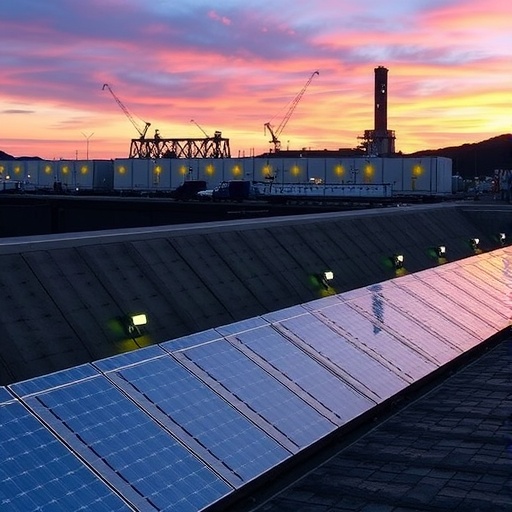
As societies worldwide embark on urgent energy transitions, an innovative proposition is gaining traction within scientific and industrial circles: the recycling of fossil fuel infrastructure to accelerate the shift toward cleaner energy systems. This concept leverages the vast networks of pipelines, storage facilities, and processing plants historically built for fossil fuels, repurposing them to support renewable resources, hydrogen economies, and carbon capture solutions. The novel framework, recently detailed in a seminal study by Schlesier, Guillén-Gosálbez, and Desing, published in Nature Communications, offers a technically nuanced roadmap that could dramatically reduce greenhouse gas emissions while maximizing economic and material efficiency.
The premise underpinning this research lies in acknowledging that dismantling fossil fuel infrastructure not only wastes valuable materials but also incurs significant environmental and financial costs. Instead, by retrofitting and integrating these existing assets into emerging clean energy frameworks, it is possible to avoid the resource-intensive construction of entirely new infrastructure. This strategy aligns with principles of circular economy and sustainable development, emphasizing reuse and repurposing as key mechanisms to address climate change challenges.
From a technical perspective, the study presents comprehensive modeling of infrastructure repurposing scenarios, taking into account the complex interplay of material flows, energy demands, and emissions trajectories. For instance, natural gas pipelines, traditionally used for fossil methane transport, can be adapted for hydrogen transmission, which is widely anticipated as a cornerstone fuel for decarbonized economies. However, this conversion is not straightforward; the research highlights required modifications to manage hydrogen’s distinct physical and chemical properties, including its lower energy density and tendency for material embrittlement. Such detailed engineering assessments form a crucial component of the pathway toward infrastructure recyclability.
Moreover, the study delves deep into the potential for utilizing carbon capture and storage (CCS) sites, formerly associated with fossil fuel extraction, as repositories for sequestered CO2. Repurposing depleted oil and gas reservoirs, as well as saline aquifers, leverages existing geological knowledge and technical infrastructure, thereby accelerating CCS deployment and reducing the risks inherent in underground storage operations. This aspect of recycling fossil infrastructure serves a dual purpose: it mitigates ongoing emissions and creates negative emissions, both imperative for meeting ambitious climate targets.
Another pivotal element investigated by Schlesier and colleagues concerns the integration of renewable electricity generation with repurposed fossil sites. For example, abandoned oil fields, characterized by wide-open spaces and existing grid connection assets, can host solar arrays or wind farms. The grid infrastructure originally engineered for fossil fuel power plants can then facilitate the transmission of cleaner electricity, enhancing system flexibility and reliability. This technical adaptation framework not only conserves resources but also exploits the strategic geographies and technical specifications embedded in the fossil infrastructure.
In analyzing lifecycle environmental impacts, the research employs advanced lifecycle assessment (LCA) methodologies combined with techno-economic optimization algorithms. This hybrid approach enables granular quantification of greenhouse gas emissions avoided, energy savings, and cost implications of conversion pathways. Importantly, the study finds that the emission reductions from recycling fossil infrastructure far exceed the emissions generated during retrofit processes, offering strong evidence that such an approach is environmentally advantageous relative to extensive new-build investments.
Economically, the reutilization of fossil infrastructure can mitigate what would otherwise be considered stranded assets in a decarbonizing world. The financial burden of premature fossil infrastructure decommissioning—combined with massive capital expenditures for green infrastructure development—poses significant challenges to investors and policymakers alike. By providing technically robust alternatives that prolong asset utility in low-carbon systems, the study offers a pragmatic pathway that reconciles current economic realities with urgent climate imperatives.
Furthermore, the social and geopolitical dimensions are also critically considered. Transition strategies involving the recycling of fossil infrastructure could preserve jobs, maintain energy security, and allow communities dependent on fossil fuel economies to adapt more smoothly to the changing energy landscape. Such an approach could also reduce geopolitical tensions by diminishing the reliance on new raw materials or technologies monopolized by specific regions, fostering a more distributed and resilient clean energy future.
The researchers emphasize that successful infrastructure recycling demands multidisciplinary coordination among engineers, material scientists, policymakers, and industry stakeholders. Regulatory frameworks must evolve to encourage retrofitting investments and mitigate liability risks. Simultaneously, technical standards and operational protocols require updating to accommodate the altered use cases—whether transporting hydrogen or storing CO2—ensuring safety and system longevity.
The study also sheds light on the innovation potential unlocked by this paradigm. The mere prospect of reutilizing fossil infrastructure stimulates research into advanced materials and inspection technologies capable of identifying and mitigating degradation unique to new operating conditions. For example, novel coatings and alloy formulations may be necessary to withstand hydrogen-induced stress and corrosion, while enhanced sensor networks support real-time monitoring and predictive maintenance to enhance operational safety.
From an energy policy standpoint, the integration of recycled fossil infrastructure into decarbonization roadmaps can provide governments with a flexible, cost-effective instrument for meeting Nationally Determined Contributions (NDCs) under the Paris Agreement. By unlocking existing capital and physical resources, this strategy could accelerate the deployment of key technologies such as green hydrogen and CCS, fostering synergies across sectors and reducing overall transition costs.
Importantly, the paper highlights the imperative of timely action. The window of opportunity to repurpose infrastructure shrinks as fossil assets deteriorate or face irreversible decommissioning. Strategic planning and investment must begin now to map the conversion pathways, build technical capacity, and develop the necessary policy incentives. In doing so, fossil infrastructure can transition from a liability to a fundamental enabling asset for sustainable energy systems.
The broader implications extend beyond energy supply chains. Circular use of infrastructure can serve as a blueprint for other heavy industries grappling with legacy structures, offering a replicable model for material efficiency and climate mitigation. This approach underscores the inherent interconnectedness of energy, environment, and industry sectors and the necessity of holistic solutions capable of producing systemic change.
In conclusion, Schlesier, Guillén-Gosálbez, and Desing’s research offers a pioneering vision for the intersection of decarbonization and infrastructure management. By advocating for the recycling of fossil fuel networks to support clean energy transitions, their work challenges conventional wisdom that views fossil infrastructure only as obsolete baggage. Instead, it reframes these assets as critical enablers of a sustainable future—transforming yesterday’s emissions sources into tomorrow’s climate solutions. As the world races to curb global warming, this strategy may well prove instrumental in bridging the gap between ambition and implementation.
Cite Scienmag News
Faith Mcneil. (March 16, 2026). Repurposing Fossil Infrastructure for Clean Energy Future. Scienmag. https://scienmag.com/repurposing-fossil-infrastructure-for-clean-energy-future/
Faith Mcneil. "Repurposing Fossil Infrastructure for Clean Energy Future." Scienmag, 16 March 2026, https://scienmag.com/repurposing-fossil-infrastructure-for-clean-energy-future/. Accessed 4 September 2026.
Faith Mcneil. "Repurposing Fossil Infrastructure for Clean Energy Future." Scienmag. March 16, 2026. https://scienmag.com/repurposing-fossil-infrastructure-for-clean-energy-future/


