

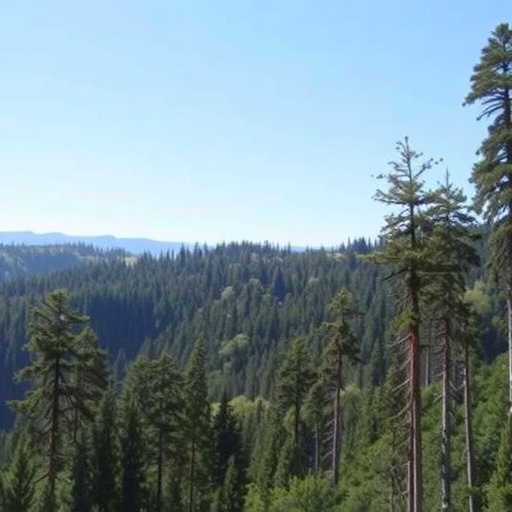
Reforestation has long been heralded as a vital strategy for combating climate change, with widespread societal, political, and scientific backing. Notable global initiatives, such as the United Nations Environment Programme’s Trillion Tree Campaign, aim to sequester billions of tonnes of carbon dioxide through extensive tree planting projects. Yet, despite such ambitions, the precise amount of land suitable for large-scale reforestation and its real-world climate impact continue to be subjects of intense debate. Estimates fluctuate widely, suggesting that between 150 million and 1 billion hectares could be effective in absorbing anywhere from 130 to 750 gigatonnes of CO₂, depending on the criteria and assumptions employed.
Until recently, most analyses have tended to focus on individual or idealized reforestation scenarios without fully capturing the complex and multifaceted interactions that real-world ecosystems exhibit. However, a groundbreaking study spearheaded by Professor Robert Jnglin Wills of ETH Zurich has, for the first time, employed an advanced Earth system model to simulate and contrast the climate outcomes of three distinct global reforestation scenarios. These scenarios differ not only in their assumptions about economic and ecological feasibility but also in spatial distribution and management strategies.
Unlike previous approaches that primarily accounted for the biochemical role of trees—namely the uptake of CO₂ through photosynthesis—this study incorporates both biochemical and biophysical effects. The latter includes crucial factors such as alterations in surface albedo, evapotranspiration rates, and changes to land surface properties resulting from forest cover, which can significantly modulate local and global climate feedbacks. For instance, while photosynthesis directly reduces atmospheric CO₂ concentrations, changes in albedo can either amplify or counteract cooling depending on factors like latitude and seasonal snow cover.
The study’s three selected reforestation scenarios include one developed by Jean-François Bastin’s team at ETH Zurich in 2019, a pivotal but controversial plan still referenced in various international policy frameworks. Researchers modeled maximal reforestation implementation between 2015 and 2070, after which forest areas were held constant for three decades. Importantly, the scenarios excluded urban, barren, or ice-covered land, and minimized conversion of agricultural land to avoid threatening food security. This ensured the focus remained on ecologically and socially viable restoration areas.
To rigorously evaluate the climate impacts, the team deployed a comprehensive coupled climate model integrating atmosphere, ocean, and terrestrial components. To avoid conflating random climate variability with reforestation effects, the simulations were replicated five times under slightly varying initial conditions. Conducted on the ETH ‘Euler’ supercomputer, the extensive simulations spanned over four months and generated voluminous data amounting to 300 terabytes, allowing for unprecedented detail in capturing subtle climatic responses.
Remarkably, the results revealed that despite a disparity of 450 million hectares between two of the examined scenarios, their global cooling effects were nearly identical. This difference in land area approximates the combined size of all European Union countries, underscoring the importance of spatial targeting over sheer quantity. According to lead author Nora Fahrenbach, the efficiency gain is attributable to the geographical placement of reforestation efforts—demonstrating that strategic location trumps scale alone in optimizing climate benefits.
Tropical regions stood out as hotspots for maximal climate mitigation efficacy. Forest restoration in the Amazon basin and regions within West and Southeast Africa results not only in robust carbon storage but also in significant local cooling through elevated evapotranspiration, which dissipates heat via water vapor release. Southeast Asia also demonstrated moderate potential in this regard. Conversely, reforesting vast tracts in high northern latitudes, such as Siberia, Canada, and Alaska, often leads to less net cooling or even localized warming.
This northern warming phenomenon arises from the biophysical feedbacks associated with albedo during snow-covered months. Snow and ice reflect a substantial portion of solar radiation, maintaining regional cooling. When these white surfaces are replaced by dark tree canopies, more sunlight is absorbed, elevating surface temperatures. This effect can counterbalance or negate the biochemical cooling effects from CO₂ sequestration, illustrating the nuanced trade-offs inherent in high-latitude reforestation.
Beyond direct local impacts, the research highlights how modified land cover through reforestation influences atmospheric and oceanic circulation patterns, thereby affecting climate variables thousands of kilometers away. Intriguingly, the sign and magnitude of these teleconnections varied substantially among the three scenarios, revealing complex interdependencies in the global climate system. This recognition challenges simplistic local-to-global extrapolations and calls for integrated planning that accounts for these remote effects.
Importantly, the study confined itself to analyzing climatic outcomes, deliberately excluding considerations of biodiversity, ecosystem health, and socio-economic impacts on local communities. Moreover, the results derive from a single Earth system model, highlighting the need for future inter-model comparisons to validate and refine these insights. Nonetheless, congruence with observational data and other modeling efforts lends credence to the key conclusions.
One of the most crucial takeaways is the affirmation that tropical forests exert a disproportionately greater cooling influence than their temperate and boreal counterparts, a finding that has been qualitatively known but now quantitatively substantiated through rigorous simulation. This evidence offers an invaluable tool for policymakers striving to prioritize reforestation investments with maximal climate leverage.
Looking ahead, the researchers advocate for internationally coordinated, climate-smart reforestation strategies that emphasize where trees are planted, rather than indiscriminate scaling up of forest area. Such an approach would preclude inefficient or counterproductive interventions. However, the absence of global institutional frameworks to govern reforestation efforts remains a significant gap. Additionally, existing climate agreements, including the Paris Agreement and UN REDD+ initiatives, tend to regard forests solely as carbon sinks and insufficiently acknowledge their biophysical climate effects.
Furthermore, the scientists emphasize that reforestation, while beneficial, is not a panacea for climate change. Even under optimistic scenarios, tree planting could at most reduce global average temperatures by approximately 0.25°C by the end of the century. This incremental benefit, while noteworthy, pales compared to the scale of emissions reductions urgently necessary to avoid catastrophic warming. Therefore, aggressive curtailment of fossil fuel use remains paramount.
Moreover, ethical and ecological best practices must prevail in reforestation efforts, avoiding monocultures that are particularly vulnerable to pests, diseases, and wildfires. The study’s call for a systematic, science-based, and globally coordinated approach aims to optimize climate outcomes while safeguarding biodiversity and ecosystem resilience.
In essence, these findings underscore the critical importance of nuanced, data-driven strategies in leveraging reforestation for climate mitigation. Generating not only carbon storage but also harnessing favorable biophysical feedbacks requires a geographically informed approach centered on tropical ecosystems. Sound policy built on this foundation can significantly strengthen global efforts to combat climate change, even as it underscores the indispensability of comprehensive emissions reductions.
News Publication Date: 11 March 2026
Web References:
References:
- Wills, R. J., Fahrenbach, N., et al. (2026). Communications Earth & Environment. DOI: 10.1038/s43247-026-03331-3
Cite this news
SCIENMAG. (March 16, 2026). Not All Forests Help Cool the Earth. https://scienmag.com/not-all-forests-help-cool-the-earth/
SCIENMAG. "Not All Forests Help Cool the Earth." Scienmag, 16 March 2026, https://scienmag.com/not-all-forests-help-cool-the-earth/. Accessed 28 August 2026.
SCIENMAG. "Not All Forests Help Cool the Earth." Scienmag. March 16, 2026. https://scienmag.com/not-all-forests-help-cool-the-earth/


