


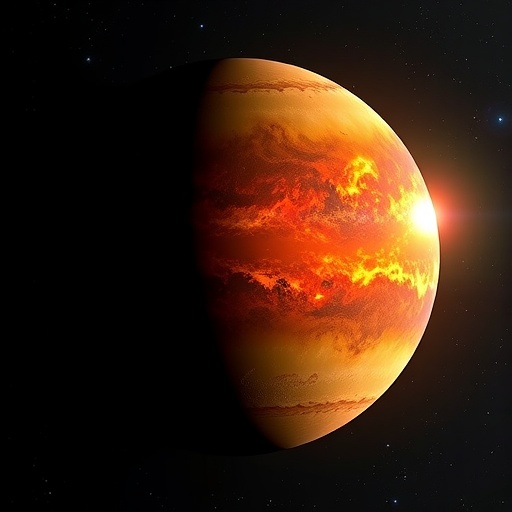
A groundbreaking study spearheaded by researchers at the University of Oxford has uncovered an extraordinary new class of exoplanet distinguished by its capacity to store vast amounts of sulphur deep beneath a surface dominated by a permanent ocean of molten rock. This remarkable discovery, published in the prestigious journal Nature Astronomy, challenges our existing planetary classifications and broadens the horizons of planetary science beyond our Solar System.
The exoplanet in question, designated L 98-59 d, lies approximately 35 light-years from Earth, orbiting a modest red dwarf star. Its physical dimensions, about 1.6 times larger than Earth, alongside its notably low density, initially baffled astronomers. Recent measurements captured by the James Webb Space Telescope (JWST) and corroborated by terrestrial observatories indicated the unexpected presence of abundant hydrogen sulfide—a sulphur compound—in its atmosphere, a finding that defies conventional planetary models.
Traditionally, astrophysicists categorized planets like L 98-59 d as either rocky “gas dwarfs” enveloped by thick hydrogen atmospheres or as water-rich worlds dominated by oceans and ice. However, comprehensive simulations developed by an international team of scientists from the University of Oxford, Groningen, Leeds, and ETH Zurich reveal that L 98-59 d does not conform to either paradigm. Instead, it represents a novel planetary archetype defined by sulphur-rich chemistry and a molten, magma-dominated interior.
Using advanced physical and chemical modeling techniques, the research team meticulously reconstructed the evolutionary history of L 98-59 d over nearly five billion years. These simulations, integrating observational data with detailed planetary interior and atmospheric models, unveiled a planet with a mantle composed predominantly of molten silicate rock—akin to terrestrial lava—wrapped in a global magma ocean extending thousands of kilometers in depth. This magma ocean serves as a massive reservoir capable of sequestering enormous quantities of sulphur, influencing the planet’s atmospheric composition over geological timescales.
One of the key insights from this study lies in the dynamic exchange of volatile compounds between the molten interior and the overlying hydrogen-rich atmosphere. Despite the intense X-ray radiation emitted by the host star, which typically strips light atmospheres from low-mass planets, L 98-59 d has retained a dense envelope containing gases such as hydrogen sulfide (H₂S). The magma ocean acts as a stabilizing buffer, gradually releasing sulphurous volatiles into the atmosphere, maintaining chemical equilibrium across eons.
The implications of these findings suggest the existence of an entire class of sulphur-laden, magma-ocean-bearing exoplanets, challenging the simplicity of planetary classification and hinting at a far richer diversity of planetary types than previously recognized. If L 98-59 d is representative, then the Galaxy may host numerous planets where internal geochemical processes fundamentally shape atmospheric characteristics in ways not witnessed in our own Solar System.
Dr. Harrison Nicholls, the leading astrophysicist on this research, expressed enthusiasm about the ramifications of this discovery. “Our findings imply that the current frameworks astronomers use to categorize small exoplanets may be overly simplistic,” he said. “While a molten, sulphur-rich planet like L 98-59 d is unlikely to harbor life, it underscores the extraordinary variety of planetary environments awaiting discovery. This prompts the profound question: what other exotic worlds remain hidden in the cosmos?”
Central to the planet’s atmospheric composition is the interaction of ultraviolet radiation from the red dwarf star with sulphur-based gases high in the atmosphere. JWST data from 2024 revealed spectral signatures consistent with sulphur dioxide and other sulphur compounds. The research models elucidate how photochemical reactions driven by stellar UV flux produce these gases. Simultaneously, the vast magma ocean below continuously supplies these volatiles, ensuring a steady-state atmospheric composition that aligns with observational data.
From a planetary formation standpoint, simulations suggest that L 98-59 d originally possessed an abundance of volatile compounds, possibly resembling a sub-Neptune in its youth. Over billions of years, the planet cooled and contracted, shedding portions of its primordial atmosphere yet retaining its characteristic magma ocean and sulphur-rich atmosphere. This evolutionary pathway provides a new lens to interpret how rocky planets, including Earth and Mars, may have cooled from molten beginnings, but with the added complexity of volatile sulphur chemistry.
Professor Raymond Pierrehumbert, a prominent co-author, emphasized the power of computer modeling to illuminate the concealed interiors of distant worlds. “Despite our observational constraints—we can only assess a planet’s size, mass, and atmosphere remotely—these models provide a means to reconstruct a planet’s hidden past and interior processes,” he noted. This approach heralds a new era where theoretical frameworks and observational data interlace to reveal the intricate tapestries of alien planets unseen by human eyes.
Looking forward, the study’s authors highlight the promise of forthcoming missions such as Ariel and PLATO, which will yield more detailed atmospheric measurements of exoplanets. By applying machine learning algorithms to integrate these data with sophisticated interior-atmosphere models, researchers aim to map the vast diversity of worlds populating our galaxy. This pursuit not only deepens our understanding of planetary formation mechanics but also informs the search for potentially habitable environments beyond Earth.
Dr. Richard Chatterjee from the University of Leeds and Oxford remarked on the intriguing role of hydrogen sulfide—a gas familiar to us as the source of the scent of rotten eggs—in shaping planetary atmospheres in unforeseen ways. “Our simulations enable us to essentially rewind the evolutionary clock, offering insights into how this peculiar class of rocky exoplanets developed complex atmospheres dominated by sulphur compounds,” he explained. “Further observational efforts will be critical to discern whether such ‘pungent’ planets are anomalies or a common occurrence in the Universe.”
This pioneering research opens an exciting chapter in exoplanetary science by unveiling a heretofore unrecognized planetary type, defined by deep magma oceans and sulphur-rich atmospheres. As humanity’s astronomical toolkit advances, revealing ever more detailed portraits of distant planets, the cosmic menagerie of worlds continues to expand, reminding us that the Universe is more diverse and stranger than our most imaginative speculations.
News Publication Date: 16 March 2026
Web References:
DOI Link – http://dx.doi.org/10.1038/s41550-026-02815-8
Keywords
Exoplanet, L 98-59 d, sulphur-rich atmosphere, magma ocean, hydrogen sulfide, James Webb Space Telescope, planetary evolution, molten super-Earth, red dwarf star, photochemistry, planetary interior, volatile compounds
Cite Scienmag News
Grant Pearson. (March 16, 2026). Scientists Discover a New Class of Molten Planets. Scienmag. https://scienmag.com/scientists-discover-a-new-class-of-molten-planets/
Grant Pearson. "Scientists Discover a New Class of Molten Planets." Scienmag, 16 March 2026, https://scienmag.com/scientists-discover-a-new-class-of-molten-planets/. Accessed 2 September 2026.
Grant Pearson. "Scientists Discover a New Class of Molten Planets." Scienmag. March 16, 2026. https://scienmag.com/scientists-discover-a-new-class-of-molten-planets/


