


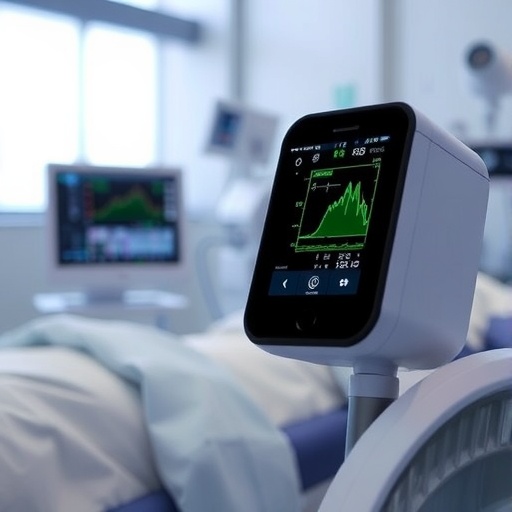
In the rapidly evolving realm of neonatal and pediatric care, accurate and continuous monitoring of respiratory status remains paramount. Carbon dioxide (CO2) levels serve as a critical marker reflecting a patient’s ventilatory adequacy and metabolic state. The advent and refinement of transcutaneous carbon dioxide monitoring (tcCO2) herald a potential paradigm shift from traditional arterial and end-tidal CO2 measurements toward a less invasive, continuous, and reliable modality. Recent research authored by van de Geer, Miedema, and Tingay, published in Pediatric Research (2026), explores this technology’s readiness to become a new standard of care in pediatric respiratory monitoring, sparking considerable discussion across clinical and scientific communities.
Transcutaneous carbon dioxide monitoring capitalizes on measuring the partial pressure of CO2 diffusing through the skin, providing an indirect yet continuous estimate of arterial CO2 tension (PaCO2). This method involves the application of a sensor heated to enhance capillary blood flow beneath the skin, thereby facilitating accurate gas diffusion detection. Such a technique is non-invasive, causing minimal discomfort to patients who often require frequent or prolonged monitoring, including neonates, infants, and critically ill children. The research highlights substantial advancements in sensor technology, calibration, and data integration, overcoming historical barriers such as sensor drift, skin irritation, and response time delays.
From a physiological perspective, CO2 monitoring is crucial because fluctuations in carbon dioxide levels directly affect acid-base balance, cerebral blood flow, and respiratory drive. Traditional methods include arterial blood gas (ABG) analysis, which is invasive and provides only intermittent snapshots of the patient’s status, and end-tidal CO2 (EtCO2) measurement, which depends heavily on ventilatory mechanics and may be unreliable in specific pathological states. The transcutaneous modality addresses these limitations by delivering real-time continuous data with minimal invasiveness, thus offering a more dynamic and patient-friendly approach, especially vital in neonatal intensive care units (NICUs).
The article rigorously compares tcCO2 monitoring accuracy with blood gas analysis and EtCO2 measurements in diverse clinical scenarios. The findings emphasize a high correlation between tcCO2 readings and PaCO2 in stable patients, with slight discrepancies predominantly observed during rapid physiological changes or poor skin perfusion. These limitations are counterbalanced by improvements in algorithmic data processing and sensor design, which enhance real-time accuracy and minimize the impact of external factors like temperature variability and patient movement. The study underscores that while tcCO2 may not fully replace blood gas analysis, it serves as a crucial adjunct capable of reducing the frequency of invasive blood draws.
One of the most critical clinical implications of adopting tcCO2 as standard care relates to patient safety and comfort. Neonates and pediatric patients in respiratory distress frequently undergo repetitive blood sampling, which carries risks such as anemia, infection, and pain. Transcutaneous monitoring mitigates these risks by drastically reducing the need for arterial punctures and continuous invasive catheterization. The technology’s seamless integration with existing monitoring systems also facilitates proactive respiratory management by enabling clinicians to detect early signs of ventilatory failure, hypercapnia, or hypocapnia before clinical deterioration occurs.
Moreover, the adoption of tcCO2 monitoring has significant utility in managing chronic respiratory conditions and during procedural sedation or anesthesia. Prolonged mechanical ventilation and non-invasive ventilation strategies can be fine-tuned with continuous transcutaneous data, improving ventilator synchrony and reducing the risk of lung injury related to inappropriate ventilation settings. The device’s ability to provide continuous feedback during sedative administration allows anesthesiologists to adjust respiratory support dynamically, avoiding potential complications associated with hypoventilation.
Technology integration stands at the forefront of the article’s discussion, emphasizing the pivotal role of digital health innovations. Modern tcCO2 monitors are equipped with wireless data transmission capabilities, algorithmically enhanced trend analyses, and alarm systems capable of alerting healthcare providers in real time to critical deviations. Such features promote rapid clinical decision-making and facilitate remote monitoring, a paradigm particularly relevant amidst growing telemedicine applications and the demand for decentralized critical care in resource-limited settings.
The authors acknowledge the remaining challenges to universal implementation, including cost considerations, staff training, and the necessity of protocol standardization. Although tcCO2 monitoring equipment entails initial investment, the potential reductions in blood sampling-related complications and the optimization of ventilatory support can offset these costs over time. The article advocates for comprehensive education programs to ensure clinical teams are proficient in sensor placement, interpretation of data trends, and troubleshooting technical pitfalls, which are essential for maximizing patient outcomes.
An interesting dimension covered in the research involves the physiological variations affecting transcutaneous CO2 readings in neonates compared to older children or adults. Neonates possess thinner skin and differing thermoregulatory characteristics, factors which both facilitate and complicate tcCO2 monitoring. Sensor calibration must be finely tuned to these variables to avoid false results caused by heat sensitivity and skin perfusion disparities. The authors call for ongoing research into sensor materials and heating protocols to optimize performance in this delicate patient population.
Equally compelling is the discussion on future research directions and technology enhancements. The researchers propose developing multi-parameter sensors capable of simultaneously measuring oxygen saturation, CO2, and other vital signs through a single skin probe. Integration with artificial intelligence-driven predictive models could revolutionize patient monitoring, offering clinicians unprecedented foresight into respiratory trends and enabling truly personalized respiratory care regimens. They emphasize the necessity for multicenter clinical trials assessing long-term outcomes associated with tcCO2 monitoring across various pediatric populations.
The comprehensive review also contrasts international guidelines regarding CO2 monitoring, revealing a notable gap in standardized practices related to transcutaneous technology. Although some institutions have begun adopting tcCO2 monitoring in routine care, heterogeneity in protocols persists, potentially limiting broader acceptance and consistent reporting standards. The article advocates for consensus-building workshops and guideline updates spearheaded by pediatric respiratory and critical care societies to harmonize approaches globally, facilitating clearer benchmarks for technology use.
The clinical vignettes interspersed in the article vividly demonstrate tcCO2 monitoring’s tangible benefits in complex cases, such as infants with congenital diaphragmatic hernia or severe bronchiolitis. Continuous CO2 monitoring provided crucial insights into respiratory fluctuations during therapeutic interventions, enabling tailored adjustments to ventilation strategies and minimizing incidences of hypercapnia and acidosis. Such real-world applications significantly bolster the argument for transcutaneous carbon dioxide monitoring’s routine incorporation into pediatric respiratory management.
Further analysis addresses potential risks associated with the technology, such as skin burns from prolonged sensor heating or inaccurate readings due to poor sensor adherence. The authors stress vigilant monitoring for these adverse events and recommend protocols involving periodic sensor repositioning and skin assessment, particularly in fragile neonates. The balance between continuous monitoring and skin integrity preservation remains a delicate clinical consideration and an area requiring continued innovation.
Perhaps most excitingly, the article situates transcutaneous CO2 monitoring within the larger context of evolving critical care paradigms characterized by minimally invasive monitoring technologies and personalized medicine. As healthcare shifts towards data-driven, patient-centric interventions, the ability to continuously, non-invasively monitor critical physiological parameters in real-time aligns perfectly with these modern priorities. The research foretells a future where tcCO2 measurement is not just an adjunct but a cornerstone method enhancing respiratory management and optimizing outcomes.
In conclusion, van de Geer, Miedema, and Tingay’s study presents a compelling case for transcutaneous carbon dioxide monitoring to become standard of care in pediatric respiratory monitoring. With its non-invasive nature, continuous data provision, and technological sophistication, tcCO2 monitoring promises to revolutionize clinical care by improving patient safety, comfort, and clinical outcomes. Although pockets of challenge remain, the trajectory of ongoing research, technological innovation, and clinical adoption suggests that transcutaneous CO2 measurement is poised to become an indispensable tool in pediatric medicine within the next decade.
van de Geer, A., Miedema, M. & Tingay, D.G. Transcutaneous carbon dioxide monitoring: ready to be standard of care?. Pediatr Res (2026). https://doi.org/10.1038/s41390-026-04910-y
Cite Scienmag News
Harold Sullivan. (March 15, 2026). Transcutaneous CO2 Monitoring: The Future Standard of Care? Scienmag. https://scienmag.com/transcutaneous-co2-monitoring-the-future-standard-of-care/
Harold Sullivan. "Transcutaneous CO2 Monitoring: The Future Standard of Care?" Scienmag, 15 March 2026, https://scienmag.com/transcutaneous-co2-monitoring-the-future-standard-of-care/. Accessed 4 September 2026.
Harold Sullivan. "Transcutaneous CO2 Monitoring: The Future Standard of Care?" Scienmag. March 15, 2026. https://scienmag.com/transcutaneous-co2-monitoring-the-future-standard-of-care/


