


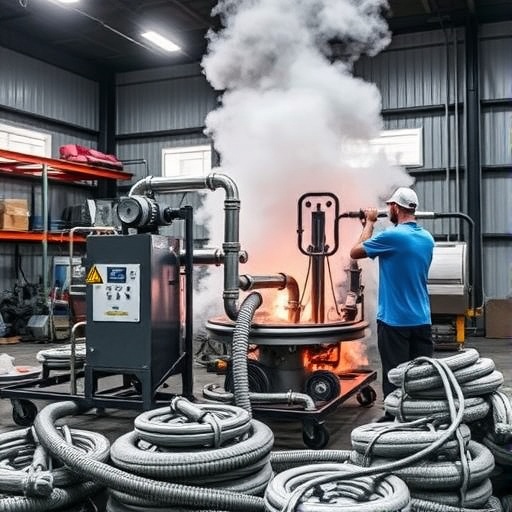
In a groundbreaking development that promises to revolutionize sustainability in high-tech manufacturing, a team of researchers led by Liu, Ni, and Zhou has unveiled an innovative approach to repurpose wastewater from integrated circuit (IC) fabrication into a valuable resource for producing metal catalysts. Their study, recently published in Nature Communications, elucidates how the often-overlooked byproducts of semiconductor manufacturing can be transformed into critical components of catalytic processes, potentially reshaping the entire metal catalyst supply chain.
Integrated circuit manufacturing is at the heart of modern electronics, driving everything from smartphones to quantum computing devices. However, the elaborate chemical processes involved generate large quantities of wastewater laden with trace metals and complex chemical species. Traditionally, this wastewater has posed significant environmental challenges due to the presence of heavy metals such as copper, nickel, and palladium, which are toxic at high concentrations and difficult to extract efficiently. Conventional treatment methods often focus merely on detoxification rather than resource recovery, leading to wastage of precious metals.
The research team approached this challenge by reimagining wastewater not as a waste stream but as a secondary resource that could feed into industrial catalyst production. Metal catalysts are indispensable in various chemical industries, including pharmaceutical manufacturing, petrochemicals, and renewable energy technologies. The high demand and cost of noble metals used in catalysts pose economic and environmental burdens, thereby motivating efforts to find alternative sourcing strategies.
Central to their approach is a novel extraction and purification technique that harnesses tailored chemical processes to selectively isolate metal ions from the complex wastewater matrix. By leveraging advanced chelation chemistry combined with electrochemical separation technologies, the researchers achieved recovery efficiencies surpassing 90% for metals critical to catalytic activity. This method effectively concentrates the metals to purity levels suitable for subsequent catalyst synthesis.
Once purified, the reclaimed metals serve as feedstock for manufacturing a suite of metal catalysts with performance metrics comparable to those produced from virgin raw materials. The team demonstrated this by fabricating catalysts for hydrogenation and oxidation reactions, pivotal in chemical industries. Rigorous characterization techniques, including X-ray diffraction and electron microscopy, confirmed the structural integrity and catalytic activity of the recovered-material catalysts.
This research holds profound implications beyond resource efficiency. By integrating wastewater recycling into the catalyst supply chain, the environmental footprint of both semiconductor fabrication and catalytic processes could be significantly reduced. It addresses pressing concerns over mining impacts, geopolitical dependencies on critical metals, and the mounting challenge of industrial waste management.
Moreover, the circular economy model proposed represents a paradigm shift in industrial symbiosis, where waste streams from one sector become valuable inputs for another. Such integration enhances sustainability, resilience, and economic viability of manufacturing ecosystems, aligning with global initiatives toward greener, more responsible industrial practices.
The study also provides a blueprint for scaling and industrial adoption. The modularity of extraction systems allows retrofit into existing wastewater treatment facilities at semiconductor plants, minimizing disruption while maximizing economic returns. The cost-benefit analyses conducted suggest that the recovery process can not only cover its operational costs through metal reclamation but also generate surplus value, incentivizing broader application.
Beyond metals typically present in IC wastewater, the approach may be adapted for other emerging contaminants, enabling comprehensive recovery of diverse valuable elements. This opens pathways for multidisciplinary collaborations across materials science, environmental engineering, and industrial chemistry to further expand sustainability portfolios.
A notable aspect of the research is its alignment with recent policies encouraging resource circularity in technology sectors. Governments and industries worldwide increasingly emphasize reducing reliance on virgin raw materials and promoting recycling, making this innovation timely and potentially transformative for global supply chains.
Critically, the environmental lifecycle assessments performed indicate substantial reductions in greenhouse gas emissions, water consumption, and hazardous waste generation compared to conventional practices. These benefits contribute not only to corporate social responsibility agendas but also to achieving international climate and sustainability goals.
The findings have already sparked interest across academia and industry, with several semiconductor manufacturers and catalyst producers exploring pilot projects to validate these processes at commercial scales. Successful translation could catalyze a wave of sustainable manufacturing innovations, fostering collaboration between sectors historically viewed as distinct.
In conclusion, the pioneering work by Liu, Ni, Zhou, and colleagues represents a significant stride towards sustainable high-tech manufacturing. By transforming integrated circuit wastewater from an environmental challenge into a resource stream feeding metal catalyst production, their approach exemplifies the power of innovative chemistry coupled with systems thinking. This integration heralds a new era in circular industrial practices, promising economic, environmental, and technological benefits that extend well beyond the confines of semiconductor factories.
As industries worldwide grapple with resource constraints and environmental mandates, such creative cross-sector solutions will be crucial. The research invites further exploration into other waste-to-resource opportunities, inspiring a future where sustainability and technological advancement go hand in hand.
Cite Scienmag News
Bethany Barker. (March 15, 2026). Recycling IC Wastewater in Metal Catalyst Supply. Scienmag. https://scienmag.com/recycling-ic-wastewater-in-metal-catalyst-supply/
Bethany Barker. "Recycling IC Wastewater in Metal Catalyst Supply." Scienmag, 15 March 2026, https://scienmag.com/recycling-ic-wastewater-in-metal-catalyst-supply/. Accessed 4 September 2026.
Bethany Barker. "Recycling IC Wastewater in Metal Catalyst Supply." Scienmag. March 15, 2026. https://scienmag.com/recycling-ic-wastewater-in-metal-catalyst-supply/


