


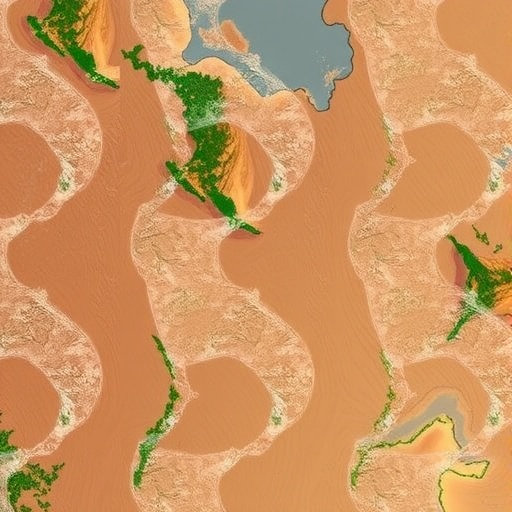
In a groundbreaking study poised to transform environmental monitoring and disaster preparedness, scientists have unveiled how satellite-derived insights into soil surface dynamics dramatically reduce both the extent and frequency of sediment flux events. These revelations stand to reshape early warning systems, providing unprecedented capabilities to predict and mitigate sediment-related hazards, with profound implications for ecological conservation, infrastructure stability, and community safety worldwide.
Sediment flux— the movement of soil particles across landscapes driven primarily by water and wind erosion—poses a persistent environmental challenge. It contributes to soil degradation, water quality loss, reservoir silting, and elevated flood risks. However, until recently, the ability to monitor and predict sediment flux over large areas in near real-time has been severely constrained by limitations in ground-based observation networks and traditional modeling approaches. The recent study led by Zhou, Chappell, Zhang, and colleagues employs state-of-the-art satellite imagery to bridge this critical knowledge and technology gap.
At the heart of the research lies the innovative use of remote sensing technologies that capture detailed soil surface dynamics with unprecedented temporal and spatial resolution. By deploying multispectral and hyperspectral satellite sensors, researchers could monitor subtle changes in soil moisture, texture, surface roughness, and vegetation cover—key determinants of sediment mobilization and transport. These satellite-derived datasets facilitate a dynamic, high-fidelity portrait of landscape conditions susceptible to erosion, enabling predictive analytics seldom attainable through conventional methods.
The researchers integrated this wealth of remote sensing data into advanced computational models that simulate sediment flux processes under a variety of meteorological and land-use scenarios. This approach captures the interactive complexity of erosive forces, capturing how rainfall intensity, wind patterns, soil composition, and anthropogenic activities dynamically influence sediment detachment, transport, and deposition. Crucially, it moves beyond static assessments into a framework capable of real-time monitoring and forecasting.
One of the most compelling findings of the study is the quantification of how reductions in sediment flux frequency and magnitude can be linked to specific soil surface dynamics remotely detected via satellite. Variations in vegetation cover, for instance, serve as natural buffers against erosion; these fluctuations tracked from space provide early indications of landscape vulnerability well before large-scale soil displacement occurs. Moreover, the temporal data reveal how episodic events such as droughts or intense precipitation periods act as triggers for heightened sediment flux, allowing for time-sensitive hazard alerts.
The implications of these findings extend significantly into the realm of early warning systems. Current warning protocols for landslides, flash floods, and sediment-induced turbidity events are often reactive and hampered by sparse observational inputs. By contrast, satellite-driven soil surface monitoring introduces a proactive dimension, where predictive thresholds derived from empirical satellite data inform timely advisories. Early interventions—such as temporary land use restrictions or targeted conservation practices—can then be strategically implemented to avert catastrophic sediment displacement.
Beyond disaster risk reduction, the study’s outcomes also hold substantial value for sustainable land and water resource management. Soil erosion is a leading factor in agricultural productivity decline and habitat degradation. The refined understanding of soil surface conditions and sediment flux patterns enabled by satellites permits more precise, site-specific conservation measures. For instance, farmers can optimize soil stabilization techniques in vulnerable zones, while watershed managers can prioritize sediment control infrastructure based on dynamically updated risk maps.
Technically, the success of this research hinges on synergizing diverse satellite capabilities, including synthetic aperture radar (SAR) and optical imaging, which complement each other in capturing surface texture and moisture content. Coupled with machine learning algorithms that analyze vast temporal datasets, this hybrid approach assures high accuracy and robust generalizability across diverse geographies and soil types. This interdisciplinary synthesis marks a significant leap from previous sediment monitoring approaches, which typically relied on either limited ground samplings or coarse-resolution remote sensing.
Moreover, the study pioneers the use of satellite telemetry not only to observe soil surface features but also to discern their evolving feedback mechanisms with climatic variables. This insight is essential given the escalating climate variability that exacerbates soil erosion through increased frequency of extreme weather events. By calibrating sediment flux models with live environmental data streams, the system adapts iteratively to emerging patterns, enhancing forecast reliability under future climate scenarios.
A critical aspect of the research is the validation of satellite-based sediment flux estimations against extensive field measurements and sediment transport records. The close concordance between satellite-derived predictions and independent observational datasets attests to the methodological rigor of the study. It confirms that remote sensing can serve as a credible proxy for in-situ sediment monitoring, particularly in remote or inaccessible terrains where traditional observations are logistically challenging.
The study also addresses the socio-economic dimensions of sediment flux mitigation. Sediment-related disasters disproportionately impact vulnerable communities with limited adaptive capacity. By making sediment flux monitoring more accessible and scalable via satellite platforms, the approach democratizes hazard information dissemination. This empowers local authorities and residents with actionable knowledge, fostering community resilience through informed decision-making and participatory risk management practices.
While the potential is immense, the researchers note ongoing challenges to be tackled to fully operationalize satellite-retrieved soil surface dynamics for early warning systems. Data latency and satellite revisit intervals can limit real-time responsiveness in some contexts. Additionally, integrating heterogeneous datasets from multiple satellite missions requires harmonization protocols to ensure consistency and interoperability. Nonetheless, emerging satellite constellations with higher temporal revisit rates and improved sensor technologies promise to overcome these hurdles imminently.
Cross-sector collaborations will be vital to translating these scientific advancements into operational early warning frameworks. Partnerships between government agencies, environmental organizations, technology providers, and local stakeholders can leverage satellite data to inform policy-making, land management, and emergency preparedness. The study emphasizes that embedding satellite-derived sediment flux insights into existing geospatial information systems and decision support tools will maximize their societal impact.
In essence, this pioneering research affirms that satellite technologies provide an unparalleled vantage point to capture the dynamic interplay between soil surfaces and sediment transport processes. By transforming our ability to observe and predict sediment flux, the findings chart a new frontier in environmental monitoring that aligns with global priorities on disaster risk reduction, sustainable development, and climate resilience. As nations face mounting pressures from land degradation and extreme weather, harnessing such remote sensing innovations will be indispensable.
Looking ahead, the integration of artificial intelligence and big data analytics with high-resolution satellite observations is poised to unlock even deeper insights into sediment flux phenomena. Future studies may extend this framework to explore the complex interactions between soil erosion, carbon cycling, and ecosystem services, thereby embedding sediment flux understanding within broader Earth system science paradigms. This trajectory underscores the transformative potential of satellite Earth observation to safeguard landscapes and livelihoods alike.
In conclusion, the application of satellite retrieved soil surface dynamics represents a quantum leap forward for sediment flux assessment and mitigation. By significantly reducing the spatial reach and temporal frequency of sediment displacement events, this approach equips society with cutting-edge tools for early detection and intervention. The multi-disciplinary, data-driven methodology championed by Zhou, Chappell, Zhang, and their team signals a promising horizon where science and satellite technology converge to protect our planet’s fragile soil resources and build a safer, more resilient future.
Zhou, Z., Chappell, A., Zhang, C. et al. Satellite retrieved soil surface dynamics reduce the extent and frequency of sediment flux with implications for early warning systems.
Commun Earth Environ (2026). https://doi.org/10.1038/s43247-026-03368-4
Cite Scienmag News
Violet Maxwell. (March 15, 2026). Satellite Data Reveals Soil Dynamics Curtailing Sediment Flux. Scienmag. https://scienmag.com/satellite-data-reveals-soil-dynamics-curtailing-sediment-flux/
Violet Maxwell. "Satellite Data Reveals Soil Dynamics Curtailing Sediment Flux." Scienmag, 15 March 2026, https://scienmag.com/satellite-data-reveals-soil-dynamics-curtailing-sediment-flux/. Accessed 31 August 2026.
Violet Maxwell. "Satellite Data Reveals Soil Dynamics Curtailing Sediment Flux." Scienmag. March 15, 2026. https://scienmag.com/satellite-data-reveals-soil-dynamics-curtailing-sediment-flux/


