


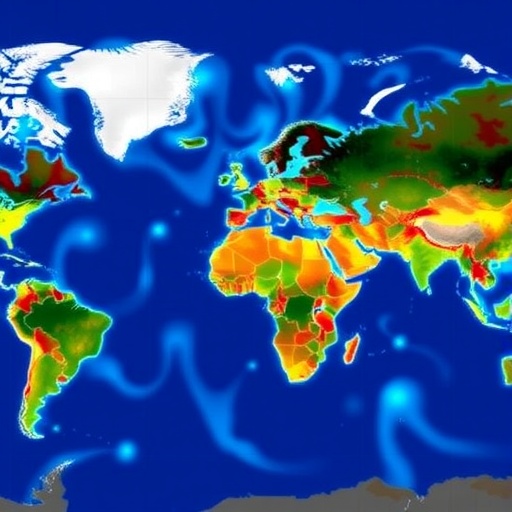
In recent years, the accelerating impact of global change drivers such as climate change, habitat destruction, and pollution has posed unprecedented threats to biodiversity worldwide. Understanding how species respond over time to these complex environmental pressures remains one of the most pressing challenges in ecology and conservation biology. A groundbreaking study published in Nature Communications in 2026 by Sasaki, Iwachido, Lam-Gordillo, and colleagues breaks new ground by demonstrating that the biological traits of species can robustly predict their dynamic responses to multiple simultaneous global change drivers.
The crux of this research lies in bridging species-specific biological characteristics with their temporal response patterns to a suite of environmental stressors that operate concurrently and vary over different spatial and temporal scales. Prior investigations have often focused on single stressors or snapshot observations, limiting our ability to forecast how biodiversity might shift under multifaceted global change scenarios. Sasaki and team have taken a significant leap forward by employing a trait-based framework that integrates physiological, morphological, and life-history traits to model species trajectories through space and time as influenced by several interacting global drivers.
Key to the study is the recognition that biological traits are not static but exert varying influences on species resilience and vulnerability depending on the temporal context and the specific combination of drivers in play. For example, a species’ reproductive rate, dispersal ability, or thermal tolerance may confer advantages or increase susceptibility at different stages of environmental change. By systematically quantifying these traits and their temporal modulation, the researchers provide a predictive lens capable of anticipating which species are more likely to persist, adapt, or decline under complex change regimes.
The methodological innovation underpinning this work involves sophisticated statistical modeling coupled with extensive empirical data gathered from diverse ecosystems spanning terrestrial, freshwater, and marine realms. The team curated and synthesized trait databases alongside long-term population monitoring to calibrate models that capture non-linear and time-varying effects of global change drivers on species abundances and distributions. This integrative approach allowed them to tease apart the nuanced interplay between intrinsic biological traits and extrinsic environmental pressures over multiple time horizons.
Findings from this research have profound implications for conservation prioritization and ecosystem management in a rapidly changing world. By identifying trait syndromes linked to heightened sensitivity or resilience, conservationists can better target interventions toward species and habitats at greatest risk. Moreover, recognizing that species responses fluctuate over time underscores the necessity of adaptive management strategies that evolve as environmental conditions and biological responses unfold dynamically.
In addition, the study advances theoretical frameworks within ecology by highlighting how trait-environment interactions operate within temporal niches. This dynamic perspective challenges traditional static models of species vulnerability and calls for integrating trait plasticity and temporal variability into predictive biodiversity assessments. It also suggests that evolutionary responses to global change may be constrained or facilitated by the temporal context in which traits confer fitness advantages or penalties.
The research addresses an urgent need to improve forecasts of biodiversity outcomes amid the compounded effects of global change drivers. As climate extremes intensify, habitats degrade, and anthropogenic pressures mount, the capacity to anticipate temporal shifts in species responses is critical for mitigating biodiversity loss. Sasaki et al.’s trait-driven predictive framework offers a valuable tool for scenario planning, enabling policymakers and scientists to simulate future trajectories under alternative intervention pathways.
Equally important is the study’s demonstration of cross-ecosystem applicability. By encompassing terrestrial, freshwater, and marine species, the models reveal consistent trait patterns that transcend ecosystem boundaries, suggesting underlying universal principles governing species responses to global change. This universality enhances the utility of the approach for global-scale biodiversity assessments and international conservation initiatives.
Moreover, the authors underscore the relevance of incorporating evolutionary biology into global change ecology. The recognition that species traits evolve in response to environmental pressures adds an additional layer of complexity and underscores the need for long-term monitoring and evolutionary-informed management approaches. Understanding how trait evolution interacts with ecological dynamics over time can refine predictions of species persistence and adaptive capacity.
The study further emphasizes the importance of high-quality, longitudinal biodiversity data to inform trait-based models. The integration of remote sensing, genomic analyses, and citizen science data streams holds promise for refining temporal resolution and accuracy in future applications. Leveraging technological advances in data acquisition can greatly enhance the predictive power and scope of trait-based forecasting tools.
Crucially, this research contributes to the emerging paradigm of multifactorial global change science—acknowledging that species are rarely subjected to isolated drivers in nature, but rather to complex, interacting factors that shift over time. By capturing this reality, the trait-based approach offers a more realistic and actionable understanding of biodiversity resilience in the Anthropocene.
As global ecosystems confront ever-increasing pressures, strategies informed by the insights of Sasaki and colleagues can facilitate more effective conservation outcomes. Their work advocates for integrating trait-based predictions within adaptive management frameworks to dynamically respond to unfolding environmental challenges, ultimately bolstering ecosystem stability and function.
The implications extend beyond academia and conservation; this research can inform environmental policy, land use planning, and climate mitigation efforts by clarifying which species and ecosystems warrant immediate attention and resources. Given the accelerating rate of biodiversity loss, such predictive tools are indispensable for safeguarding the natural foundations of human wellbeing.
In conclusion, the 2026 study by Sasaki, Iwachido, Lam-Gordillo, and others represents a transformative advance in our ability to understand and anticipate species’ time-varying responses to the multifaceted drivers of global change. By harnessing the predictive power of biological traits within a dynamic, integrative modeling framework, this research charts a promising path for conservation science and ecological forecasting in a profoundly uncertain future.
Cite Scienmag News
Margaret Porter. (March 14, 2026). Biological Traits Forecast Species’ Responses to Global Change. Scienmag. https://scienmag.com/biological-traits-forecast-species-responses-to-global-change/
Margaret Porter. "Biological Traits Forecast Species’ Responses to Global Change." Scienmag, 14 March 2026, https://scienmag.com/biological-traits-forecast-species-responses-to-global-change/. Accessed 3 September 2026.
Margaret Porter. "Biological Traits Forecast Species’ Responses to Global Change." Scienmag. March 14, 2026. https://scienmag.com/biological-traits-forecast-species-responses-to-global-change/


