


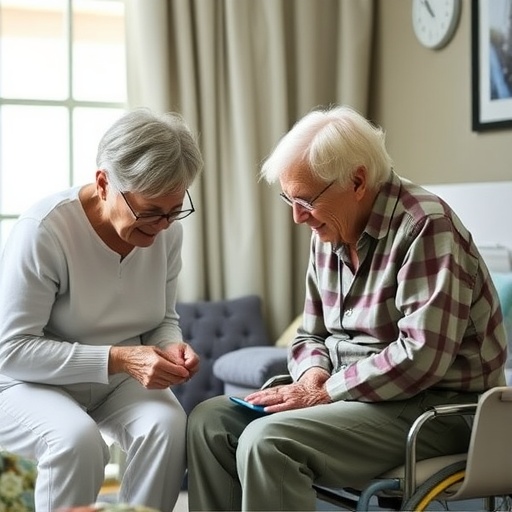
In contemporary geriatric healthcare, one of the most pressing challenges confronting medical professionals and caregivers alike is the phenomenon of falls among older adults. Recent research emerging from the Armed Forces Hospital in the Southern Region shines a critical light on the prevalence, underlying factors, and resultant injuries associated with falls in older individuals receiving home healthcare services. This comprehensive study, slated for publication in BMC Geriatrics, offers unprecedented insights that could reshape preventative strategies and clinical protocols, ultimately improving the quality of life for a vulnerable population segment.
Falls among the elderly constitute a significant public health concern due to their frequency and the severity of consequences. They are a complex phenomenon driven by multifaceted risk factors, encompassing physiological decline, environmental hazards, and medication-related side effects. The study undertaken by Qahtani et al. meticulously assesses these dimensions, utilizing robust epidemiological methods to paint a detailed picture of the current state of fall incidence in home healthcare settings. Their analysis reveals not only the prevalence but also the intricate web of causative elements that make fall prevention a formidable but vital goal.
One of the pivotal findings from this recent inquiry is the surprisingly high prevalence of falls amongst recipients of home healthcare. This group, while shielded from many institutional risks, faces distinct challenges due to their health status and living environment. Home care providers often manage patients with multiple chronic conditions, decreased mobility, and cognitive impairments—all factors that independently contribute to heightened fall risk. The study’s data underscore that, despite the personalized attention inherent to home care, these patients remain acutely vulnerable to falls, mandating a reevaluation of current care paradigms.
Technological and environmental considerations form a substantial part of the study’s discourse. Home environments, typically designed without the specific needs of older adults in mind, harbor numerous hazards facilitating falls—ranging from inadequate lighting to structural impediments such as loose rugs and uneven flooring. Advanced sensor technologies and smart home adaptations emerge in the discussion as potential mitigators. These innovations, when integrated effectively into home healthcare frameworks, have the potential to detect risks preemptively and alert caregivers, thus possibly averting falls before they occur.
The physiological underpinnings of fall susceptibility detailed in the research invite a closer look at aging-related changes in balance, muscle strength, and neurological function. Sarcopenia, a condition denoted by the progressive loss of skeletal muscle mass and function, plays a critical role. This deterioration not only compromises stability but also hampers the body’s ability to recover from perturbations, ushering in a heightened fall risk. Moreover, sensory impairments—particularly in vision and proprioception—exacerbate instability. The study’s nuanced exploration of these biological factors equips clinicians with a deeper understanding necessary to design both individualized and population-wide interventions.
Medication management surfaces as another core aspect of the fall risk profile. Polypharmacy, common among older adults receiving home healthcare, introduces a layer of complexity wherein drug interactions and side effects such as dizziness or hypotension significantly elevate the chances of falling. The researchers emphasize the urgent need for meticulous pharmacological reviews integrated into routine home health assessments. This step aims to optimize therapeutic regimens, balancing efficacy with safety, to reduce fall incidences attributable to medication-induced impairments.
Cognitive impairment is also closely intertwined with fall risk, as elucidated in the study. Conditions such as dementia bring challenges like impaired judgment, decreased hazard awareness, and behavioral symptoms that precipitate falls. The research highlights that cognitive decline, when coupled with physical vulnerabilities, amplifies risk exponentially. This intersection demands holistic care models that incorporate cognitive assessments and tailored interventions to mitigate falls among cognitively impaired elderly populations.
The consequent injuries from falls further highlight the gravity of this issue. Fragility fractures—particularly of the hip, spine, and wrist—are profoundly debilitating and impose substantial morbidity and mortality risks. The study provides quantitative data on injury patterns, offering valuable epidemiological insight that can inform rehabilitation strategies and the allocation of healthcare resources. Importantly, the findings reiterate the vicious cycle where falls lead to injuries, which in turn reduce mobility and elevate the probability of subsequent falls.
Crucially, the study discusses fall prevention strategies within the context of home healthcare. It advocates for a multidisciplinary approach encompassing physical therapy, occupational therapy, environmental modification, and caregiver education. Physical therapy focuses on strengthening and balance training to counteract muscle weakness and improve proprioception. Occupational therapy assists in adapting homes to reduce hazards and foster safer mobility. Meanwhile, educating caregivers about fall risks and preventive behaviors ensures continuous vigilance and timely interventions.
The role of data analytics and continuous monitoring also emerges prominently as a frontier in fall prevention. Wearable devices, gait analysis tools, and real-time alert systems present exciting prospects for revolutionizing how home care patients are monitored. Such technologies can provide granular data on movement patterns, detect deviations indicative of fall risk, and trigger alerts to healthcare providers. These innovations promise to transform reactive care models into proactive ones, thereby minimizing the impact of falls in real time.
Psychosocial factors, often underrated in fall risk evaluations, receive attention for their subtle yet potent influences. Loneliness, depression, and social isolation can degrade physical health and motivation for exercise, indirectly increasing fall vulnerability. The study’s holistic lens includes these dimensions, underscoring the importance of social support networks and mental health interventions as adjunctive components of fall prevention plans.
The implications of this research for healthcare policy are significant. Falls in older adults receiving home care represent a preventable source of suffering and healthcare expenditure. By applying evidence-based insights from the study, policymakers can refine standards for home healthcare delivery, incentivize the adoption of safety technologies, and allocate funding towards fall prevention programs. Such systemic changes could curtail hospitalizations and long-term care admissions stemming from fall-related injuries.
Through its comprehensive exploration of falls among older adults in home healthcare, this research advances the field significantly. It underscores that fall prevention is not attributable to a single factor but requires a symphony of coordinated efforts spanning clinical care, environmental engineering, and technological innovation. The study beckons stakeholders in geriatrics and home health to envisage a future where falls can be predicted, prevented, and managed with unmatched precision.
In essence, the emerging narrative from the Armed Forces Hospital Southern Region research compels the medical community to revisit assumptions about fall risk in home care settings. It challenges providers to integrate multifactorial assessment protocols and encourages deployment of cutting-edge technologies to safeguard the elderly. The insights presented are poised to shape not only clinical practice but also empower patients and families with knowledge to create safer living spaces.
Ultimately, this inquiry reaffirms that while aging imposes inherent vulnerabilities, strategic interventions can markedly diminish the burden of falls. The convergence of precise medicine, innovative environmental adaptations, and vigilant caregiving holds powerful promise. The research embodies a call to action—one that could catalyze paradigm shifts in how society protects its aging population, ensuring that the twilight years are marked by safety, dignity, and autonomy.
Cite Scienmag News
Ophelia Keating. (March 13, 2026). Falls in Older Adults Receiving Home Healthcare: Insights. Scienmag. https://scienmag.com/falls-in-older-adults-receiving-home-healthcare-insights/
Ophelia Keating. "Falls in Older Adults Receiving Home Healthcare: Insights." Scienmag, 13 March 2026, https://scienmag.com/falls-in-older-adults-receiving-home-healthcare-insights/. Accessed 7 September 2026.
Ophelia Keating. "Falls in Older Adults Receiving Home Healthcare: Insights." Scienmag. March 13, 2026. https://scienmag.com/falls-in-older-adults-receiving-home-healthcare-insights/


