


In the unfolding saga of climate change, soil carbon dynamics stand as a critical yet deeply complex chapter. A recent breakthrough study, conducted over twelve years in a grassland environment, has illuminated how the interaction between warming temperatures and variable moisture conditions profoundly influences soil carbon stocks. This investigation reveals an intricate web woven by microbial processes, climate factors, and soil chemistry, which combined dictate whether soil acts as a carbon sink or source amid environmental change.
The research tackles a pivotal uncertainty in climate science: how warming-induced soil carbon loss is modulated by concurrent environmental shifts, particularly drought and soil moisture variations. Soil carbon, a vital reservoir of terrestrial carbon, regulates atmospheric carbon dioxide levels and thus impacts global climate feedback loops. This study’s revelation—that warming can either deplete or augment soil carbon depending on moisture availability—shifts the conventional narrative centered predominantly on warming alone.
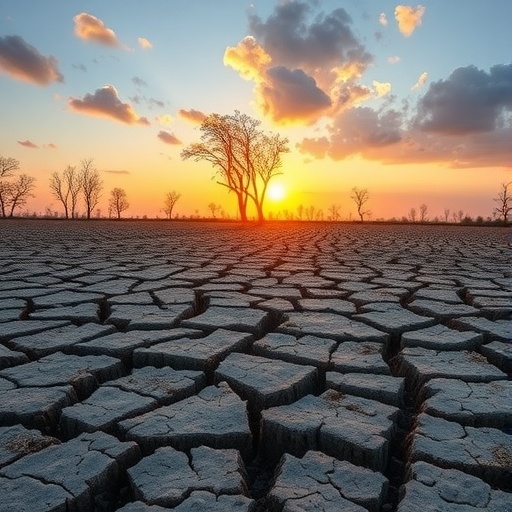
In dry, drought-affected scenarios, warming intensifies the depletion of soil carbon by an average of 12.2%. This pronounced loss is predominantly ascribed to the breakdown of mineral-associated organic carbon (MAOC), a stable form of soil carbon historically regarded as resilient against disturbance. The erosion of this carbon pool signals a destabilization of long-term carbon storage, indicative of an alarming climate feedback mechanism accelerating the atmospheric release of greenhouse gases.
Conversely, the same warming conditions under wet, moisture-rich environments elicit an opposite effect, leading to a 6.7% increase in soil carbon stocks. This surprising outcome challenges the simplistic view that warming invariably drives carbon release from terrestrial systems. Instead, moisture availability emerges as a critical moderator, enabling microbial communities and soil chemistry dynamics that favor carbon retention and potentially bolster soil carbon sequestration in wetter climates.
Central to these contrasting outcomes are microbial processes operating beneath the surface. The study uncovered that warming differentially alters the microbial metabolic quotient (qCO2)—essentially a measure of microbial respiration efficiency. Under drought conditions, microbial respiration per unit biomass surges, indicating a stressed microbial community that inefficiently utilizes carbon, thereby accelerating organic matter decomposition and carbon loss.
In wetter conditions, warming exerts a suppressive effect on microbial metabolic quotient, reflecting a microbial community that maintains or even optimizes carbon use efficiency. These microbial nuances directly influence how carbon-cycling genes express and reshape the microbial community composition itself, showcasing a profound microbial mediation of soil carbon feedbacks influenced by environmental context.
Moreover, the shifts in microbial community composition underscore a broader ecological transformation induced by warming and water availability. The altered balance of microbial taxa and their functional genes related to carbon degradation pathways reveal that microbial ecology—not just abiotic factors—plays an instrumental role in controlling soil carbon fate. This ecological insight bridges a crucial knowledge gap in linking microbial community dynamics to ecosystem-scale carbon processes.
Integrating these microbial metrics into ecosystem models substantially enhances the predictive capability regarding soil carbon dynamics. Traditional soil carbon models have often failed to capture the nuanced responses observed here, largely because they overlooked microbial metabolism and community shifts. This enhanced modeling approach provides a promising avenue for tailoring predictive tools that can incorporate microbial ecology as a dynamic driver of soil carbon feedbacks to climate change.
This revelation also resonates with broader climate projections, particularly the increasing prevalence of droughts predicted under various global climate scenarios. The amplification of warming-induced carbon loss by drought conditions suggests a potentially accelerated feedback loop, wherein dry and warm environments could rapidly turn soil carbon reservoirs into atmospheric carbon sources, exacerbating climate warming.
The findings fundamentally recalibrate how scientists and policymakers should approach soil carbon management under climate change. Rather than a universal warming-induced carbon decline, soil carbon responses must be contextually evaluated within the matrix of moisture availability and microbial ecospace. This necessitates nuanced mitigation strategies that recognize and harness the microbial underpinnings of carbon cycling.
Furthermore, the study underscores the importance of long-term and integrative ecosystem experiments. The twelve-year duration allowed for capturing temporal processes and cumulative effects that short-term studies might overlook. It exemplifies how persistent environmental monitoring, combined with cutting-edge molecular and biochemical techniques, can unravel the mechanistic drivers behind ecosystem responses to global change.
The implications extend beyond scientific understanding into terrestrial carbon management and climate mitigation frameworks. Soils—often viewed as passive carbon reservoirs—are dynamic actors influenced by microbial life and fluctuating environmental conditions. Preserving soil health and moisture regimes could, therefore, represent strategic levers to buffer soil carbon losses under warming climates.
In addition, this research invites a reevaluation of carbon accounting in climate models used for policy-making. Incorporating microbial metabolic traits and community composition shifts into Earth system models could improve climate predictions and refine carbon budget assessments. Hence, these microscopic life forms emerge as surprisingly consequential participants in the global climate saga.
Importantly, the study’s context—grassland ecosystems—highlights an underexplored biome in soil carbon research. Grasslands cover vast terrestrial areas and play a significant role in the global carbon cycle, yet much of the soil carbon-climate interaction research has prioritized forests or croplands. Insights from grassland microbial ecology and carbon dynamics enrich the broader understanding needed for comprehensive earth system assessments.
These groundbreaking findings not only sharpen the scientific community’s awareness of the complex biotic and abiotic interplays driving soil carbon responses to warming but also prompt urgent calls for further investigations spanning diverse ecosystems and climatic regimes. Only with such multifaceted approaches can we hope to anticipate and mitigate the potentially accelerating soil carbon-climate feedbacks in an increasingly unpredictable world.
In conclusion, the delicate balance of soil carbon under the twin forces of warming and drought is distinctly microbial-dependent. This decade-long experiment reveals how moisture conditions pivotally dictate whether warming leads to soil carbon loss or gain by orchestrating microbial metabolism and community shifts. These revelations propel microbial ecology to center stage in soil carbon-climate science and open vital pathways for enhancing global climate resilience through informed ecosystem management.
Cite Scienmag News
Sloane Callahan. (March 13, 2026). Drought Intensifies Soil Carbon Loss from Warming. Scienmag. https://scienmag.com/drought-intensifies-soil-carbon-loss-from-warming/
Sloane Callahan. "Drought Intensifies Soil Carbon Loss from Warming." Scienmag, 13 March 2026, https://scienmag.com/drought-intensifies-soil-carbon-loss-from-warming/. Accessed 2 September 2026.
Sloane Callahan. "Drought Intensifies Soil Carbon Loss from Warming." Scienmag. March 13, 2026. https://scienmag.com/drought-intensifies-soil-carbon-loss-from-warming/


