


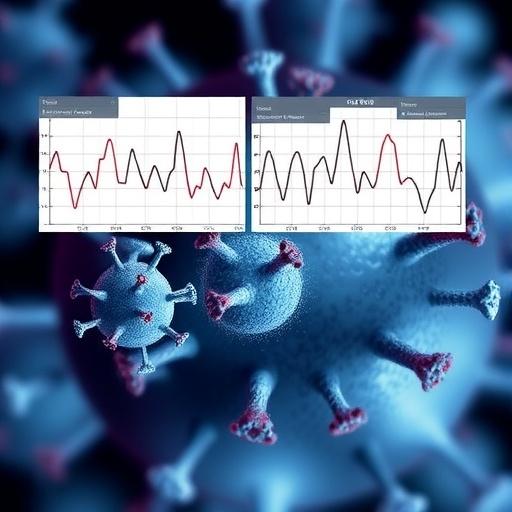
In a groundbreaking study that could reshape our understanding of viral replication and antiviral treatment efficacy, researchers have developed advanced mathematical models to decode the complex dynamics of SARS-CoV-2 replication. Utilizing sophisticated ordinary differential equations (ODEs), the team illuminates the intricate spread and suppression mechanisms of the virus within human host cells, providing an unprecedented quantitative framework that promises to accelerate antiviral drug development and optimization.
The COVID-19 pandemic, driven by the SARS-CoV-2 virus, has challenged the scientific community to unravel the nuanced biological processes underpinning viral replication and propagation. Conventional experimental approaches, while indispensable, often fall short in capturing the temporal and dynamic complexities of viral life cycles. Against this backdrop, the integration of mathematical modeling emerges as a potent tool to simulate and predict viral behavior under various conditions, including therapeutic intervention.
At the heart of this research lies the use of ordinary differential equation models, a class of mathematical constructs that describe how quantities change over time. By mapping key stages of the viral life cycle—such as entry, replication, assembly, and release—into a system of coupled, time-dependent equations, the researchers capture the evolving viral load and cellular responses within host tissues. Such models offer granular insight into the timing and magnitude of infection processes, enabling the prediction of viral spread and clearance kinetics with remarkable precision.
The researchers crafted their model by integrating parameters derived from experimental data, including viral replication rates, decay rates, and the kinetics of target cell infection. This holistic approach ensures that the model reflects biological reality rather than abstract mathematical possibility. The interplay between free virions, infected cells in various stages, and uninfected target cells is meticulously represented, facilitating simulations that mirror real-world viral infection dynamics.
A remarkable aspect of this study is the application of these ODE models to evaluate antiviral drug efficacy. By incorporating drug action mechanisms directly into the equations, the team simulates how different antiviral compounds influence viral replication and spread. This approach transcends traditional pharmacodynamics by enabling predictions of treatment outcomes under various dosing regimens, potentially revolutionizing antiviral therapeutic strategies and personalized medicine.
Beyond merely simulating viral replication, the model accommodates the impact of host immune responses and drug-induced perturbations, accounting for the multifaceted environment in which SARS-CoV-2 operates. This complexity is vital for understanding how treatment efficacy may fluctuate based on timing, dosage, and patient-specific factors like immune status. Consequently, the model serves as a powerful virtual laboratory for optimizing antiviral interventions prior to costly and time-consuming clinical trials.
The results of the modeling reveal nuanced insights into the mechanisms by which antiviral drugs can suppress SARS-CoV-2 replication. The temporal patterns show that early intervention is critical for effective viral load reduction, underscoring the importance of timely diagnosis and treatment initiation. Moreover, the simulations indicate that certain drug classes may be more efficacious at different stages of infection, providing a rational basis for combination therapy strategies.
Notably, the model predicts scenarios where partial drug efficacy or late administration fails to substantially impact viral proliferation, highlighting potential drivers of treatment failure and viral persistence. These findings elucidate the need for developing highly potent antivirals and optimizing treatment windows, which could ultimately improve patient outcomes and limit viral transmission.
The study’s implications extend beyond SARS-CoV-2, offering a methodological blueprint for modeling other viral infections and evaluating antiviral agents across diverse pathogens. By coupling rigorous mathematical frameworks with biological data, this research bridges gaps between virology, pharmacology, and systems biology, promoting a multidisciplinary approach to infectious disease control.
In interpreting the findings, the authors emphasize that mathematical models are simplifications that rely on accurate parameter estimation and biological assumptions. Nonetheless, ongoing refinement through iterative experimental validation bolsters the models’ predictive power and applicability to evolving viral variants and therapeutic developments.
Future directions suggested by the study include integrating host immune signaling pathways more explicitly, exploring stochastic effects of viral replication at the single-cell level, and incorporating heterogeneous tissue environments. Such expansions could yield even deeper insights into viral dynamics and refine therapeutic targeting to an unprecedented degree.
This innovative research, emerging amid a global effort to quell the COVID-19 pandemic, exemplifies how computational and mathematical tools can accelerate biomedical discoveries. The development of ODE-based SARS-CoV-2 replication models and their application to antiviral drug efficacy assessment marks a significant leap forward in our capacity to combat viral diseases with precision and speed.
As the scientific community embraces these dynamic modeling techniques, the vision of personalized antiviral regimens and preemptive pandemic responses moves closer to reality. Harnessing such quantitative models empowers researchers and clinicians alike to anticipate viral behavior, optimize drug development, and ultimately save lives.
The study underscores the transformative potential of integrating quantitative modeling with experimental biology, catalyzing a new era in infectious disease research. It beckons a future where understanding and overcoming viral threats hinge as much on mathematical insight as on laboratory investigation.
This work not only deepens our grasp of SARS-CoV-2 but also sets the stage for adaptive, data-driven strategies against emerging and re-emerging viral pathogens globally, fortifying public health resilience in the face of future outbreaks.
Cite Scienmag News
Kristina Jarvis. (March 13, 2026). Modeling SARS-CoV-2 Dynamics and Antiviral Effects. Scienmag. https://scienmag.com/modeling-sars-cov-2-dynamics-and-antiviral-effects/
Kristina Jarvis. "Modeling SARS-CoV-2 Dynamics and Antiviral Effects." Scienmag, 13 March 2026, https://scienmag.com/modeling-sars-cov-2-dynamics-and-antiviral-effects/. Accessed 8 September 2026.
Kristina Jarvis. "Modeling SARS-CoV-2 Dynamics and Antiviral Effects." Scienmag. March 13, 2026. https://scienmag.com/modeling-sars-cov-2-dynamics-and-antiviral-effects/


