


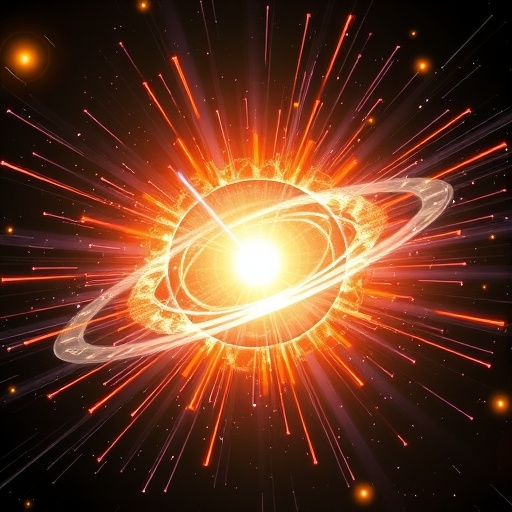
In a groundbreaking study published in Nature, a team of astrophysicists has unveiled compelling evidence linking the extraordinary luminosity of a Type I superluminous supernova (SLSN-I) to a rapidly spinning magnetar whose behavior is influenced by the relativistic Lense–Thirring effect. These findings, reported by Farah et al., provide an unprecedented glimpse into the dynamic processes in the aftermath of a supernova and open a new chapter in both astrophysics and tests of general relativity under extreme conditions.
SLSNe-I are among the most luminous stellar explosions in the universe, outshining typical supernovae by at least an order of magnitude. Despite numerous observations, the power source driving their immense brightness has remained elusive. Traditional models struggle to account for the complex and often irregular light curves exhibited by these events, particularly the presence of distinct bumps—secondary increases and decreases in brightness that defy simple explanation.
Previously, the leading hypothesis attributed the energy powering SLSNe-I to a magnetar—an ultra-magnetized neutron star formed in the core-collapse of a massive progenitor star. Magnetars, with their intense magnetic fields and rapid spin rates, can inject vast amounts of energy into the expanding supernova ejecta via spin-down radiation. However, while the magnetar engine explains the general brightness, the intricate structure and several “bumpy” features in the light curves resisted direct modeling within this framework.
The breakthrough came through the meticulous observation of a SLSN-I with high-cadence, multi-wavelength monitoring that revealed a highly distinctive “chirped” pattern in the light curve’s bumps. Unlike previous cases where the intervals between bumps were irregular or unexplained, this supernova’s bumps exhibited a systematically decreasing period—a signature that hinted at an underlying physical mechanism closely tied to the magnetar’s properties.
The study’s novel interpretation posits that the magnetar sits at the core of the supernova remnant and is surrounded by an accretion disk formed from infalling stellar material. This disk does not remain static; instead, it undergoes Lense–Thirring precession—a relativistic frame-dragging effect predicted by Einstein’s general theory of relativity, where the spinning magnetar’s angular momentum warps spacetime itself, causing the disk to precess or wobble over time.
Such precession modulates the magnetar’s energy output, imprinting a distinct periodic signature onto the light curve. The decreasing period of the bumps reflects the changing dynamics of this precession as the system evolves, offering a direct observational handle on the magnetar’s spin and magnetic field strength. By fitting the light curve data and frequencies of the bumps, the researchers independently constrained the magnetar’s initial spin period to approximately 4.2 milliseconds and its magnetic field strength to about 1.6 × 10^14 gauss.
This dual verification—using both the light curve and bump frequency—marks the first observational evidence of Lense–Thirring precession occurring in the immediate environment of a magnetar. Previously confined to theoretical predictions and indirect observations around black holes, detecting this effect in a young neutron star system is unprecedented and carries profound implications for our understanding of relativistic physics and stellar evolution.
Moreover, the confirmation of the magnetar spin-down model as the driver for SLSNe-I provides a unifying explanation for the extreme energies and complex light-curve features seen in these luminous explosions. It also suggests that fallback accretion disks, long proposed but rarely directly evidenced, play a crucial role in shaping the observational signatures of supernova remnants.
Beyond its astrophysical significance, this discovery heralds a transformative approach to testing general relativity in new and extreme regimes. The violent, rapidly evolving environments of young supernovae offer a natural laboratory where relativistic effects on matter and radiation can be studied with exquisite detail, potentially revealing deviations or novel phenomena not accessible through other means.
The researchers anticipate that their methodology—combining high-cadence, multi-band photometric monitoring with detailed theoretical modeling—will pave the way for systematic studies of other SLSNe-I. Such surveys could uncover further instances of relativistic precession, refining our understanding of the formation and evolution of magnetars, the physics of their disks, and the ultimate fates of massive stars.
This finding also serves as a powerful reminder of the complexity inherent in cosmic explosions and the intricate interplay between gravity, magnetism, and radiation. By illuminating the hidden mechanics of magnetars and their accretion disks, it enriches our broader quest to comprehend the life cycles of stars and the forces sculpting our universe.
In practical terms, the study’s novel analysis techniques and its interpretation of light-curve morphology may even aid in distinguishing between competing models of SLSNe-I, such as those invoking interactions with circumstellar material. This capability is crucial for accurately classifying transient phenomena in rapidly expanding time-domain surveys.
Ultimately, this research exemplifies the synergy between observational astronomy, theoretical physics, and cutting-edge data analysis, pushing the boundaries of what we can infer about the cosmos from distant, transient beacons. As monitoring technologies improve, and more SLSNe-I are discovered, the signatures of Lense–Thirring precession and magnetar-driven luminosity could become key diagnostics in the exploration of the universe’s most energetic events.
Farah et al.’s study stands as a milestone in astrophysics, marking the first time that Lense–Thirring precession—a hallmark prediction of Einstein’s theory—has been connected inextricably to the light from a stellar explosion. It not only settles longstanding debates about the energy sources behind SLSNe-I but also enshrines magnetars once more as cosmic powerhouses with complex, relativistically influenced dynamics.
As these revelations ripple through the scientific community, they invite further inquiry into how relativistic frame-dragging phenomena influence other compact-object systems and the diversity of cosmic transients. Future observations with next-generation telescopes and facilities are poised to capitalize on these insights, promising an era where the violent afterlives of stars illuminate fundamental physics in the universe’s most extreme environments.
Cite Scienmag News
Denise Maddox. (March 12, 2026). Magnetar Spin Powers Superluminous Supernova. Scienmag. https://scienmag.com/magnetar-spin-powers-superluminous-supernova/
Denise Maddox. "Magnetar Spin Powers Superluminous Supernova." Scienmag, 12 March 2026, https://scienmag.com/magnetar-spin-powers-superluminous-supernova/. Accessed 6 September 2026.
Denise Maddox. "Magnetar Spin Powers Superluminous Supernova." Scienmag. March 12, 2026. https://scienmag.com/magnetar-spin-powers-superluminous-supernova/


