


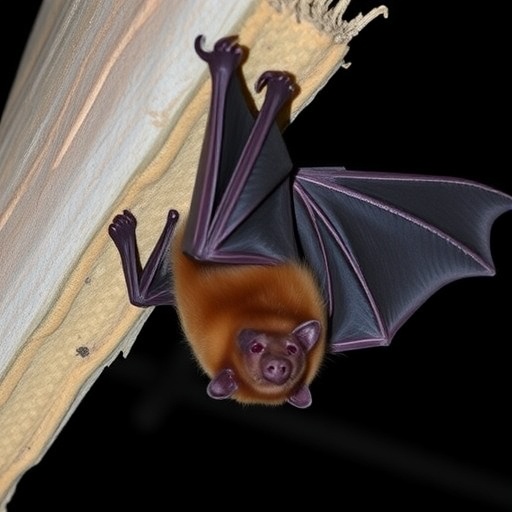
In the realm of wildlife conservation, efforts to protect endangered species often hinge on the development of innovative strategies that closely mimic natural habitats. The Florida bonneted bat (Eumops floridanus), an elusive and critically endangered species native to southern Florida, has long posed a challenge to conservationists due to its specialized roosting behavior and the rapid loss of its natural habitats. Recent groundbreaking research conducted by the University of Illinois Urbana-Champaign, in collaboration with key partners such as the U.S. Army Corps of Engineers and the Florida Fish and Wildlife Conservation Commission, has demonstrated that novel, rocket-style bat boxes provide a viable and thermally stable refuge for these bats, heralding new possibilities for their conservation.
Historically, bonneted bats have exhibited a preference for large, old trees with natural cavities, which offer stable microclimates essential for roosting and breeding. However, anthropogenic impacts, including deforestation and competition from invasive species, have severely limited these natural roosting sites. Consequently, many bonneted bats have resorted to inhabiting human structures such as attics and roof spaces, creating conflict with homeowners and necessitating interventions that sometimes culminate in the exclusion of these vulnerable bats.
Previous attempts to mitigate human-bat conflicts involved deploying artificial roosts or bat boxes. Unfortunately, many traditional bat box designs fail to provide the microclimate regulation necessary to buffer against Florida’s extreme temperature fluctuations. Thermal instability within these roosts can cause distress or mortality among bats, undermining conservation efforts. Recognizing these limitations, the research team explored the efficacy of three distinct bat box models: a conventional flat-faced single-chambered box, a four-chambered rocket box enabling greater spatial flexibility, and a rocket box integrated with an external water jacket designed to enhance thermal buffering.
The research deployed these diverse box designs across six locations within a natural habitat in southern Florida, establishing clusters that were intermittently accompanied by acoustic lures simulating bonneted bat echolocation calls to potentially attract bats. Over an extensive 18-month monitoring period, conducted with meticulous weekly inspections, initial results seemed discouraging, with no immediate occupancy detected despite frequent nearby bat activity.
However, patience proved crucial. Approximately 16 months into the study, a breakthrough occurred when a solitary male bonneted bat was documented occupying one of the rocket boxes outfitted with the external water jacket. This discovery not only validated the hypothesis that enhanced thermal regulation within artificial roosts is critical for bonneted bats but also underscored the importance of long-term monitoring in ecological research. Remarkably, over a year after the formal conclusion of the study, researchers observed the formation of a stable harem colony within the same water-jacketed box, signaling successful colonization.
Thermal analysis from prior investigations indicated that the external water jacket notably dampens temperature extremes, maintaining an environment conducive to bat survival. This microclimate stability distinguishes the water-jacketed rocket box from traditional designs, which often expose bats to deleterious heat stress or chilling. The durability of these novel boxes was confirmed when the structure withstood Hurricane Ian, a tempest of unprecedented intensity, without sustaining damage or abandonment by its occupant, illustrating their potential resilience amid escalating climate variability.
Interestingly, the deployment of acoustic lures did not significantly influence bat colonization rates. Researchers speculate that these calls, while intended as attractants, could have inadvertently functioned as territorial signals indicative of occupied or hostile territories, thereby deterring bats. This nuance emphasizes the complexity of bat behavioral ecology and communication, where call types and contextual meaning remain incompletely understood, highlighting avenues for further behavioral studies to unravel these mysteries.
The success in attracting nearly two dozen bonneted bats, including breeding females migrating from adjacent natural cavities, into a single artificial roost carries profound conservation implications. Given population estimates for Florida bonneted bats range from low hundreds to low thousands, this roost effectively supports a meaningful fraction of the regional population, reinforcing that artificial roosts, when thoughtfully designed and strategically deployed, can supplement natural habitat scarcity.
This research exemplifies the synergy achievable through interdisciplinary collaboration, drawing expertise from ecology, engineering, and wildlife management. It also underscores the necessity of patience and longitudinal commitment in conservation fieldwork, where behavioral responses and colonization patterns may only manifest over prolonged periods. The findings advocate for the integration of improved rocket-style bat boxes within conservation and urban wildlife management programs to provide safer habitats, minimize human-bat conflicts, and enhance species survival prospects.
Moreover, the rocket box design, characterized by modular chambers and thermally protective water jackets, offers a practical and replicable solution. Its straightforward construction makes it feasible for wide-scale installation by conservation agencies, land managers, and even community stakeholders interested in contributing to bat conservation. Crucially, by emulating the spatial complexity and stable conditions of natural roosts, these structures foster environments where bats can thrive despite the adversities posed by habitat loss and climate change.
Looking ahead, further research is essential to optimize artificial roost designs tailored to the sensitive behavioral and physiological needs of bonneted bats. Expanding studies on the function and interpretation of bat acoustic signals could enhance the utility of acoustic lures or inform alternative strategies to facilitate colonization. Additionally, ongoing monitoring efforts are vital to evaluate the long-term viability of these interventions and adapt management practices responsive to environmental challenges and evolving bat population dynamics.
Through this innovative study published in the Journal of Mammalogy, the University of Illinois Urbana-Champaign team delivers compelling evidence that thoughtfully engineered artificial roosts can be pivotal tools in the conservation of one of Florida’s most endangered mammalian species. These findings not only advance scientific understanding but also inspire hope that human ingenuity can harmonize with nature to safeguard biodiversity for generations to come.
News Publication Date: Not explicitly provided.
Web References:
- Journal article DOI: 10.1093/jmammal/gyag013
- University of Illinois Natural Resources and Environmental Sciences: https://nres.illinois.edu/
- Illinois Extension: https://extension.illinois.edu/
References:
- Crawford, R. D., Wolff, P. J., Pierce, E. C., Braun de Torrez, E. C., Pourshoushtari, R. D., & O’Keefe, J. M. (Year). Calling home: Do acoustic lures and novel roosts attract the rare Florida bonneted bat (Eumops floridanus)? Journal of Mammalogy. DOI: 10.1093/jmammal/gyag013
Cite Scienmag News
Margaret Porter. (March 11, 2026). Florida’s Most Vulnerable Bat Finds Safety in Artificial Roosts. Scienmag. https://scienmag.com/floridas-most-vulnerable-bat-finds-safety-in-artificial-roosts/
Margaret Porter. "Florida’s Most Vulnerable Bat Finds Safety in Artificial Roosts." Scienmag, 11 March 2026, https://scienmag.com/floridas-most-vulnerable-bat-finds-safety-in-artificial-roosts/. Accessed 3 September 2026.
Margaret Porter. "Florida’s Most Vulnerable Bat Finds Safety in Artificial Roosts." Scienmag. March 11, 2026. https://scienmag.com/floridas-most-vulnerable-bat-finds-safety-in-artificial-roosts/


