

For millions of years, the rattlesnake’s signature rattle has echoed across the American landscapes, serving as one of nature’s most unmistakable warning systems. Despite the passage of time and ecological changes, this multisensory signal has proven remarkably resilient and effective at deterring a wide array of potential predators. A groundbreaking study, recently published in the prestigious journal PLOS One, sheds new light on the evolutionary persistence of this iconic display. Conducted by researchers from The University of Texas at El Paso (UTEP), the investigation employed cutting-edge technology and interdisciplinary approaches to unravel the underlying behavioral and evolutionary mechanisms that sustain the rattlesnake’s rattle as a formidable defense strategy.
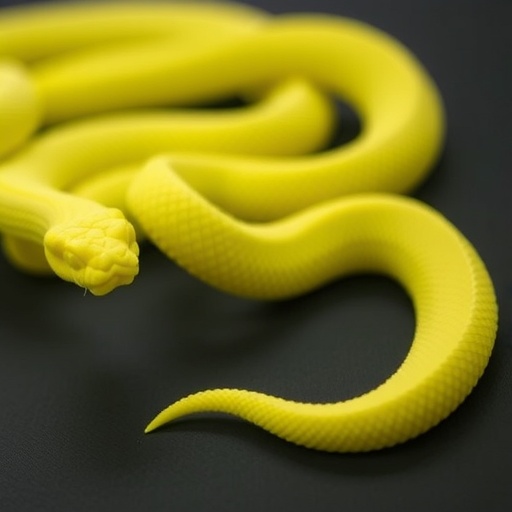
At the leadership of Océane Da Cunha, Ph.D., a lecturer and graduate student coordinator at UTEP’s College of Science, the research team crafted a novel experimental apparatus: a lifelike, 3D-printed robotic rattlesnake. Designed in collaboration with Fab Lab El Paso, the robot meticulously replicated the physical posture of a rattlesnake, while producing authentic rattling sounds captured from real rattles harvested from deceased snakes. This innovation allowed the team to conduct controlled behavioral experiments with 38 distinct animal species housed at the El Paso Zoo, enabling an unprecedentedly precise examination of responses to the rattling stimuli separate from other confounding variables present in natural encounters with live snakes.
The experimental protocol involved a sequence of presentations to each test subject. Initially, animals were offered food alone as a control baseline to gauge natural feeding motivation absent any threat cues. Subsequently, a silent snake model was introduced to determine responses to visual cues without acoustic input. Finally, the full rattling display—combining sound, body posture, and tail vibration—was activated. This stepwise approach enabled the researchers to isolate the individual and combined effects of multimodal signals on eliciting aversive behaviors. Across the sampled taxa, animals exhibited significantly heightened avoidance and fear reactions only when the rattling was audible and visually present, underscoring the rattle’s role as a potent deterrent.
Intriguingly, the degree of fear response correlated strongly with each species’ evolutionary and geographical history. Species naturally coexisting with rattlesnakes in the wild, such as collared peccaries and mountain lions, displayed far more pronounced aversive reactions compared to species originating from regions devoid of rattlesnakes. This pattern suggests an innate, evolved sensitivity to the rattling signal among sympatric species, shaped by long-term predator-prey dynamics and selective pressures. Because all animals involved were born or raised in captivity—with no opportunity for prior learning or direct encounter with live rattlesnakes—this phylogenetic imprint is likely hardwired rather than acquired through experience.
These findings lend robust empirical support to the theory that the rattlesnake rattle serves dual functions. On one hand, it acts as a deimatic or startle signal, eliciting immediate fear even in naïve animals unfamiliar with rattlesnakes. On the other hand, the escalation of this response in species sharing rattlesnake habitats reflects an evolved defensive mechanism fine-tuned through evolutionary time. Such duality provides a fascinating insight into how complex signaling systems can emerge from simpler behaviors—in this case, possibly evolving from primitive tail vibrations into a sophisticated, multisensory warning apparatus enhanced by venom potency and ecological pressures.
The rattlesnake’s rattle is an exemplar of a multimodal defensive display, combining auditory cues with visual posture, tail vibration frequency, and movement dynamics. This multiplicity enhances signal efficacy by engaging multiple sensory pathways in potential predators or threats, making the deterrent far more effective than unimodal signals. Replicating this natural complexity with a robotic model allowed the researchers to deliver highly controlled stimuli while eliminating variable factors that have constrained previous observational studies of live snakes. As a result, the study offers a rare and rigorous experimental framework to dissect the contributions of different signal components.
Rattlesnakes occupy a diverse range of ecosystems across the Americas, from deserts and grasslands to forests and wetlands. Their adaptability and venomous potency have rendered them both formidable predators and well-armed prey deterrents. Understanding how their signature warning system operates in an ecological context thus provides insights not only into rattlesnake biology but also into broader themes of predator-prey coevolution, signaling theory, and ecosystem dynamics. The UTEP team’s interdisciplinary integration of behavioral ecology, evolutionary biology, and engineering exemplifies modern scientific innovation applied to classical biological questions.
The implications of this research extend beyond rattlesnakes alone. It highlights fundamental principles about how innate fear responses can evolve, how multimodal signaling enhances communication reliability, and how these traits influence community-level interactions. Moreover, it poses important questions about the speed at which such innate responses arise in evolutionary time and how environmental and experiential factors modulate signal perception. Future investigations building on this work could explore neurobiological mechanisms underpinning fear responses, comparative analyses across other warning displays in animal taxa, and potential applications in conservation and wildlife management.
Liz Walsh, Ph.D., interim dean of UTEP’s College of Science, lauded the study as a testament to scientific creativity and cross-disciplinary collaboration. By merging technological engineering with behavioral experiments and evolutionary frameworks, Da Cunha’s team has illuminated fundamental aspects of animal communication and defensive strategies. The research affirms how classical biological hypotheses, often difficult to test directly, can be rigorously interrogated through innovative experimental designs—propelling our understanding of nature’s evolving signaling systems into new frontiers.
Beyond its scientific contributions, the study deepens our appreciation for the intricate evolutionary history encoded in the rattlesnake’s rattle—a simple yet powerful symbol that communicates survival, caution, and ecological balance. It reminds us that even the smallest vibrations and sounds carry profound evolutionary legacies, finely sculpted by millions of years of natural selection to maintain complex interspecies interactions and foster coexistence.
This pioneering investigation into the multimodal display of rattlesnakes not only solves a long-standing mystery of nature’s evolutionary playbook but also opens fresh avenues for exploring the complexities of innate behavior and signal evolution. It exemplifies how blending advanced technologies with classical field biology can yield discoveries with broad and lasting impact across scientific disciplines.
Subject of Research: Rattlesnake rattle as a multimodal defensive signal and evolved innate sensitivity in sympatric species.
Article Title: The multimodal display of rattlesnakes is a deterring signal that works best with sympatric species.
News Publication Date: March 11, 2026
Web References: https://journals.plos.org/plosone/article?id=10.1371/journal.pone.0343121
Image Credits: The University of Texas at El Paso
Keywords: Ethology, Animal physiology, Animal learning, Animal instincts, Evolutionary biology, Animal communication, Behavioral ecology, Adaptive evolution


