


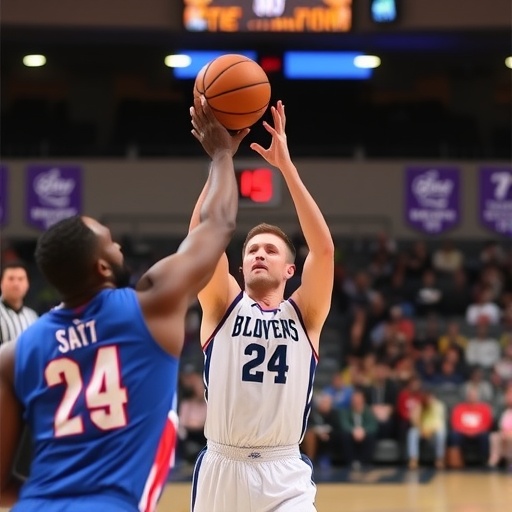
LAWRENCE — The elusive art of three-point shooting in basketball, often epitomized by iconic players like Stephen Curry, is not exclusively reliant on natural talent or sheer practice volume. Recent biomechanical research emerging from the University of Kansas offers groundbreaking insights into the subtleties of shooting mechanics that could revolutionize how athletes train for long-range accuracy. This new study leverages cutting-edge markerless motion capture technology to dissect the intricate physical movements that underpin proficient three-point shooting, revealing that precise elbow alignment coupled with significant flexion in hips, knees, and ankles during the preparatory phase is pivotal in optimizing shooting performance.
The University of Kansas Jayhawk Athletic Performance Laboratory, affiliated with the Wu Tsai Human Performance Alliance, spearheaded this investigation by meticulously analyzing basketball players using non-invasive markerless motion capture systems. Unlike conventional marker-based setups, this technology captures movement efficiently, allowing for swift, detailed assessment of motor patterns associated with elite shooting. Researchers discovered that shooters maintaining a wide stance to establish superior balance and substantial lower-body flexion create biomechanical conditions that greatly enhance shot accuracy. These findings not only advance the scientific understanding of shooting but also form the foundation of an audacious attempt to break the world record for the most consecutive made three-pointers.
Building on an extensive body of prior research exploring biomechanical predictors of proficiency in basketball shooting — including free throws and two-point attempts — this latest study naturally gravitates towards the ever-more prominent three-point shot. With the three-point shot’s strategic importance escalating across all basketball tiers, the University of Kansas sought to decipher why some shooters consistently succeed from the perimeter while others falter. “Heat maps from modern basketball reveal that scoring is predominately clustered around the perimeter and the rim, which underscores the necessity of understanding long-range shot mechanics,” explained Dimitrije Cabarkapa, associate director of the laboratory.
Central to the novelty of this investigation is the utilization of DARI markerless motion capture technology, which facilitates rapid and unobtrusive data collection during live shooting. This system can instantaneously assess biomechanical metrics such as elbow positioning, shoulder and knee flexion angles, foot placement, and peak angular velocities within 30 to 60 seconds per testing session. In practical terms, this allows athletes and coaches to receive immediate biomechanical feedback that can be translated directly to refinements in shooting form.
The empirical component involved 24 male basketball players, divided into proficient and nonproficient groups based on their shooting success, who each executed ten three-point attempts from the top of the key. The nonconsecutive shots had controlled rest periods to mitigate fatigue influences and ensured testing consistency by demanding all shots be taken from the identical location. Analysis underscored that proficient shooters consistently demonstrated greater levels of flexion in their hips, knees, and ankles during the preparatory phase, effectively lowering their center of mass and fostering greater shooting stability.
Cabarkapa emphasized the paramount importance of establishing a stable base through a wider stance: “Without a wide stance, shooters cannot maintain equilibrium, resulting in off-balance shots that drastically reduce accuracy.” He noted that while the ball release moment remains important, it is the preparatory phase — from ball catch to shot initiation — that predominantly dictates shooting outcome. “Loss of control over the shot after ball release means that the biomechanical setup beforehand is crucial,” he added. The preparatory phase mechanics therefore serve as the primary determinants of whether a shot consistently finds its mark.
Moreover, players who failed to generate adequate lower-body flexion, despite attaining suitable release height, struggled to produce the necessary force and velocity to effectively negate the increased distance demands of three-point shooting. This biomechanical deficit evidently compromises shot efficiency beyond traditional focus areas such as wrist flick or follow-through mechanics. The study’s implications extend into coaching philosophy, reinforcing that nurturing proper preparatory movement patterns can elevate shooting performance more than isolated emphasis on release technique alone.
This work represents an elaborate collaboration among KU researchers, including co-authors Damjana Cabarkapa of Singidunum University and Andrew Fry, professor emeritus and former performance lab director. Their findings were publicly disseminated in the respected journal Frontiers in Sports and Active Living, advancing the field of sports biomechanics with technical precision and translational promise.
Intriguingly, the study also contextualizes its findings within the practical wisdom imparted by legendary coaches. Dimitrije Cabarkapa recounted how his coach Mike Deane distilled shooting into four simple yet profound phases: catch, set, step, and shoot. The research validates this approach by empirically demonstrating that the “set” phase — the preparatory positioning and flexion — is fundamental for consistent success. This synergy between coaching tradition and biomechanical science offers a holistic framework to enhance player development.
Bridging laboratory research and on-court application, the study demonstrates the utility of instant biomechanical feedback in real-world settings, thereby enabling athletes and coaches to implement objective, data-driven adjustments seamlessly. This translational emphasis ensures that sports science advances are not confined to academic journals but actively contribute to athletic excellence.
Inspired by these insights, former Cal State Dominguez Hills basketball player and physicist Cornell Jenkins is applying the research findings as he attempts to break the Guinness World Record for most consecutive made three-pointers. Using the same markerless motion capture tools employed in the KU study, Jenkins conducts regular shooting sessions where each attempt’s biomechanical signature is analyzed in real-time. Should he err on his 41st shot, the team immediately pinpoints biomechanical discrepancies to recalibrate his form and precision.
Jenkins and the KU team have completed the initial phase of this ambitious project, with plans to incorporate three-dimensional force plate analysis alongside motion capture to deepen understanding of the forces involved in shooting. Furthermore, ongoing work examines the effects of fatigue on both biomechanical and physiological shooting parameters to simulate game conditions accurately.
As Cabarkapa summarizes, “This initiative epitomizes the intersection of science and athletic performance optimization, helping athletes harness objective data to elevate their craft. Our athlete-centered approach ensures that innovations in sports biomechanics translate directly into performance gains, empowering shooters like Cornell Jenkins to push human limits.”
This marriage of sophisticated technology, empirical research, and athletic endeavor signals a new era where biomechanical precision could redefine basketball training paradigms and permanently enhance the art of the three-point shot.
News Publication Date: 11-Feb-2026
Web References:
Frontiers in Sports and Active Living article
References:
Cabarkapa, D., Cabarkapa, D., Fry, A. (2026). Biomechanical determinants of proficient 3-point shooters: markerless motion capture analysis. Frontiers in Sports and Active Living. DOI: 10.3389/fspor.2026.1732293
Keywords
Biometrics, Human biology, Physical exercise, Human physiology, Life sciences, Research methods, Imaging, Photography
Cite Scienmag News
Denise Maddox. (March 11, 2026). Researchers Aim for World Record Using Key Finding That Prep Phase Is Crucial to Accurate Three-Point Shooting. Scienmag. https://scienmag.com/researchers-aim-for-world-record-using-key-finding-that-prep-phase-is-crucial-to-accurate-three-point-shooting/
Denise Maddox. "Researchers Aim for World Record Using Key Finding That Prep Phase Is Crucial to Accurate Three-Point Shooting." Scienmag, 11 March 2026, https://scienmag.com/researchers-aim-for-world-record-using-key-finding-that-prep-phase-is-crucial-to-accurate-three-point-shooting/. Accessed 3 September 2026.
Denise Maddox. "Researchers Aim for World Record Using Key Finding That Prep Phase Is Crucial to Accurate Three-Point Shooting." Scienmag. March 11, 2026. https://scienmag.com/researchers-aim-for-world-record-using-key-finding-that-prep-phase-is-crucial-to-accurate-three-point-shooting/


