


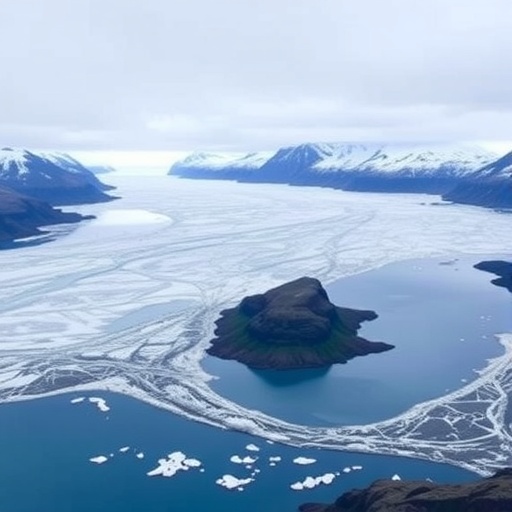
A groundbreaking study led by Colorado State University has unveiled alarming insights into the rapid expansion of glacial lakes in Alaska, a phenomenon accelerating at unprecedented rates due to glacier retreat. The implications of this research extend well beyond regional environmental changes—offering essential data for global climate models, risk assessment of catastrophic flooding, and the management of evolving ecosystems and infrastructure in cold regions.
Published in the prestigious Proceedings of the National Academy of Sciences, this research highlights a startling acceleration: between 2018 and 2024 alone, Alaskan glacial lakes expanded 50% faster than during the preceding decade. This surge translates into a substantial increase of 156 square kilometers — approximately 60 square miles — of newly formed or enlarged glacial lakes within just six years. When compared with historical data, the findings suggest that current expansion rates are more than double those observed between 1986 and 1999, underscoring the escalating pace of glacial retreat and its hydrological impact.
Dan McGrath, an associate professor of geosciences at CSU and the lead author of the study, expressed profound astonishment at the magnitude of these changes. Despite his extensive experience studying glacier dynamics, the rapidity and scale of lake growth witnessed recently surpass all prior observations. This scale of transformation represents not only a tectonic environmental shift but also an urgent call for enhanced hazard preparedness in regions downstream from retreating glaciers.
Glacial lakes form in the depressions created by melting ice, and their sudden drainage—known as glacial lake outburst floods (GLOFs)—poses significant risks to communities, ecosystems, and infrastructure. These outbursts can release immense volumes of water, sediments, and debris in a short time, triggering destructive floods downstream. The greater the volume of water amassed in these lakes, the more severe such flood events can become, necessitating precise monitoring and modeling to anticipate potential impacts.
The study draws attention to the disproportionate risk some areas face due to their proximity to glaciers and lakes prone to outburst floods. While Alaska’s widely spaced population means many expanding lakes pose limited immediate human threat, key population centers and crucial infrastructure—including roads and railways—are not immune to these evolving hazards. Notably, Juneau’s Mendenhall River region has experienced repeated flooding events linked to the nearby Suicide Basin draining from the Mendenhall Glacier, a relatively small but impactful glacier among Alaska’s 27,000.
Beyond immediate flood risks, the changing glacial and lacustrine landscape profoundly influences regional hydrology and ecology. Newly formed and expanding lakes alter streamflow patterns, sediment transport, water storage capacities, and temperature regimes, all of which cascade through aquatic ecosystems. Such transformations challenge ecosystem equilibrium and could shift the distribution and viability of aquatic and terrestrial species in these sensitive environments as glaciers continue to wane.
A novel aspect of McGrath’s research involved mapping the previously hidden subglacial terrain beneath Alaska’s ice masses to better understand lake formation potential. By leveraging elevation and ice-thickness datasets, the team identified “overdeepenings”—glacially carved deep basins beneath the ice—that act as natural reservoirs filling with meltwater. Remarkably, 80% of the lake growth observed between 2018 and 2024 occurred within these overdeepened basins, pointing to their critical role in shaping Alaska’s evolving landscape.
The implications of mapping these features extend far into future projections. The research suggests that existing glacial lakes could expand up to fourfold, covering over 4,250 square kilometers (approximately 1,640 square miles) as more ice recedes. Furthermore, the team identified a staggering 14,500 square kilometers (about 5,600 square miles) of presently ice-covered overdeepened basins, signaling vast areas where new lakes may emerge in coming decades and centuries. This granular topographic knowledge allows for more precise forecasting of landscape evolution in a warming world.
Crucially, the study also reveals disparities in glacier melt rates connected directly to their relationship with these lakes. Glaciers terminating in lakes—known as lake-terminating glaciers—exhibit thinning rates 23% to 54% faster than glaciers ending on land. Some of these glaciers have retreated enough to become land-terminating entities, which paradoxically slows their melt rates due to the absence of direct lake water contact. Understanding these differential dynamics is vital for refining predictions of glacier mass balance and the resulting contributions to global sea-level rise.
The significance of Alaska’s glacial lake and ice retreat phenomena transcends regional boundaries, offering vital insights for climate science worldwide. Alaska currently hosts some of the globe’s fastest-melting glaciers, and recognizing the interactions between glacier dynamics and lake growth is essential to accurately model future changes in ice mass, freshwater storage, and downstream hydrology. These interactions highlight the complex feedback mechanisms at play, where melting ice fosters lake formation, which in turn accelerates glacier thinning.
Moreover, the study provides a crucial knowledge base for public safety and infrastructure planning. Anticipating where new lakes may materialize enables land managers and communities to prepare for potential hazards and mitigate risk proactively. It also informs the development of infrastructure that can withstand or avoid damage from flooding or landscape changes, such as road realignments and the safeguarding of rail lines pivotal to Alaska’s connectivity.
Equally important is the recognition of the broad ecological transformations underway in these glacial regions. As lake systems grow and multiply, shifts in aquatic habitats will affect biodiversity and ecosystem services. These changes have cascading effects on predator-prey relationships, nutrient cycling, and the broader ecological network, necessitating new conservation and management strategies aligned with a rapidly evolving physical environment.
Finally, the collaboration between CSU researchers and the U.S. Geological Survey illustrates the power of combining scientific expertise with governmental support to tackle emerging environmental challenges. Their integrated approach, combining field data, remote sensing, and advanced geospatial modeling, sets a new standard in studying cryospheric changes and their multifaceted impacts, offering a template for future Arctic and mountainous research globally.
In summary, this transformative study uncovers the intricate patterns and rapid pace of glacial lake expansion in Alaska. It signals a future where landscapes once frozen solid are reshaped by water, impacting not only glaciers themselves but also human settlements, infrastructure, and ecological communities. As climate change relentlessly pushes glaciers to retreat, this research provides a critical roadmap for navigating the uncertain and dynamic terrain ahead.
News Publication Date: 9-Mar-2026
Web References: DOI: 10.1073/pnas.2513289123
Cite Scienmag News
Violet Maxwell. (March 11, 2026). Rapid Expansion of Glacial Lakes in Alaska: Research Predicts Future Growth Trends. Scienmag. https://scienmag.com/rapid-expansion-of-glacial-lakes-in-alaska-research-predicts-future-growth-trends/
Violet Maxwell. "Rapid Expansion of Glacial Lakes in Alaska: Research Predicts Future Growth Trends." Scienmag, 11 March 2026, https://scienmag.com/rapid-expansion-of-glacial-lakes-in-alaska-research-predicts-future-growth-trends/. Accessed 3 September 2026.
Violet Maxwell. "Rapid Expansion of Glacial Lakes in Alaska: Research Predicts Future Growth Trends." Scienmag. March 11, 2026. https://scienmag.com/rapid-expansion-of-glacial-lakes-in-alaska-research-predicts-future-growth-trends/


