

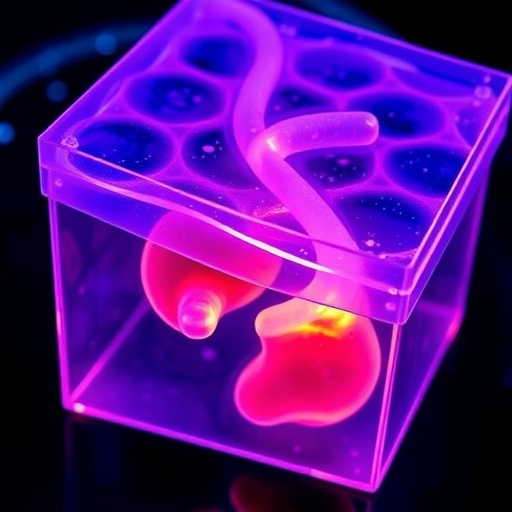
In a groundbreaking advancement that promises to revolutionize tissue engineering and regenerative medicine, researchers at the University of California, San Francisco (UCSF) have unveiled a novel biomaterial designed to transform the way miniature organs, or organoids, are cultivated in laboratories. These organoids, complex three-dimensional cellular structures, have long been heralded as a game-changing tool for modeling human disease and development. Yet, their inherent variability in shape and organization has posed significant hurdles, limiting their broad applicability and reproducibility in scientific research. The newly developed hybrid gel material addresses this challenge by providing a more physiologically faithful environment that guides organoids to grow with remarkable consistency and precision.
The core innovation centers around the integration of alginate microparticles—biocompatible, complex polysaccharides derived from algae—into Matrigel, the conventionally used extracellular matrix surrogate for organoid culture. This unique composite gel mimics the natural biomechanical properties of human tissue, specifically the delicate balance between softness and structural support that living tissues experience in their native milieu. Unlike pure Matrigel, which can be either too fluid to maintain architectural fidelity or too stiff to accommodate dynamic cellular remodeling, the addition of alginate microparticles endows the matrix with an adaptive mechanical behavior known as stress relaxation. This phenomenon allows the gel to gradually yield to cellular forces over time, enabling organoids to sculpt themselves into more natural and functional forms.
The facilitation of stress relaxation is critical as developing tissues in vivo continuously exert mechanical forces upon their surroundings, guiding morphogenesis and differentiation. If the matrix surrounding growing cells resists deformation excessively, it impedes this developmental choreography, causing halted or aberrant growth. Conversely, excessively compliant materials fail to provide essential cues, resulting in disorganized structures. By fine-tuning the stress relaxation properties, the UCSF team effectively recapitulates the mechanical microenvironment of embryogenesis, striking the optimal equilibrium necessary for robust organoid development.
A complementary breakthrough achieved with this enhanced matrix is the ability to leverage state-of-the-art 3D bioprinting methods to precisely place stem cells into predetermined shapes within petri dishes before maturation. Traditional Matrigel’s lack of mechanical stability has thwarted attempts to print cells with spatial accuracy; it either permits printed cells to spread uncontrollably or recoils strongly, displacing them from intended locations. The hybrid gel’s unique rheological profile, emulating the tactile yet adaptable nature of wet sand, provides a printable substrate that fixes stem cells accurately while remaining permissive for their subsequent growth and self-assembly.
This technology has been validated across a spectrum of organoid systems, including murine intestinal and salivary gland cells, human endothelial cells involved in vascular formation, and human pluripotent stem cell-derived neuronal populations that model brain development. Printed cellular clusters consistently matured into organoids characterized by healthy morphology and functional complexity, such as intestinal tubes capable of fluid transport and branching neural buds reminiscent of early brain structures. These results underscore the hybrid matrix’s versatility and potential for broad applicability in modeling developmental biology and disease pathogenesis.
The implications extend far beyond the laboratory bench. The ability to grow organoids with reproducible architectures and to harness 3D printing for spatial patterning of stem cells paves the way for scalable manufacturing of replacement tissues tailored for transplantation and personalized medicine. By sidestepping the need for manual assembly of cellular components, this approach harnesses the cells’ intrinsic developmental programs, supporting a paradigm shift from biomaterial assembly toward biologically driven organogenesis.
“Rather than building tissues block by block, our method entrusts cells with the blueprint,” explained Dr. Zev Gartner, UCSF professor and lead investigator of the study published in Nature Materials. He emphasizes that the gel’s capacity to progressively relax mechanical stress is crucial, enabling the dynamic reshaping that mimics living tissue behavior during embryonic development. “This stress relaxation must be finely calibrated; the material needs to give way synchronously with tissue growth and remodeling,” he added.
The project’s first author, Austin Graham, also highlighted the challenge that standard Matrigel’s physical properties posed to bioprinting applications. “Liquid Matrigel is too runny for printing precision, and once solidified, it pushes back against the cells,” he said. The new composite gel overcomes these pitfalls by offering a reversible, adaptive firmness that ensures both print fidelity and biological compatibility.
By closely studying embryonic tissue formation, the researchers gained critical insights into the role of mechanical cues—a dynamic push-and-pull between growing cells and their extracellular environment. These insights directly informed the design of the alginate-Matrigel composite, which structurally and functionally embodies this biomechanical feedback loop. The alginate microparticles serve as mechanical anchors interspersed within the gel, providing initial support while permitting gradual deformation in response to cellular traction forces.
The versatility of this system roots from its ability to balance stability and plasticity, a feat rarely achieved in synthetic biomaterials. Unlike conventional hydrogels that tend to be either too brittle or too viscoelastic, the microparticle-laden gel exhibits tunable viscoelasticity that can be customized to different tissue types and developmental stages. This adaptability enhances the relevance of organoid models across research domains, from drug screening to developmental biology.
This innovation follows a growing trajectory in biofabrication technologies that aim to reconcile engineering precision with biological complexity. As 3D bioprinting matures, the integration of materials that faithfully replicate native tissue mechanics becomes paramount for building clinically viable tissue constructs. UCSF’s advance represents a crucial step in this evolution, merging material science with developmental biology to create environments where cells autonomously organize into life-like tissues.
With funding support from National Institutes of Health, Chan Zuckerberg Initiative, and other notable institutions, the UCSF team continues to explore applications of their stress-relaxing biomaterial to further biomedical research. Their approach may soon facilitate breakthroughs in disease modeling, regenerative therapies, and personalized medicine by enabling the generation of sophisticated organoids that more accurately mimic human organ function and structure.
By harmonizing mechanical support with cellular autonomy, this novel material and approach reveal a future where tissue engineering increasingly becomes an orchestration of developmental cues, rather than mere assembly. This shift could herald a new era in biomedicine, offering unprecedented opportunities to understand, replace, and repair human tissues with precision and reproducibility.
Subject of Research: Development of biomaterials to enhance organoid growth and 3D bioprinting precision
Article Title: UCSF Researchers Develop Stress-Relaxing Gel for Predictable Organoid Formation and Advanced 3D Bioprinting
News Publication Date: March 10, 2024
Web References:
https://nature.com/articles/s41563-024-XXXX-X (linked article in Nature Materials)
https://ucsf.edu/news/biomaterial-organoids-3d-printing
References:
Gartner Z, Graham A et al., “Stress-relaxing alginate microparticle-enhanced Matrigel for controlled organoid morphogenesis,” Nature Materials, 2024.
Image Credits: UCSF Center for Cellular Construction / Nature Materials
Keywords: Organoids, Alginate microparticles, Matrigel, Stress relaxation, 3D bioprinting, Tissue engineering, Stem cells, Developmental biology, Biomaterials, Viscoelasticity, Regenerative medicine, Organogenesis


