


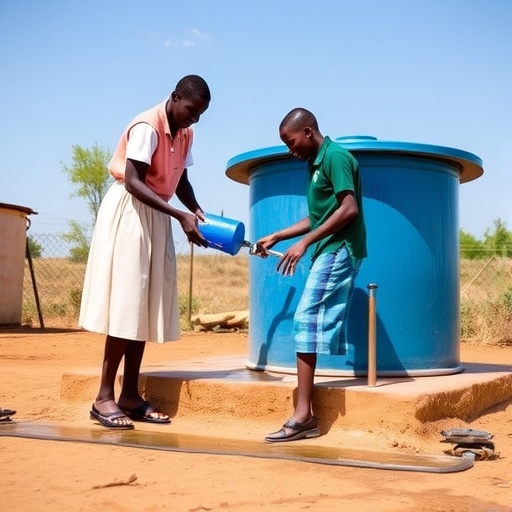
In the vast rural landscapes of sub-Saharan Africa, access to clean water hinges significantly on the functionality of shared handpumps that serve millions. With over 184 million people depending on these water points, the reliability of such infrastructure is not merely a matter of convenience but one of life and health. Yet, a staggering number of handpumps—over 50,000—remain broken at any given time, threatening the health and stability of surrounding communities. Addressing this hidden crisis, recent groundbreaking research from the University of Notre Dame offers a transformative blueprint for managing the maintenance and repair of community handpumps in resource-constrained settings.
The research, spearheaded by assistant professor Chengcheng Zhai of the Mendoza College of Business at Notre Dame, explores the complex dynamics faced by local nongovernmental organizations (NGOs) operating in Ethiopia, Malawi, and the Central African Republic. Each context presents unique challenges and approaches towards maintaining thousands of community handpumps under conditions of incomplete or uncertain information. The study analyzes data from a vast sample of 3,584 handpumps, delivering insights with real-world consequences for water accessibility and sustainability. Crucially, the study reveals how optimized preventive maintenance can significantly reduce pump downtime while maintaining cost-efficiency—a finding that holds critical implications for NGOs functioning under tight budgetary constraints.
At its core, the research integrates detailed empirical observations into a sophisticated decision-making framework known as the Markov Decision Process (MDP). This mathematical model captures the uncertain, time-variant conditions characterizing pump functionality, guiding NGOs on optimal maintenance schedules and repair interventions. By doing so, it balances competing priorities: minimizing water pump downtime to ensure continuous access to safe water, while controlling logistics costs related to travel, labor, and parts. The MDP dynamically adapts to inputs such as the frequency of reported pump breakdowns and elapsed time since the last maintenance visit, thereby empowering NGOs to strategically dedicate mechanics to specific clusters of handpumps.
Fieldwork across the three countries revealed markedly different maintenance strategies reflecting diverse operational contexts. In the Central African Republic, NGOs rely on a fixed annual rotation where each pump receives scheduled visits irrespective of reported issues. In Ethiopia, a reactive system prevails wherein an incoming call center responds to community reports of pump failures, sending mechanics only when breakdowns are flagged. Malawi employs an outgoing call center that proactively contacts communities to assess the status of pumps, enabling targeted repairs before failures compound. By embedding these operational modalities into their modeling approach, the research crafts tailored solutions that respect localized constraints and information flows.
The study’s findings challenge conventional wisdom about reactive versus preventive maintenance. When sufficient data are available and pumps demonstrate high reliability, a reactive approach—fixing pumps as they break—is often optimal. However, in scenarios where failure rates are elevated, the research demonstrates that scheduled, proactive preventive maintenance substantially curtails downtime. This nuanced understanding informs NGOs as to when investment in routine service schedules outweighs purely reactive repairs, guiding more efficient resource allocation and strategic planning for long-term water system resilience.
Analysis of thousands of handpumps over multiple time periods showcased dramatic improvements in operational uptime. Preventive maintenance coupled with optimized repair scheduling reduced pump downtime by an impressive 42 to 62 percent across the three countries, with the most significant gains observed in Ethiopia and Malawi. While costs decreased in Malawi and Ethiopia, the Central African Republic experienced a modest rise between 15 and 19 percent; yet, these costs were deemed justifiable given the leaps in pump reliability and consequent benefits to community health and well-being. This cost-benefit calculus exemplifies the delicate balance between expense and impact NGOs must strike.
Behind these numbers lie the logistical challenges faced daily by NGOs operating in remote, resource-limited environments. Maintenance personnel must navigate difficult terrain, limited transportation options, and supply chain constraints for spare parts. The study’s model provides actionable guidance for crafting efficient travel routes and visit schedules for mechanics, improving both operational efficiency and pump functionality. Simultaneously, organizations must determine how much to invest in information gathering—from community reports to call center operations—to maintain accurate situational awareness despite incomplete data.
This research not only advances theoretical understanding of rural water infrastructure maintenance but also delivers practical insights directly translatable to on-the-ground policy and operational decisions. By leveraging data-driven optimization using real-world metrics, NGOs can better anticipate failure patterns, reduce service interruptions, and extend the lifespan of their investments. Such improvements have cascading effects on public health by ensuring safe water availability, reducing waterborne disease, and enhancing community resilience.
Moreover, the Notre Dame team’s efforts cultivate an important symbiosis between academic research and social impact. The collaboration involves MBA students from the Mendoza College of Business’ Meyer Business on the Frontlines program, who apply these findings to advise NGOs and social enterprises, fostering evidence-based improvements in water management strategies. This fusion of scholarly inquiry and practical consulting demonstrates how operations research can catalyze societal benefits when tightly coupled with field experts and local stakeholders.
Fundamentally, the results underscore the vital role of preventive maintenance—a concept often undervalued or perceived as too costly—in sustaining rural water systems. When deployed optimally, preventive maintenance schedules not only conserve scarce financial resources but also safeguard millions from the profound human costs associated with water scarcity and pump failure. For NGOs operating with minimal budgets and incomplete information, the ability to deploy maintenance resources more intelligently may well be the critical lever that keeps clean water flowing in even the most vulnerable communities.
As the global community intensifies its focus on ensuring universal access to safe drinking water, particularly within underserved rural regions, these findings contribute timely evidence toward scalable solutions. With ongoing refinement, expansion, and local adaptation, methodologies like the Markov Decision Process model have the potential to transform maintenance paradigms—shifting them from reactive firefighting to proactive stewardship. The research exemplifies how analytical rigor combined with empathetic field engagement can illuminate pathways out of hidden crises, translating complex data into tangible improvements in daily life.
In the wider context of sustainable development, this study stands as a testament to the power of integrating technology, operations research, and community collaboration to address pressing infrastructure challenges. It highlights how thoughtful innovation can drive meaningful social change, enabling over a million people across Ethiopia, Malawi, and the Central African Republic to reclaim reliable access to clean water—improving health outcomes and fortifying resilience in the face of environmental and economic uncertainties. The path forward may be navigated with data, but it is paved with hope.
News Publication Date: Not specified in text (article publication date is March 2, 2026)
Web References:
- Mendoza College of Business
- Journal Article DOI
- Meyer Business on the Frontlines
- Notre Dame Water Management News
References:
Zhai, C., Pedraza-Martinez, A., Parker, R., Bretthauer, K., & Mejia, J. “Keep the Water Flowing: The Hidden Crisis of Rural Water Management.” Manufacturing & Service Operations Management, forthcoming 2026.
Keywords
Rural water management, handpump maintenance, preventive maintenance, Markov Decision Process, NGO logistics, sub-Saharan Africa, water infrastructure, service operations, sustainable development, data-driven optimization, community water access, operations research
Cite Scienmag News
Denise Maddox. (March 10, 2026). Innovative Model Paves the Way for Sustainable Clean Water Access in Rural Africa. Scienmag. https://scienmag.com/innovative-model-paves-the-way-for-sustainable-clean-water-access-in-rural-africa/
Denise Maddox. "Innovative Model Paves the Way for Sustainable Clean Water Access in Rural Africa." Scienmag, 10 March 2026, https://scienmag.com/innovative-model-paves-the-way-for-sustainable-clean-water-access-in-rural-africa/. Accessed 4 September 2026.
Denise Maddox. "Innovative Model Paves the Way for Sustainable Clean Water Access in Rural Africa." Scienmag. March 10, 2026. https://scienmag.com/innovative-model-paves-the-way-for-sustainable-clean-water-access-in-rural-africa/


