


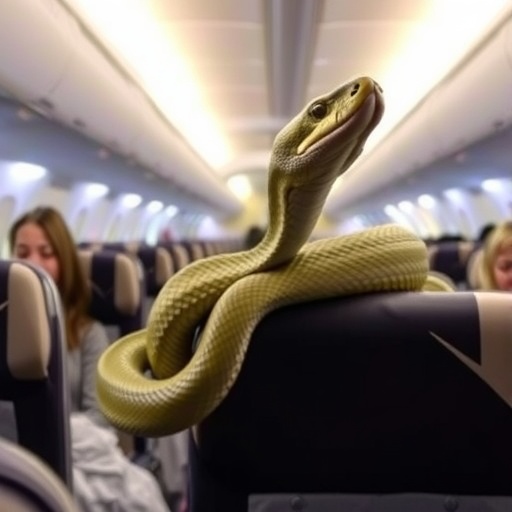
Snakes have long captivated scientists and laypeople alike with their sinuous movement and unique physiology. While their iconic slithering locomotion is extensively studied, a less explored but equally astonishing aspect of snake behavior is their remarkable ability to maintain an upright posture on narrow perches. This is a feat that defies the typical constraints of limblessness and flexibility, allowing certain snake species to stand vertically over 70% of their body length with an almost impossible degree of balance. Recent research led by Harvard University sheds light on the underlying biomechanical and neurophysiological mechanisms enabling this extraordinary postural control, offering profound insights into the intricate interplay between muscle function, sensory feedback, and physical forces.
At the heart of this discovery is the observation that snakes manage to “stand” upright not by stiffening their entire bodies, but by concentrating muscle activity and bending control within a confined region near the base of their body. This strategic localization of control manifests as a boundary layer where the snake’s trunk leaves the perch, while the rest of its body remains nearly rigid and vertical. Gravity acts minimally on this elevated section, reducing the bending torque and thus energy expenditure needed to maintain the posture. This finding overturns intuitive expectation that an organism would need to stiffen its entire body to sustain such an extreme pose, revealing instead a highly efficient and elegant biological control strategy.
To elucidate these complex dynamics, the research team developed a mathematical model treating the snake as an “active elastic filament” — a deformable structure capable of sensing its own shape and exerting muscle forces in response. This quantitative framework incorporated principles from physics, applied mathematics, and biology to simulate two primary control strategies: local feedback control where muscles respond directly to bending sensed at their position, and optimal non-local control involving coordinated muscle activation along the snake’s length to minimize energy cost. Both models successfully recreated the characteristic S-shaped vertical posture observed in the wild, but the optimal control model demanded significantly less muscular effort, underscoring nature’s penchant for energy efficiency in extreme postural regulation.
However, the greatest challenge snakes face is not merely achieving this vertical stance, but dynamically maintaining their equilibrium against toppling forces—a problem analogous to balancing an inverted pendulum. The research revealed that while modest muscle forces suffice to hold the posture statically, substantially larger forces are necessary for active stabilization against perturbations. This explains the subtle yet constant swaying motion often observed in upright snakes, demonstrating a delicate balance between biomechanics and neural control that ensures stability in a precarious position.
This interplay of mechanics and feedback control highlights a sophisticated sensory-motor integration in snakes. Proprioceptive feedback—the animal’s intrinsic sense of body shape and position—enables real-time modulation of muscle activation patterns in response to external disturbances. Such continuous adaptation is critical for maintaining a posture that involves precariously counteracting gravity without the aid of rigid skeletons or limbs, pointing toward an advanced biological control system evolved specifically for arboreal locomotion and foraging.
From a bioengineering perspective, these findings have far-reaching implications. The concept of an active elastic filament controlled by localized yet optimal muscular feedback offers a potent design blueprint for developing soft robots and medical devices that require stability in complex, flexible configurations. Unlike traditional robotic systems that rely heavily on rigid components and brute force actuation, mimicking the snake’s strategy could yield machines that are simultaneously resilient, lightweight, and energy-efficient. Such bioinspired robots could excel in navigating constrained environments, performing delicate manipulations, or extending reach without sacrificing balance.
Moreover, the study bridges disciplines by integrating experimental observations with mathematical modeling and biomechanical theory, exemplifying the power of interdisciplinary approaches in unraveling natural phenomena. By combining direct tracking of snake motion with muscle activity data and theoretical frameworks, the researchers have provided a comprehensive picture of postural control that transcends simple description, revealing fundamental principles applicable to diverse fields from neuroscience to robotics.
Notably, this research challenges the notion that biological control requires large amounts of energy or brute muscular force. Instead, it emphasizes how subtle control strategies—leveraging the organism’s physical morphology and the nonlinear mechanics of flexible bodies—can yield remarkably efficient solutions to complex motor problems. Such insights could revolutionize how engineers approach control problems, shifting focus toward integrating material properties and sensory feedback into design rather than merely increasing actuating power.
The slow, gentle swaying of upright snakes is evocative of balancing an inverted pendulum, a canonical problem in classical mechanics and control theory. The equilibrium position is inherently unstable, requiring continuous modulation of muscle forces to counteract perturbations. In biological terms, this resembles a closed-loop feedback system where sensory inputs guide motor outputs to maintain homeostasis. Understanding these dynamics within the snake’s flexible body could inspire novel control algorithms that enable robots and prosthetics to balance dynamically without rigid supports or extensive computational resources.
The ecological significance of this ability also merits attention. Many arboreal snakes rely on vertical postures to bridge gaps between thin branches and to survey their environment from elevated vantage points, vital for hunting and predator avoidance. Thus, the evolution of such refined postural control likely confers substantial adaptive advantages, shaping the behavioral ecology of these species. This underscores how physical constraints and environmental challenges can drive sophisticated motor control strategies in limbless animals.
Looking forward, this research opens new avenues for exploring the neuromechanics of other limbless organisms and how their motor systems interact with body mechanics to solve stability problems. It also highlights the potential for leveraging biological insights to address engineering challenges in soft robotics, where flexibility and control balance are paramount. By unraveling the physics of snakes standing tall, scientists are inching closer to building machines that can emulate life’s subtle complexities with minimal energy consumption and maximal adaptability.
In conclusion, the study from Harvard represents a milestone in understanding postural control in limbless creatures. By revealing how snake muscles, proprioception, and gravity interact to produce upright stability, the research not only solves a biological mystery but also seeds future innovation in robotics and applied physics. The combination of theoretical rigor, experimental validation, and interdisciplinary collaboration in this work stands as a testament to the richness of studying nature’s most unusual locomotion feats and their broader technological implications.
News Publication Date: 25-Feb-2026
Web References:
- Journal of the Royal Society Interface: https://royalsocietypublishing.org/rsif/article/23/235/20250314/480507/Postural-control-in-an-upright-snake
- DOI link: http://dx.doi.org/10.1098/rsif.2025.0314
Cite Scienmag News
Reid Dalton. (March 10, 2026). Serpents Disrupt Flight: Unraveling the Science Behind Snakes on the Plane. Scienmag. https://scienmag.com/serpents-disrupt-flight-unraveling-the-science-behind-snakes-on-the-plane/
Reid Dalton. "Serpents Disrupt Flight: Unraveling the Science Behind Snakes on the Plane." Scienmag, 10 March 2026, https://scienmag.com/serpents-disrupt-flight-unraveling-the-science-behind-snakes-on-the-plane/. Accessed 3 September 2026.
Reid Dalton. "Serpents Disrupt Flight: Unraveling the Science Behind Snakes on the Plane." Scienmag. March 10, 2026. https://scienmag.com/serpents-disrupt-flight-unraveling-the-science-behind-snakes-on-the-plane/


