


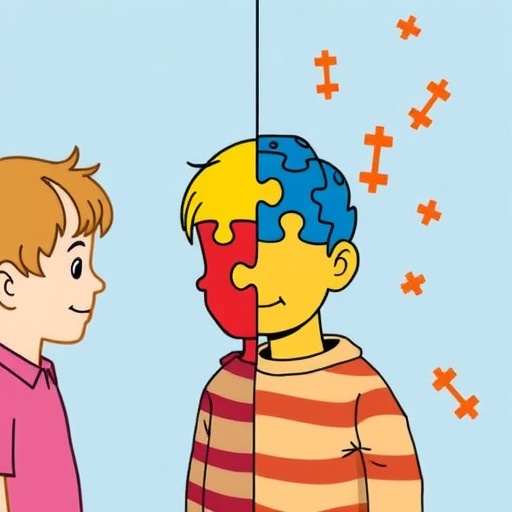
Autism spectrum disorder (ASD) has long been understood as a complex neurodevelopmental condition characterized primarily by difficulties in social communication and the presence of restricted and repetitive behaviors. Yet, this broad diagnostic category conceals immense heterogeneity at multiple biological, developmental, and clinical scales. Researchers have increasingly recognized that lumping all presentations under a single umbrella term may obscure critical differences that determine individual outcomes and therapeutic needs. In a groundbreaking study published in Nature Mental Health, Lombardo, Severino, and Mandelli propose a novel stratification framework that distinguishes autism subtypes into type I and type II categories based on distinct early developmental features alongside unique neurobiological signatures. This paradigm shift offers a more nuanced and data-driven approach toward understanding the “autisms” as plural entities rather than a monolithic condition.
The conventional autism diagnosis primarily revolves around identifying early social communication challenges and repetitive behavioral patterns. However, this single-dimensional focus has limited predictive power regarding later-life trajectories or the underlying neurogenetic mechanisms. The research team employed advanced machine learning algorithms applied to large-scale developmental datasets, integrating variables beyond core criteria, including non-core language acquisition, motor skills, intellectual functioning, and adaptive behaviors manifested in early childhood. By leveraging these multi-domain measurements, they identified two reproducible clusters—designated as type I and type II—with clear distinctions in developmental pathways and functional outcomes.
Crucially, type I autism, as defined through this framework, presents with relatively preserved intellectual and motor abilities but with subtle impairments in adaptive functioning and communication nuances. These individuals tend to follow a developmental course that allows for better social adaptation and educational attainment but may still experience persistent challenges in nuanced social contexts. In contrast, type II autism is marked by more pronounced deficits in early language acquisition, intellectual functioning, and motor competence. Children in this group often exhibit delayed milestones and require substantial supportive interventions. Importantly, this stratification holds stable across independent cohorts, underscoring its replicability and clinical relevance.
The delineation between type I and type II autisms is not merely clinical but extends to distinct neurobiological underpinnings. Neuroimaging analyses reveal divergent patterns in brain cortical structure and connectivity associated with each subtype. Type I autism is correlated with atypical cortical patterning that implicates early embryonic neurogenesis processes, while type II shows alterations suggestive of disrupted neuronal migration and synaptic development. This biological dissociation points to differential pathophysiological pathways, offering a fruitful avenue for precision medicine tailored to subtype-specific mechanisms.
Genetic explorations further reinforce the dichotomy between type I and type II autisms. The study highlights varying contributions of rare, high-impact genetic variants predominately linked to type II presentations, which often coincide with severe developmental delays and syndromic features. Conversely, common polygenic risk factors with subtler effects appear more influential in shaping type I autism phenotypes. This dichotomy not only advances our understanding of autism’s etiology but also emphasizes the necessity for refined genetic counseling and testing strategies that consider subtype-specific genetic architectures.
The implications of distinguishing autism into type I and type II subtypes extend deeply into clinical practice and research. Accurate early identification of subtype membership can guide prognosis and therapeutic planning, enabling interventions better aligned with each child’s unique profile. For example, type II individuals typically benefit from intensive multidisciplinary support focusing on language development and motor coordination, whereas type I might respond better to social cognitive training and executive functioning enhancement. This tailored approach holds promise for optimizing functional outcomes and quality of life.
Moreover, the newly proposed stratification aids in reconciling divergent perspectives within the autism community, including clinicians, researchers, and autistic individuals and their families. Recognizing the pluralistic nature of autism challenges the notion of a “one-size-fits-all” diagnosis. It validates the diversity of experiences and supports the personalization of care pathways. By bridging clinical symptomatology with objective biological and developmental markers, this framework promotes equity and inclusivity in both research and applied settings.
From a methodological perspective, the study capitalizes on machine-learning paradigms that can manage the complexity of multidimensional early developmental data. Unlike traditional diagnostic models reliant on isolated symptom clusters, machine learning algorithms parse intricate patterns and identify meaningful subgroups based on convergent traits. This quantitative, unbiased approach lays a robust foundation for future biomarker discovery and mechanistic investigations. It also exemplifies the transformative role of artificial intelligence tools in psychiatric research.
The discovery that type I and type II autism diverge so dramatically at developmental and biological levels has the potential to transform clinical trials and drug development pipelines. Historically, the heterogeneity within autism trials has obscured therapeutic efficacy, as treatments effective for one subset may show no benefit in others. Stratified clinical trial designs incorporating subtype classifications promise heightened sensitivity in detecting treatment response and side-effect profiles. This could accelerate the identification of personalized pharmacological and behavioral interventions, thus addressing a major unmet need in autism care.
Neurodevelopmental timing also emerges as a critical determinant distinguishing autisms within this framework. Type I autism’s features seem rooted in subtle but early neurogenetic patterning disruptions, whereas type II autism is associated with broader neurodevelopmental perturbations manifesting at later stages such as synaptogenesis and circuit refinement. This temporal dimension may open novel windows for intervention at critical periods, maximizing neuroplastic potential. It further underscores the intricate choreography of neural development that underlies autism’s heterogeneity.
Importantly, this two-type classification system does not aim to replace existing clinical diagnostic criteria but serves as a complementary framework enhancing precision medicine. It harmonizes with dimensional models of autism traits while providing categorical stratifications grounded in objective developmental phenotypes and biology. Future diagnostic manuals may integrate such stratifications to capture the full complexity of autism presentations more faithfully, transforming both clinical psychiatry and neurodevelopmental science.
The framework’s applicability across diverse populations is another strength worth noting. The multi-cohort validations demonstrated robustness across various ethnic and socioeconomic backgrounds, increasing confidence in generalizability. However, future research must continue exploring environmental, cultural, and epigenetic modifiers that may interact with these subtypes. Understanding such factors will advance holistic models of autism etiopathogenesis and foster more equitable healthcare delivery.
This paradigm shift also invites reevaluation of early screening protocols. Current autism screening instruments may benefit from refinement to capture markers distinguishing type I and type II trajectories reliably. Enhanced screening will facilitate timely subtype-specific interventions, reducing diagnostic delays and mitigating adverse developmental cascades. Such improvements are crucial as early childhood represents the most sensitive and responsive window for altering neurodevelopmental courses.
Finally, this study exemplifies the critical need for multidisciplinary collaboration encompassing developmental neuroscience, genetics, machine learning, and clinical psychiatry to unravel autism’s complexities. It provides a conceptual and empirical roadmap for future research aiming to dissect the neurobiological basis of heterogeneity across other neurodevelopmental and psychiatric disorders. By advocating for personalized approaches aligned with biological and developmental stratifications, Lombardo and colleagues propel the field toward a new era of precision mental health care.
In conclusion, the novel type I versus type II autism distinction articulated in this seminal study has the potential to revolutionize how autism is understood, diagnosed, and treated. Far from being a single entity, autism emerges as multiple intersecting syndromes with distinctive developmental, genetic, and neurobiological signatures. Embracing this complexity through robust, data-driven stratifications will pave the way for more effective interventions, personalized support, and ultimately improved outcomes for individuals across the autism spectrum.
Cite Scienmag News
Courtney Benton. (March 10, 2026). Autism Types: Early Development Divides Type I, II. Scienmag. https://scienmag.com/autism-types-early-development-divides-type-i-ii/
Courtney Benton. "Autism Types: Early Development Divides Type I, II." Scienmag, 10 March 2026, https://scienmag.com/autism-types-early-development-divides-type-i-ii/. Accessed 3 September 2026.
Courtney Benton. "Autism Types: Early Development Divides Type I, II." Scienmag. March 10, 2026. https://scienmag.com/autism-types-early-development-divides-type-i-ii/


